


Table of Contents
A SERP (Search Engine Results Page) is the page users see after entering a search query on a search engine like Google, Bing, Yahoo, or DuckDuckGo. It displays different types of results, including websites, ads, featured answers, maps, videos, and other SERP features.
Understanding how a search engine results page works helps businesses and
professionals improve visibility, attract more clicks, and create content that matches what users are searching for.
In this guide, you will learn how SERPs work, their different components, important features, and ways to improve your website’s presence in search results.
What Is a SERP?
A SERP (Search Engine Results Page) is the page displayed by a search engine after a user enters a search query. It contains a combination of organic results, paid advertisements, and special search features that help users find answers.
In simple words:
A SERP is the results page you see after typing something into a search engine like Google Search.
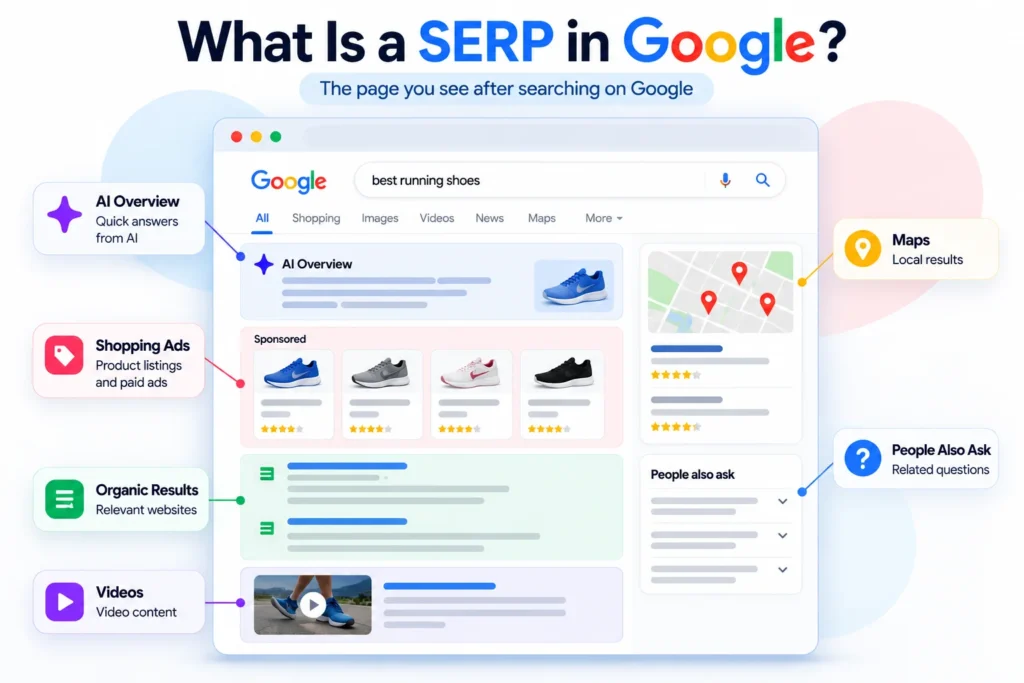
For example, when someone searches: “best running shoes”
Google creates a SERP containing:
- AI Overview
- Shopping advertisements
- Product reviews
- Organic website results
- Videos
- Related questions
- Brand information

The exact layout depends on the search query, user location, device, and search intent.
What Does SERP Stand For?
SERP stands for Search Engine Results Page.
Breaking down the term:
| Term | Meaning |
| Search Engine | A platform that helps users find information online |
| Results | Web pages, advertisements, images, videos, and answers shown after a search |
| Page | The interface where these results appear |
The SERP full form is commonly used in SEO discussions because marketers analyze search results to understand ranking opportunities.
SERP Meaning in SEO
In SEO, SERP refers to the position and appearance of a website on search engine results pages.
When SEO professionals talk about improving SERP ranking, they usually mean improving how a website appears in search results.
For example:
A website ranking at position #1 on Google has stronger SERP visibility than a website ranking at position #50.
However, modern SEO is not only about ranking number one. It is also about gaining visibility through different SERP features, including:
- Featured snippets
- Local results
- Image packs
- Video results
- Knowledge panels
A website appearing in multiple areas of a SERP can attract more attention and increase its click-through rate (CTR).
How Does a Search Engine Results Page Work?
A SERP is created through a complex process involving crawling, indexing, and ranking.
When a user enters a search query, the search engine follows several steps.
- Crawling: Discovering Web Pages
Search engines use automated programs called crawlers or bots to discover content across the internet.
For example, Google uses Googlebot to:
- Find new webpages
- Scan updated content
- Follow links between pages
If a page cannot be crawled, it may not appear in search results.
- Indexing: Storing Information
After discovering a webpage, the search engine analyzes and stores its information inside a database called an index.
During indexing, search engines evaluate:
- Page content
- Keywords
- Images
- Structured data
- Links
- Page quality signals
A webpage must usually be indexed before it can appear on a Google SERP.
- Ranking: Selecting the Best Results
When someone performs a search, the search engine analyzes thousands or millions of indexed pages.
The algorithm decides which pages provide the best answer based on factors such as:
- Search intent
- Content relevance
- Website authority
- User experience
- Page quality
- Technical SEO
The selected pages appear on the SERP in a specific order
SERP Anatomy: Understanding the Google Search Results Page
A modern Google SERP contains many different elements. These elements are called SERP features.
The exact SERP layout changes depending on the keyword.
For example:
A search for:
“weather in New York”
may show:
- Weather widget
- Local information
- Forecast data

A search for:
“best smartphones 2026”
may show:
- Shopping results
- Reviews
- Videos
- Comparison articles

Understanding SERP anatomy helps marketers create content that matches what Google displays.
SERP Features: Main Parts of a Google SERP
1. AI Overview

AI Overviews are AI-generated summaries displayed at the top of Google search results. They combine information from multiple sources and may include links to supporting webpages.
AI Overviews can provide direct answers without requiring users to visit multiple search results. Visibility in AI Overviews is influenced by factors such as:
- Search intent alignment
- Clear content structure
- Topical coverage
- Reliable sources
- Direct answers to queries
2. Paid Results (Google Ads)

Paid results are advertisements displayed above or below organic listings.
They usually appear with a “Sponsored” label.
Businesses use platforms such as Google Ads and Bing Ads to appear in paid search positions.
Paid results are influenced by factors such as:
- Bid amount
- Ad quality
- Keyword relevance
- Landing page experience
3. Organic Results

Organic results are unpaid website listings that appear because search engines consider them relevant and valuable.
SEO focuses mainly on improving organic visibility.
An organic result usually contains:
- Title tag
- URL
- Meta description
- Website link
Optimizing these elements can improve visibility and increase clicks.
4. Featured Snippets

A featured snippet is a highlighted answer box displayed at the top of some Google SERPs.
It provides a quick answer without requiring users to open a webpage.
Common featured snippet formats include:
- Paragraph snippets
- Lists
- Tables
- Steps
Example search:
“Best building materials?”
Google may display a short definition directly at the top. However, the visibility of featured snippets has reduced a lot due to the AI Overview takeover in recent times.
To optimize for featured snippets:
- Answer questions clearly
- Use concise paragraphs
- Add structured headings
- Provide accurate information
5. People Also Ask (PAA)
The People Also Ask section shows related questions users frequently search.

PAA boxes are valuable because they reveal user questions and search intent. SEO professionals often analyze PAA results during keyword research and content planning.
6. Knowledge Panels

A knowledge panel is an information box that appears on the right side of a Google SERP on desktop devices or near the top on mobile devices.
It provides summarized information about:
- People
- Companies
- Organizations
- Places
- Products
- Topics
The information is usually collected from trusted sources, including Google’s Knowledge Graph.
For example, searching for: “Google”
may show:
- Company description
- Headquarters
- Founders
- Related information
- Official website
Knowledge panels help users find reliable information quickly without visiting multiple websites.
For businesses, appearing in a knowledge panel can improve:
- Brand recognition
- Trust
- Search visibility
7. Local Pack Results

A local pack is a SERP feature that displays businesses related to a location-based search.
It usually appears when users search for services near them.
Examples:
- “dentist near me”
- “coffee shop in London”
- “SEO agency in New York”
A local pack usually includes:
- Business names
- Ratings
- Reviews
- Address
- Phone number
- Opening hours
- Google Maps location
Local SEO strategies help businesses improve their chances of appearing in local SERP results.
Important factors include:
- Google Business Profile optimization
- Customer reviews
- Local citations
- Location relevance
- Website information consistency
8. Image Results

Some searches trigger an image SERP where Google displays visual results.
Examples:
- Product searches
- Design inspiration
- Travel searches
- Recipes
Image visibility depends on:
- Image quality
- File names
- Alt text
- Page relevance
- Structured data
Optimizing images can help websites gain additional traffic from Google Images.
9. Video Results

Video content has become an important part of modern SERPs.
Google often displays videos from platforms such as:
- YouTube
- Websites
- Educational platforms
Video SERP results commonly appear for searches involving:
- Tutorials
- Reviews
- Demonstrations
- How-to questions
10. Shopping Results

Shopping results appear mainly for product-related searches. These results are important for ecommerce brands because they connect users directly with products.
Businesses can improve shopping visibility through:
- Product feeds
- Google Merchant Center
- Product schema markup
- Accurate product information
11. Related Searches
At the bottom of many Google SERPs, users see related searches.
These suggestions help users discover similar topics.
For SEO professionals, related searches provide valuable keyword research insights.
They can reveal:
- User interests
- Content ideas
- Long-tail keywords
- Search intent patterns
Why SERP Features Matter for SEO
Ranking in organic results is valuable, but SERP features create additional opportunities.
A website appearing in a featured snippet or local pack may receive more visibility than a standard ranking result.
SERP features can influence:
- Click-through rate (CTR)
- Brand awareness
- Website traffic
- User trust
For example:
A page ranking at position #5 but appearing in a featured snippet may receive more attention than a page ranking #2.
SERP vs SEO vs Ranking: What Is the Difference?
Many beginners confuse SERP, SEO, and ranking.
Although these concepts are connected, they mean different things.
| Term | Meaning |
| SEO | The process of improving website visibility in search engines |
| SERP | The page where search results appear |
| Ranking | The position a webpage holds on a SERP |
Example:
A company publishes an article about SEO.
The company uses:
SEO strategies
→ to improve visibility.
Google evaluates the page.
The page appears on the:
SERP
At:
Ranking position #3
So:
SEO is the activity.
SERP is the results page.
Ranking is the position within that page.
Why Are SERPs Important for Businesses?
A strong SERP presence helps businesses reach people actively searching for their products, services, or information.
1. SERPs Increase Organic Traffic
Most online journeys begin with a search query.
When your website appears higher in search results, more users can discover it.
Higher visibility can lead to:
- More visitors
- More leads
- More sales opportunities
2. SERPs Build Brand Visibility
Users often trust websites that appear prominently in search results.
Repeated visibility helps create:
- Brand familiarity
- Authority
- Recognition
Even when users do not click immediately, seeing a brand multiple times can influence future decisions.
3. SERPs Connect Content With Search Intent
A successful SEO strategy is not only about keywords.
It is about understanding why someone searches.
For example:
Keyword:
“best laptops for students”
Search intent:
Commercial investigation
Users likely want:
- Comparisons
- Reviews
- Recommendations
Google adjusts the SERP to match that intent.
How Does Google Decide What Appears on a SERP?
Google does not randomly choose results.
Its algorithms analyze many signals to determine the most useful pages.
Important SERP ranking factors include:
- Search Intent
Search intent refers to the reason behind a user’s query.
Common types include:
- Informational Intent: User wants information. For example, “What is a SERP?”
- Navigational Intent: User wants a specific website. For example, “Facebook login.”
- Commercial Intent: User researches before buying. For example, “best SEO tools.”
- Transactional Intent: User wants to take action. For example, “buy running shoes online.”
Content that matches search intent has a stronger chance of ranking.
- Content Relevance
Google analyzes whether a webpage answers the user’s question.
Relevant content usually:
- Covers the topic completely
- Uses clear structure
- Provides accurate information
- Answers related questions
A page about SERPs should explain more than just a definition.
It should cover:
- SERP features
- Examples
- SEO relationship
- Optimization methods
- Website Authority
Search engines consider whether a website demonstrates expertise and trust.
Authority can be influenced by:
- Quality backlinks
- Expert content
- Brand mentions
- Consistent publishing
SEO platforms such as Ahrefs, Moz, and Semrush provide tools to analyze authority signals.
- User Experience
Google also considers how users interact with webpages.
Important factors include:
- Page speed
- Mobile usability
- Clear navigation
- Helpful content
- Secure browsing experience
A technically poor website may struggle even with good content.
How to Improve SERP Visibility
Improving SERP visibility requires a combination of content, technical SEO, and user-focused strategies.
- Create Content That Matches Search Intent
Before writing content:
- Analyze current SERP results
- Understand user expectations
- Identify missing information
Do not create content based only on keywords.
Create content that solves the user’s problem.
- Optimize Title Tags and Meta Descriptions
The title and description influence whether users click your result.
A good title should:
- Include the main topic
- Be clear
- Encourage clicks
Example:
Weak:
“SERP Guide”
Better:
“What Is a SERP? Complete Guide to Google Search Results Pages”
- Target SERP Features
To appear in SERP features:
Use:
- Question-based headings
- Short answers
- Structured content
- Lists and tables
- Schema markup
- Improve Technical SEO
Technical improvements include:
- Faster loading speed
- Mobile optimization
- Proper indexing
- Clean website structure
- Internal linking
How to Analyze a SERP Before Creating Content
A successful SEO strategy starts before writing an article.
Many websites fail because they create content without studying what Google already shows for a keyword.
A SERP analysis helps you understand:
- What type of content Google prefers
- What users expect to find
- Which SERP features appear
- What competitors are missing
By analyzing the SERP first, you can create content that provides more value.
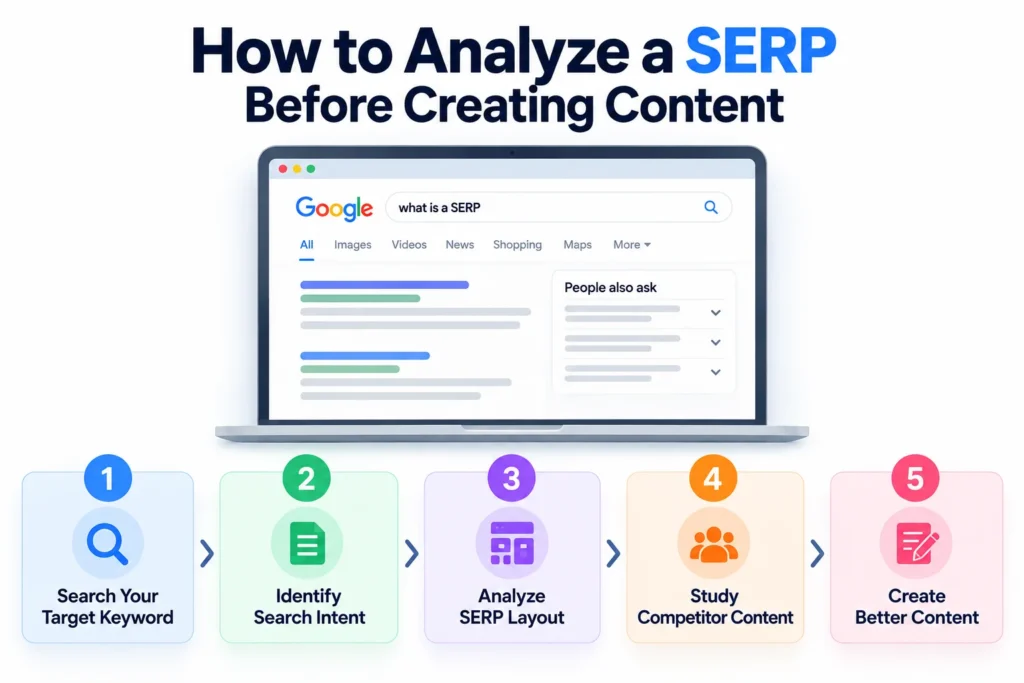
Step 1: Search Your Target Keyword
Start by entering your target keyword into Google.
For example:
“what is a SERP”
Observe:
- Ranking pages
- Content formats
- SERP features
- Search suggestions
- Related questions
This gives you a clear picture of Google’s expectations.
Step 2: Identify Search Intent
Look at the pages ranking on the first page.
Ask:
- Are they beginner guides?
- Are they tutorials?
- Are they comparison articles?
- Are they product pages?
For the keyword:
“what is a SERP”
Google mainly shows:
- Educational articles
- SEO guides
- Glossary pages
This indicates informational search intent.
Step 3: Analyze SERP Layout
Every keyword creates a different SERP layout.
Check whether Google displays:
- Featured snippets
- People Also Ask boxes
- Videos
- Images
- Local results
- Shopping results
These features tell you what content opportunities exist.
Step 4: Study Competitor Content
Analyze ranking pages and identify:
- Topics they cover
- Questions they answer
- Information they miss
A strong SEO strategy is not copying competitors.
It is finding opportunities to create a more complete resource.
Step 5: Create Better Content
After analysis, create content that:
- Answers the main question quickly
- Covers related questions
- Provides examples
- Explains concepts clearly
- Adds unique insights
This improves your chances of gaining stronger SERP visibility.
Best SERP Analysis Tools for SEO
SEO professionals use different tools to monitor rankings, study competitors, and understand search results.
Here are some popular SERP analysis tools:
- Google Search Console
Google Search Console is a free tool provided by Google.
It helps website owners understand:
- Search performance
- Keywords bringing traffic
- Ranking positions
- Click-through rates
- Indexing issues
It is one of the most important tools for monitoring real Google SERP performance.
- Semrush
Semrush provides advanced SEO features, including:
- Position tracking
- Competitor research
- Keyword analysis
- SERP feature monitoring
It helps marketers understand how websites perform across different search queries.
- Ahrefs
Ahrefs is widely used for:
- Keyword research
- Backlink analysis
- Competitor analysis
- Ranking tracking
Its SERP analysis features help identify why certain pages rank higher.
- Moz Pro
Moz Pro provides SEO tools for:
- Rank tracking
- Keyword research
- Site audits
- SERP analysis
It is commonly used by SEO professionals and marketing teams.
- SERP Tracking Software
Dedicated SERP tracking tools help monitor ranking changes over time.
They can show:
- Ranking movements
- Competitor changes
- Keyword performance
- SERP volatility
These tools are useful for businesses managing many keywords.
What Is SERP Volatility?
SERP volatility refers to frequent changes in search engine rankings.
A website ranking at position #2 today may move to position #8 tomorrow.
SERP changes happen because of:
- Google algorithm updates
- Competitor improvements
- Search behavior changes
- Content freshness
- Technical issues
SEO professionals monitor volatility to understand ranking fluctuations.
Why Do Google SERPs Keep Changing?
Search engines continuously improve their results to provide better answers.
Several factors influence SERP changes.
- Algorithm Updates
Google regularly updates its ranking systems.
These updates may affect:
- Content quality evaluation
- Spam detection
- User experience signals
A website may gain or lose visibility after major updates.
- Changing Search Intent
User expectations change over time.
For example:
Years ago, a search for:
“best phones”
might show mostly blog articles.
Today, Google may display:
- Product comparisons
- Shopping results
- Videos
- Reviews
The SERP changes because users want different information.
- New Search Features
Google continues adding new features.
Modern SERPs now include:
- AI-generated summaries
- Interactive results
- Rich results
- Visual search elements
The search experience is becoming more dynamic.
How AI Is Changing SERPs in 2026
AI is transforming SERPs from simple lists of links into more interactive search experiences. Search engines like Google now use AI to better understand user intent and provide direct answers through features such as AI Overviews.
Instead of only matching keywords, AI-powered search analyzes:
- User intent
- Context behind queries
- Relationships between topics and entities
- Information from multiple sources
This change means SEO is no longer only about ranking for keywords. Websites now need to create clear, trustworthy, and comprehensive content that answers user questions and provides real value.
To succeed in AI-driven SERPs, businesses should focus on:
- Building topical authority
- Matching search intent
- Creating helpful content
- Optimizing for SERP features such as featured snippets and People Also Ask
The future of search belongs to content that is easy for both users and AI systems to understand.
How AI Search Affects SEO and SERP Optimization
AI-powered search is changing how websites compete for visibility. SEO strategies now need to focus on creating content that is easy for both users and search engines to understand.
To perform well in modern SERPs, businesses should:
Create Comprehensive Topic Coverage
Instead of optimizing for a single keyword, create content that covers the complete topic.
For example, a detailed guide about SERPs should explain:
- SERP definition
- SERP features
- SERP analysis
- ranking factors
- optimization strategies
This helps search engines understand the depth and relevance of the content.
Strengthen Topic and Entity Connections
Modern search systems analyze relationships between concepts, entities, and topics.
Use relevant terms naturally, such as:
- Google Search
- search engine optimization
- keyword research
- ranking factors
- featured snippets
This creates stronger topical relevance.
Add Original and Useful Information
AI systems prioritize content that provides clear value.
Improve content quality by including:
- Real examples
- Practical steps
- Expert insights
- Unique explanations
- Helpful resources
Content that offers deeper understanding is more likely to stand out in competitive search results.
Common SERP Mistakes Businesses Make
Many businesses struggle with search visibility because they focus on the wrong things.
- Creating Content Before Understanding the SERP
Some businesses publish articles without analyzing the current search results. This often leads to content that does not match Google’s preferred format, depth, or user expectations.
Before creating content, review:
- Ranking pages
- SERP features
- Content formats
- Missing information
- Optimizing Only for Traditional Rankings
A webpage can gain visibility in multiple areas of a SERP, not just organic listings.
Ignoring opportunities such as:
- Featured snippets
- Local results
- Images
- Videos
can limit potential traffic sources.
- Publishing Generic Content
Many websites create basic articles that repeat information already available online.
To stand out, content should include:
- Original examples
- Practical explanations
- Expert insights
- Unique perspectives
- Tracking Rankings Without Measuring Performance
Ranking position alone does not show the complete picture.
A successful SERP strategy also evaluates:
- Organic clicks
- Click-through rate
- Search visibility
- User engagement
Frequently Asked Questions
What does SERP stand for?
SERP stands for Search Engine Results Page. It is the page displayed after entering a search query into a search engine like Google, Bing, or DuckDuckGo.
What is SERP vs SEO?
SERP and SEO are two closely related concepts in digital marketing, where SEO is the process used to improve your placement on the SERP. SEO professionals analyze SERPs to improve rankings, increase visibility, and attract more organic traffic.
What are SERP features?
SERP features are special elements shown on search results pages beyond traditional website listings. Examples include featured snippets, People Also Ask boxes, knowledge panels, local packs, images, and videos.
What is the difference between SERP and search engine?
A search engine is the platform that finds information online, such as Google or Bing. A SERP is the results page generated by that search engine after a user enters a query.
How can I improve my SERP ranking?
You can improve SERP ranking by creating helpful content, matching search intent, improving technical SEO, earning quality backlinks, optimizing pages, and improving user experience.
What is SERP analysis?
SERP analysis is the process of studying search results to understand ranking pages, search intent, SERP features, and competitor strategies before creating content.
How do SERP features affect SEO?
SERP features can increase visibility and clicks by placing content in areas beyond standard organic listings, such as featured snippets, local packs, and knowledge panels.
What tools can track SERP rankings?
Popular SERP tracking tools include Google Search Console, Ahrefs, Semrush, and Moz Pro. These tools help monitor keyword positions and search performance.