


Table of Contents
Search is no longer limited to a list of blue links. Google now combines traditional results with AI Overviews and AI Mode. Platforms such as ChatGPT, Perplexity AI, and Microsoft Copilot can search the web and provide synthesized answers with cited sources. That shift has created a new optimization discipline called Generative Engine Optimization, or GEO.
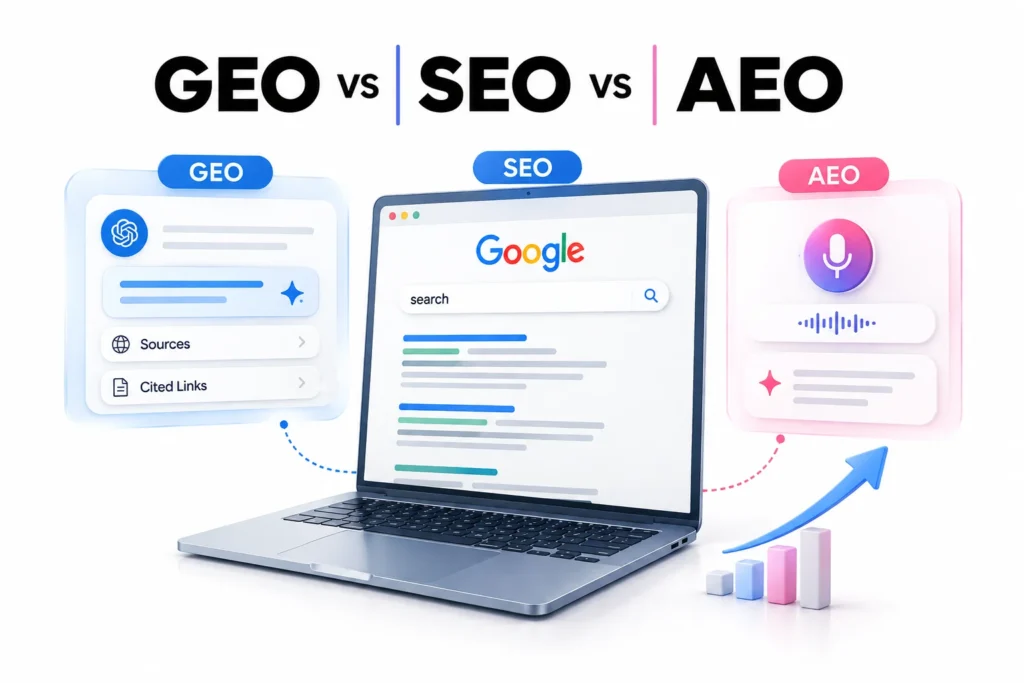
So, GEO vs SEO is not simply a comparison between two competing marketing strategies. SEO remains focused on improving a website’s visibility in traditional search results, while GEO focuses on increasing the likelihood that a brand, page, product, or fact is discovered, understood, mentioned, or cited in AI-generated answers.
The practical answer to this is straightforward: SEO optimizes for search visibility and rankings; GEO optimizes for visibility within AI-generated answers and citations. The two overlap heavily, so most businesses need GEO and SEO rather than choosing one exclusively.
GEO vs SEO at a Glance
| Factor | SEO | GEO |
| Full name | Search Engine Optimization | Generative Engine Optimization |
| Primary goal | Improve organic search visibility | Improve visibility in AI-generated answers |
| Main environment | Search engines and SERPs | AI search and generative search experiences |
| Optimization target | Web pages and websites | Content, entities, sources, and brand information |
| Typical visibility | Organic rankings, Featured Snippets, rich results | AI mentions, citations, recommendations, and references |
| Core measurement | Rankings, impressions, clicks, conversions | Mentions, citations, AI visibility, referrals, and assisted conversions |
| Main content focus | Relevance, intent, quality, technical accessibility | Relevance, clarity, authority, context, extractability, and corroboration |
| Important technologies | Crawling, indexing, ranking, semantic search | Retrieval, Large Language Models, synthesis, citations |
| Relationship | Foundation | Extends search optimization into AI experiences |
Google describes AI Overviews and AI Mode as part of its evolving AI Search experience, while OpenAI’s ChatGPT Search can retrieve current web information and provide source links. Microsoft also provides Copilot Search in Bing with summarized answers and cited sources.
What Is SEO?
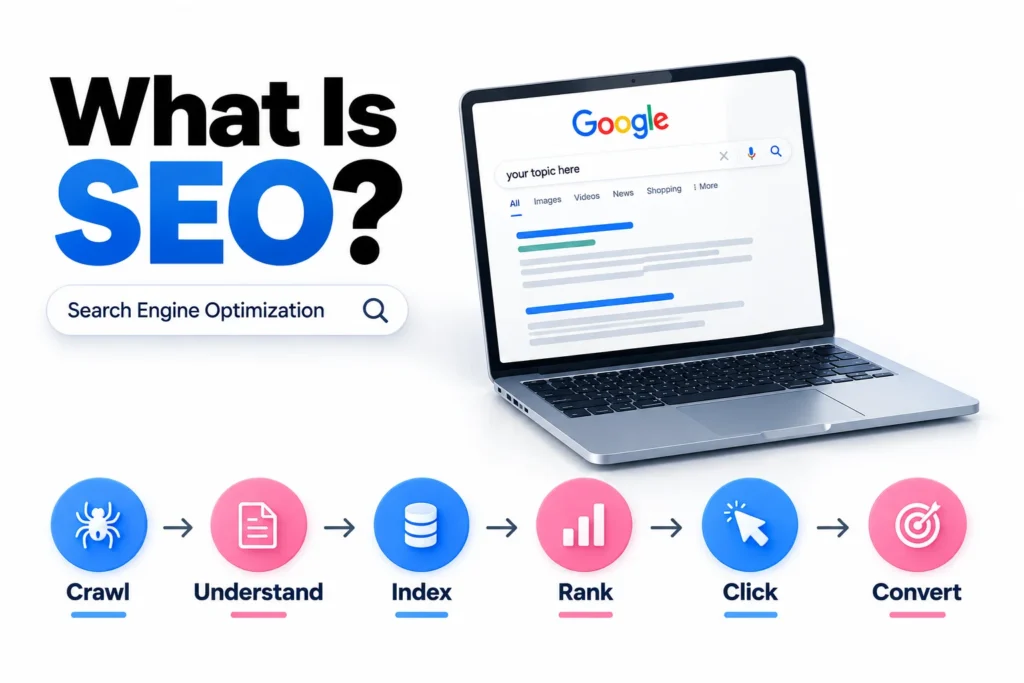
Search Engine Optimization is the process of improving a website so search engines can discover, understand, index, and rank its content for relevant queries.
SEO includes technical SEO, on-page optimization, keyword research, content creation, internal linking, backlinks, structured data, user intent analysis, and other activities that improve organic search visibility.
A simplified SEO process looks like this:
Crawl → Understand → Index → Rank → Click → Convert
SEO therefore focuses heavily on making a page relevant and useful for a search query while ensuring search engines can access and interpret it correctly.
What SEO Optimizes For
A modern SEO strategy can involve:
- Search intent
- Keyword and topic coverage
- Technical accessibility
- Internal links
- Backlinks and authority
- Content quality
- Structured data
- Entity relationships
- Page experience
- Mobile accessibility
- Local SEO
- E-commerce SEO
- Image and video SEO
Google’s Search documentation continues to emphasize helpful, reliable, people-first content rather than techniques designed solely to manipulate rankings.
SEO also remains relevant to AI search because many generative search experiences depend on information available across the web. GEO therefore does not eliminate traditional search optimization.
What Is GEO?
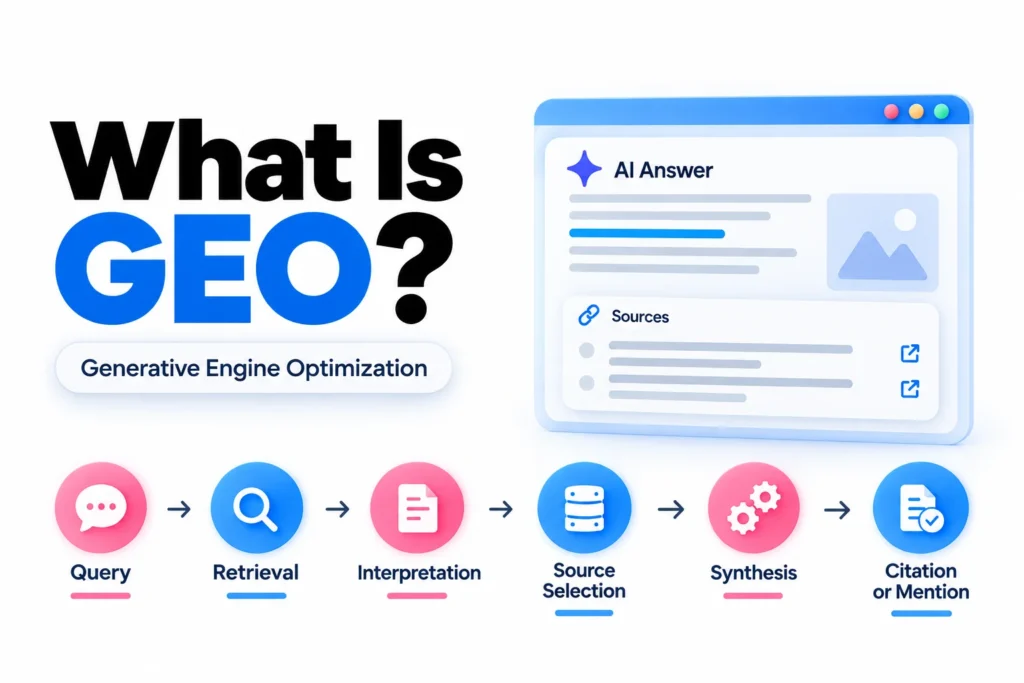
Generative Engine Optimization is the practice of improving a website, brand, or content’s visibility and representation in AI-generated responses.
In simple terms, GEO asks a different question from traditional SEO.
SEO asks:
Can this page appear prominently when someone searches for this topic?
GEO asks:
Can an AI system find, understand, trust, and potentially cite or mention this information when generating an answer?
Semrush defines GEO as optimizing a presence and content to appear in responses from AI-powered search systems such as ChatGPT, Google, Perplexity, and Claude. Ahrefs similarly describes AI visibility in terms of how frequently and prominently brands appear in AI responses.
How GEO Works
Generative search systems can retrieve information, interpret a user’s question, synthesize information from multiple sources, and provide an answer.
A simplified GEO process is:
Query → Retrieval → Interpretation → Source Selection → Synthesis → Citation or Mention
This is one of the most important points in the difference between GEO and SEO.
Traditional SEO is strongly associated with ranking pages. GEO is concerned with whether information from those pages becomes part of an AI-generated response.
What GEO Optimizes For
Effective GEO optimization can include:
- Clear answers to specific questions
- Strong topical coverage
- Well-defined entities
- Factual accuracy
- Reliable sources
- Consistent brand information
- Descriptive headings
- Self-contained passages
- Structured content
- Relevant statistics and evidence
- Internal contextual relationships
- External authority
- Content that can be efficiently retrieved and understood
GEO is therefore broader than simply inserting AI-related keywords into existing content.
GEO vs SEO: Key Differences
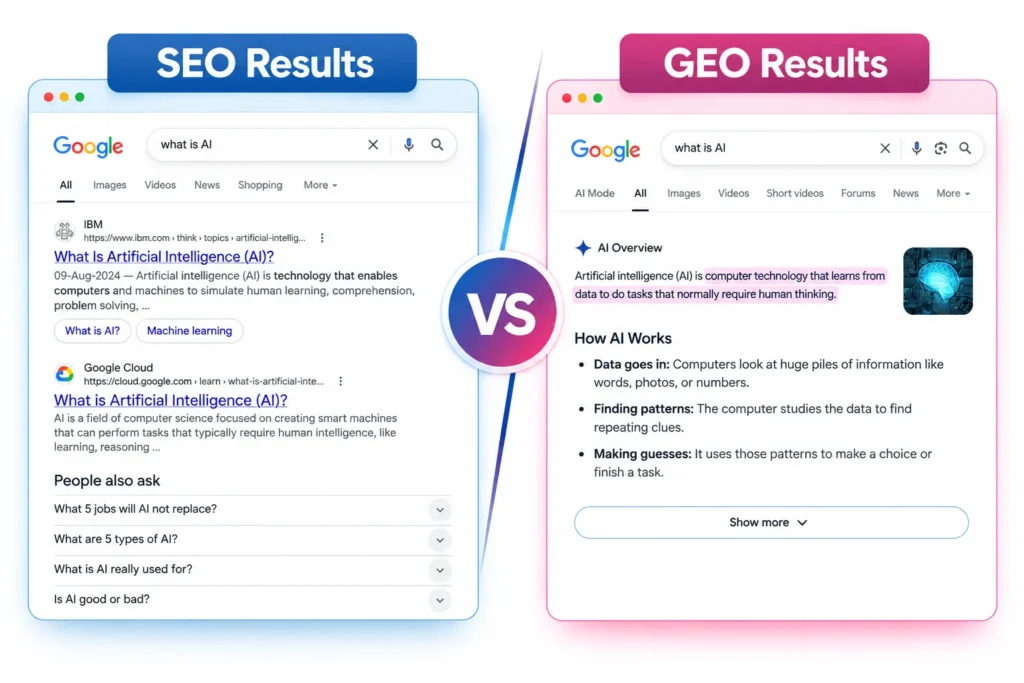
The clearest GEO vs SEO comparison is based on how each discipline creates visibility.
Search Rankings vs AI Citations
SEO primarily seeks rankings in traditional search results. GEO seeks visibility within AI-generated answers, which can include a brand mention, citation, recommendation, or link.
An AI answer may use information from several sources instead of returning one page as the answer.
Crawling and Indexing vs Retrieval and Synthesis
Search engines crawl and index web pages before ranking them for queries.
AI search can retrieve relevant information and synthesize it into a conversational response.
That means a page can be technically indexable and rank well while still not being selected as a source for a particular AI response.
Keywords and Queries vs Entities and Context
Keywords remain important for SEO, but modern search increasingly relies on semantic relationships and entities.
GEO adds another layer: AI systems need enough context to understand what a person, company, product, concept, statistic, or organization represents.
This is where Entity SEO, semantic search, and clear entity relationships become particularly valuable.
Page-Level Optimization vs Passage-Level Optimization
Traditional SEO often evaluates a page as a whole.
AI systems can use specific passages, facts, lists, definitions, or sections as evidence for an answer.
Therefore, GEO vs SEO optimization is not necessarily about rewriting an entire website. It can mean making important information independently understandable and easy to retrieve.
Clicks vs Mentions
SEO commonly measures:
- Impressions
- Rankings
- Click-through rate
- Organic traffic
- Conversions
GEO can additionally measure:
- AI mentions
- Citations
- Citation share
- Prompt coverage
- Brand prominence
- AI referral traffic
- Assisted conversions
This is why GEO vs SEO traffic should not be treated as an identical measurement problem.
What Do SEO and GEO Have in Common?
The SEO vs GEO distinction can be overstated. The two disciplines share many fundamentals.
| Shared Foundation | Why It Matters |
| Search intent | Both need content that answers the user’s underlying question |
| Content quality | Weak or inaccurate content is unlikely to perform consistently |
| Topical relevance | Both benefit from comprehensive coverage |
| Technical accessibility | Search systems need to access content |
| Clear structure | Headings and logical sections improve understanding |
| Authority | Reliable sources and reputable entities strengthen trust |
| Freshness | Time-sensitive information needs updating |
| Entity consistency | Clear relationships help systems understand brands and topics |
Ahrefs notes that GEO builds on traditional SEO fundamentals such as quality content, clear structure, and topical authority.
That makes the idea of GEO and SEO together more practical than treating them as completely separate disciplines.
How GEO Changes the Content Optimization Process
The biggest change is not that writers suddenly need an entirely different type of content.
Instead, content needs to become clearer, more authoritative, more structured, and easier to interpret at the passage level.
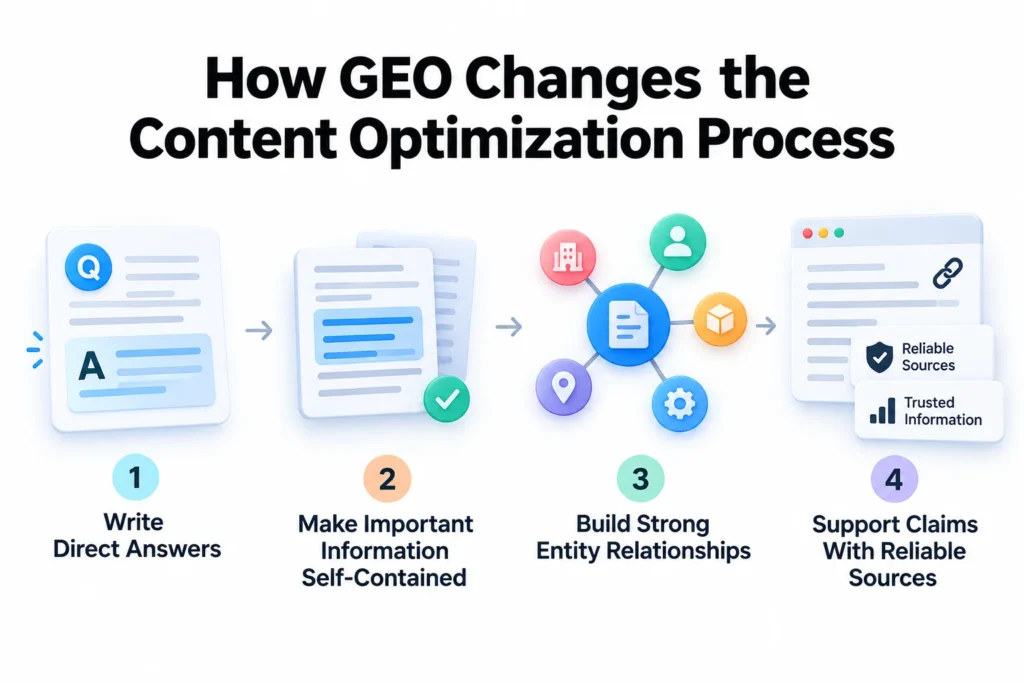
- Write Direct Answers
Place the answer close to the question.
For example, instead of spending three paragraphs introducing GEO before defining it, provide a concise definition first and then expand on it.
This structure works well for both users and AI systems.
- Make Important Information Self-Contained
A passage should make sense without requiring another paragraph to understand its subject.
Instead of:
It can also improve visibility.
Write:
GEO can improve a brand’s visibility in AI-generated search answers by making its information easier for AI systems to retrieve, interpret, and cite.
The second sentence contains the entity, action, and context.
- Build Strong Entity Relationships
Entity optimization should clearly establish relationships among:
- Organizations
- People
- Products
- Concepts
- Locations
- Services
- Industry terms
For example, an article about GEO should naturally connect Generative Engine Optimization, Google, AI Overviews, ChatGPT, Perplexity AI, Microsoft Copilot, and Large Language Models where those entities are genuinely relevant.
- Support Claims With Reliable Sources
Authority builders should be integrated where they strengthen a claim, not added as a list of brand names.
Useful sources include:
- Google Search Central for search guidance
- Google Search documentation for AI Search features
- OpenAI for ChatGPT Search information
- Microsoft for Copilot Search
- Semrush and Ahrefs for industry research and measurement
- Moz for established SEO concepts
Google has also published specific guidance around optimizing websites for generative AI features in Search, making first-party Google documentation particularly valuable when discussing AI Overviews and AI Mode.
SEO vs GEO Across Major AI Search Platforms
GEO is not one single platform. AI search experiences differ in how they retrieve, synthesize, display, and cite information.
| Platform | Relevant Optimization Focus |
| Google AI Overviews | Strong SEO foundation, helpful content, clear answers, authoritative sources |
| Google AI Mode | Comprehensive topical coverage and information that supports deeper conversational searches |
| ChatGPT | Discoverable web content, relevance, authority, and clear source information |
| Perplexity AI | Factual, source-supported content and strong topical relevance |
| Microsoft Copilot | Search visibility, authoritative information, and source accessibility |
| Google Gemini | Strong contextual relevance, entities, and authoritative information |
| Claude | Clear, authoritative information and discoverable source material |
Google’s 2026 updates show that AI Overviews and AI Mode are becoming increasingly integrated into Search, with Google describing AI Mode as a conversational AI Search experience.
OpenAI’s documentation confirms that ChatGPT can search the web and cite sources when current information is needed. Microsoft similarly describes Copilot Search as providing summarized answers with cited sources.
What About Google SGE?
Google SGE, or Search Generative Experience, was an earlier experimental name associated with Google’s generative search work. In current 2026 discussions, Google’s consumer-facing terminology centers on AI Overviews and AI Mode.
Therefore, marketers researching SGE vs SEO should generally understand SGE as part of the evolution toward Google’s current AI Search experiences rather than treat it as a separate current product.
How to Optimize for SEO and GEO Together
A practical GEO vs SEO strategy does not require two completely separate content programs.
- Start With Search Intent
Identify what the user actually wants to know, compare, solve, buy, or accomplish.
- Research Search Results and AI Answers
Analyze traditional SERPs as well as AI-generated answers for the same topic.
Look for:
- Recurring entities
- Frequently cited sources
- Common questions
- Missing information
- Contradictions
- Supporting evidence
- Content formats
- Build Comprehensive Topic Coverage
Cover the main subject, related concepts, entities, questions, and practical implications without adding unrelated material.
This is where semantic SEO optimization supports GEO.
- Structure Content for Retrieval
Use:
- Descriptive headings
- Short paragraphs
- Tables where comparison helps
- Lists
- Definitions
- Direct answers
- Clear examples
- Source-backed claims
- Strengthen Authority
Build authority through genuinely useful content, reputable references, original research, expert contributions, relevant backlinks, and consistent information across the web.
- Monitor Both Search and AI Visibility
Do not measure the campaign only through rankings.
Track traditional search performance alongside AI visibility and business outcomes.
SEO and GEO Content Optimization Workflow
| Step | SEO Focus | GEO Focus |
| 1 | Keyword and intent research | Prompt and question research |
| 2 | SERP analysis | AI-answer analysis |
| 3 | Topic mapping | Entity and concept mapping |
| 4 | Content creation | Answer and passage optimization |
| 5 | On-page optimization | Extractability and clarity |
| 6 | Internal linking | Context and entity relationships |
| 7 | Link building | External authority and corroboration |
| 8 | Ranking measurement | AI mention and citation monitoring |
| 9 | Traffic analysis | AI referral and assisted impact |
| 10 | Content refresh | Update missing or inaccurate AI-visible information |
This combined workflow explains how GEO differs from SEO without requiring marketers to abandon established SEO practices.
SEO vs GEO Metrics and KPIs
SEO and GEO should be measured separately before being connected to business outcomes.
SEO Metrics
Track:
- Organic impressions
- Organic clicks
- Rankings
- CTR
- Organic sessions
- Conversions
- Revenue
- Backlinks
GEO Metrics
Track:
- AI visibility
- Brand mention rate
- Citation rate
- Citation share
- Prompt coverage
- Mention prominence
- Citation accuracy
- Source inclusion
- AI referral traffic
- Assisted conversions
The measurement landscape is becoming more concrete. In June 2026, Google announced Search Generative AI performance reports in Search Console for visibility within generative AI features such as AI Overviews and AI Mode, with the reports rolled out globally by August 31, 2026.
Third-party platforms are also developing dedicated AI visibility measurements. Ahrefs, for example, now tracks brand visibility across AI platforms including ChatGPT, Gemini, Perplexity, Copilot, and Google AI Overviews.
How to Measure GEO Visibility
A useful GEO vs SEO audit should establish a repeatable prompt set rather than checking random AI answers.
For example:
- Build a list of commercial, informational, comparison, and problem-based prompts.
- Test those prompts across relevant AI platforms.
- Record whether the brand appears.
- Record whether the brand is cited.
- Record which competitors appear.
- Record the cited sources.
- Evaluate whether the brand information is accurate.
- Repeat the test periodically.
A simple GEO dashboard could therefore contain:
| KPI | Question |
| Prompt coverage | How often does the brand appear for tracked prompts? |
| Citation rate | How often is the brand’s website cited? |
| Mention prominence | How prominently is the brand mentioned? |
| Citation accuracy | Is the cited information correct? |
| Competitor visibility | Which competitors appear more frequently in the tracked set? |
| AI referral traffic | Are AI platforms generating visits? |
| Assisted impact | Does AI visibility contribute to conversions? |
AEO vs SEO vs GEO
AEO vs SEO vs GEO is another common comparison, but these terms describe overlapping optimization approaches rather than three completely isolated systems.
Answer Engine Optimization (AEO) generally focuses on providing concise answers that can be surfaced in answer-focused search experiences, including Featured Snippets and conversational systems.
GEO focuses more specifically on visibility within generative AI responses.
SEO remains the broader discipline of improving organic search visibility.
| Approach | Primary Objective |
| SEO | Improve visibility in search results |
| AEO | Provide answers that search and answer systems can surface |
| GEO | Increase visibility in generative AI responses |
Therefore, the practical SEO vs GEO vs AEO strategy is often an integrated one.
A page can use SEO fundamentals, answer important questions directly, and structure information so AI systems can understand and potentially cite it.
Common GEO and SEO Mistakes
Treating GEO as a Replacement for SEO
GEO does not make technical SEO, useful content, search intent, or discoverability irrelevant.
Assuming Rankings Guarantee AI Citations
Strong organic rankings and AI citations are related but should not be treated as identical outcomes.
Research from Ahrefs has found meaningful changes in click behavior when AI Overviews appear, while its analysis also emphasizes that AI Overview citations should not be treated as equivalent to conventional ranking positions.
Creating Content Only for AI
Content still needs to satisfy human readers. Clear writing, accurate information, useful examples, and strong evidence remain central.
Ignoring External Authority
AI systems can use information from multiple sources. A brand’s representation across reputable websites can therefore matter alongside its own content.
Measuring Only Traffic
AI visibility can influence awareness and consideration even when the user does not immediately click a website.
Does GEO Replace SEO?
No. The relationship is better understood as SEO plus GEO.
SEO remains important for traditional search visibility, while GEO addresses visibility in increasingly important AI-generated search experiences.
Google’s current Search development shows the two experiences increasingly operating together: users can move from an AI Overview into AI Mode and continue exploring with links to web content.
For most organizations, the practical objective is therefore not GEO or SEO, but GEO with SEO.
SEO vs GEO: Which Strategy Should You Use?
The answer depends on your existing search presence, audience, business model, and where your customers discover information.
| Situation | Primary Focus |
| New website | Build SEO foundations first |
| Established organic traffic | Expand into GEO while maintaining SEO |
| Brand frequently discussed by AI | Monitor and improve GEO accuracy |
| High informational search demand | Combine SEO, AEO, and GEO |
| E-commerce website | Combine technical/product SEO with AI visibility |
| Local business | Maintain local SEO while monitoring AI recommendations |
| Enterprise brand | Build consistent entity and authority signals across the web |
For GEO vs SEO for local business, traditional local SEO remains important because local search visibility, business information, reviews, and location relevance continue to matter. GEO can complement that foundation when customers increasingly ask AI systems for recommendations.
The same principle applies to e-commerce, SaaS, publishers, service businesses, and multi-location organizations.
GEO vs SEO Best Practices for 2026
The strongest GEO vs SEO optimization approach combines established SEO practices with content designed for clear AI retrieval.
| Practice | SEO value | GEO value |
| Clear headings | High | High |
| Search intent coverage | High | High |
| Original research | High | High |
| Internal linking | High | High |
| Technical accessibility | High | High |
| Entity clarity | High | High |
| Accurate facts | High | High |
| Relevant backlinks | High | Medium to high |
| Direct answers | High | High |
| Consistent terminology | Medium | High |
| Natural-language questions | High | High |
| Structured data | High | Supportive |
| Brand mentions | Medium | High |
| AI prompt monitoring | Low | High |
One point needs careful handling: schema markup is not a special GEO ranking hack. Google says there is no special schema required for AI Overviews or AI Mode. Structured data remains useful where Google supports it and when it accurately represents visible page content.
Google also clarified in 2026 that llms.txt is not needed for Google Search and provides no ranking or visibility benefit there.
The Future of SEO and GEO
The future is less about choosing between traditional search and generative search and more about managing visibility across multiple search interfaces.
Google is expanding AI Mode and AI Overviews, while ChatGPT, Perplexity, and Copilot provide increasingly conversational ways to discover web information.
That makes several capabilities increasingly important:
- Strong technical SEO
- Helpful content
- Semantic search optimization
- Entity SEO
- Clear information architecture
- Reliable sources
- Original research
- Consistent brand information
- AI visibility monitoring
- Search and AI performance measurement
The important shift is from optimizing only for where a page ranks to understanding how information is discovered, interpreted, presented, and attributed across search systems.
FAQs
What is the difference between GEO and SEO?
SEO focuses primarily on improving visibility in traditional search results, while GEO focuses on increasing visibility and accurate representation in AI-generated responses.
Can GEO replace SEO?
No. GEO builds on many SEO fundamentals. Businesses can use both to improve visibility across traditional and AI-powered search experiences.
Is GEO part of SEO?
GEO overlaps substantially with SEO but is generally treated as a distinct optimization discipline focused on generative AI search.
Does SEO help with GEO?
Yes. Crawlability, useful content, topical authority, strong information architecture, and technical accessibility can support visibility in AI search. However, traditional rankings should not be assumed to guarantee AI citations.
What is AEO vs SEO vs GEO?
SEO focuses on search visibility, AEO focuses on providing answer-ready information, and GEO focuses on visibility in generative AI responses. The three can be integrated into one content strategy.
Can a website rank well in Google but have low GEO visibility?
Yes. Traditional search rankings and AI citations are different visibility outcomes. AI systems may retrieve and synthesize information from sources that do not correspond directly to the top traditional ranking positions.
How do I measure GEO?
Track a consistent set of prompts across relevant AI platforms and measure brand mentions, citations, prominence, accuracy, competitor visibility, AI referrals, and business impact. Google also provides generative AI performance reporting within Search Console for eligible Search experiences.
Does GEO require different content from SEO?
Not necessarily. Strong GEO content usually builds on good SEO content but adds greater emphasis on direct answers, passage clarity, entity relationships, evidence, context, and AI retrieval.
What are the most important GEO best practices?
Create accurate, useful, well-structured content; answer questions directly; strengthen topical and entity coverage; cite reliable sources; maintain consistent brand information; and monitor AI visibility instead of relying only on traditional rankings.