


Table of Contents
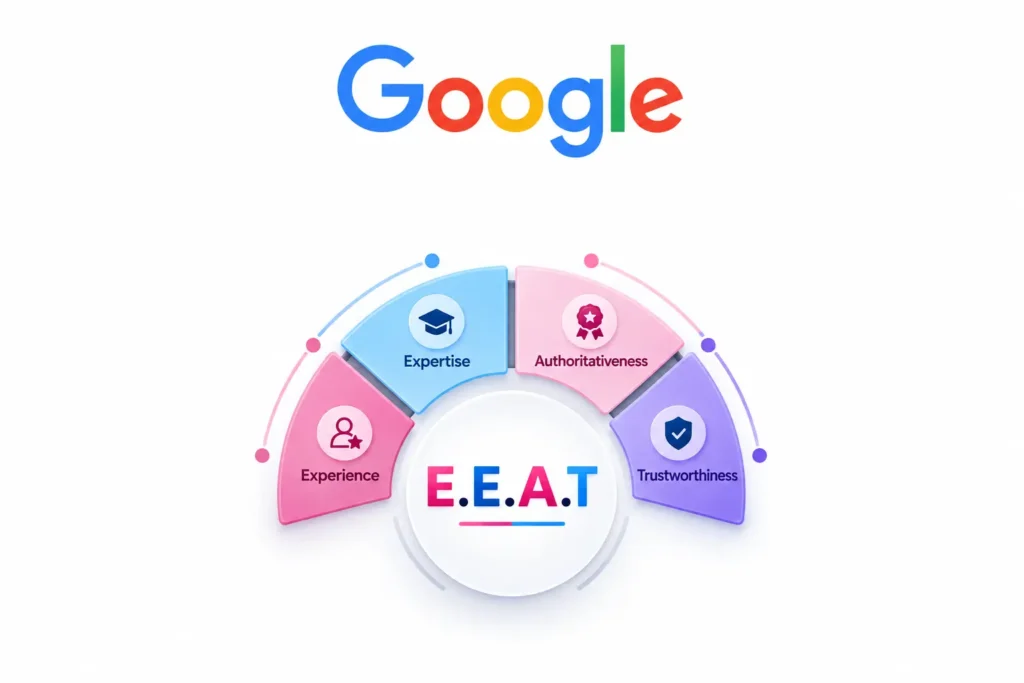
No, E-E-A-T is not a direct Google ranking factor, and Google has stated there is no E-E-A-T score inside the algorithm that publishers can directly optimize. E-E-A-T, which stands for Experience, Expertise, Authoritativeness, and Trustworthiness, is a framework from Google’s Search Quality Rater Guidelines. Google says its automated systems use a mix of factors that can help identify content demonstrating E-E-A-T, which may include evidence such as reputation, accuracy, and links from respected sources. Those systems give even more weight to strong E-E-A-T on YMYL topics such as health, finance, and safety.
The same question resurfaces in SEO communities every few months, and the answer tends to get muddier each time because many marketers treat E-E-A-T like a dial they can turn. Google has addressed the topic in its own documentation, in public statements from its Search team, and through the quality raters who help it evaluate search results. This guide lays out that evidence, explains how the framework works in practice, and shows which signals you can strengthen on your own site.
Key takeaways
- E-E-A-T is a quality framework, not a direct ranking factor.
- Google has said there is no E-E-A-T score.
- Its systems use a mix of signals to spot content with strong E-E-A-T.
- Quality raters help Google evaluate results but don’t rank pages.
- Trust matters most, especially on YMYL topics.
- The same people-first principles apply to Google’s AI features.
What Is E-E-A-T in SEO?
The E-E-A-T meaning is simple on paper: the letters stand for Experience, Expertise, Authoritativeness, and Trustworthiness. The acronym comes from Google’s Search Quality Rater Guidelines, the handbook human evaluators follow when they judge the quality of pages in search results. Google E-E-A-T is a framework for describing helpful, reliable content rather than a formula that software calculates, which is the first thing to understand about E-E-A-T in SEO. If you are new to search engine optimization, think of it as a way to judge content quality that works alongside search intent, relevance, and technical basics.
Each letter covers a different kind of credibility, and the four were not introduced at the same time:
| Letter | What it means | How you show it | Added |
|---|---|---|---|
| Experience | You have personally done, used, or lived through the topic | Original photos, first-hand testing, and specific details only a participant would know | December 2022 |
| Expertise | You understand the subject in depth | Credentials, a track record, and accuracy that a generalist can’t easily fake | 2014, as part of E-A-T |
| Authoritativeness | Other credible people and sites recognize you | Citations, mentions, and links from respected sources in your niche | 2014, as part of E-A-T |
| Trustworthiness | The page is accurate, honest, and safe | Accurate information, transparent sourcing and ownership, a corrections process, and secure HTTPS | 2014, as part of E-A-T |
Is E-E-A-T a Ranking Factor? The Direct and Indirect Answer
Whether you call it an E-E-A-T ranking factor depends on what you mean by “ranking factor.” Google describes its ranking systems as using many factors and signals, a few of which it has confirmed individually, such as HTTPS as a lightweight signal. E-E-A-T isn’t one of those individual signals or a standalone system that assigns each page a value, since Google says its systems use a mix of factors that can help identify content demonstrating aspects of E-E-A-T.
A simple model helps explain the difference, although it is an explanatory framing rather than Google’s own terminology:
- A specific signal is something a system can evaluate on its own, such as whether a page uses HTTPS or has a link pointing to it.
- A quality concept like E-E-A-T is something Google’s systems may identify through many signals together, and Google doesn’t publish a complete mapping between the two.
Treating E-E-A-T as a checklist of isolated changes, such as adding an author bio along with a few citations, is unlikely to fix underlying content-quality problems. Improvements work best when they reflect genuine expertise, first-hand experience, accuracy, and transparency.
Why both sides of the debate quote Google correctly
Google’s documentation states that “E-E-A-T itself isn’t a specific ranking factor,” a line quoted in full by Page One Power, yet the same passage adds that a mix of factors able to identify content with good E-E-A-T is useful to its systems. People who quote only the first half conclude that E-E-A-T doesn’t matter, while people who quote only the second half treat it as a ranking factor. Read together, the message is that E-E-A-T is the target, whereas signals such as links, mentions, content quality, and reputation are the measurements that point toward it.
A simple way to explain it to clients
When clients ask “is EEAT a ranking factor,” think of E-E-A-T as the job description rather than the performance review. Google publishes the qualities it looks for, its systems use many signals to identify content that shows them, while human raters evaluate search results so Google can judge whether those systems are working. Nothing in that chain hands your page an E-E-A-T number, which is why the practical goal is to have the qualities rather than to signal them.
What Google Actually Says: A Timeline of Official Statements
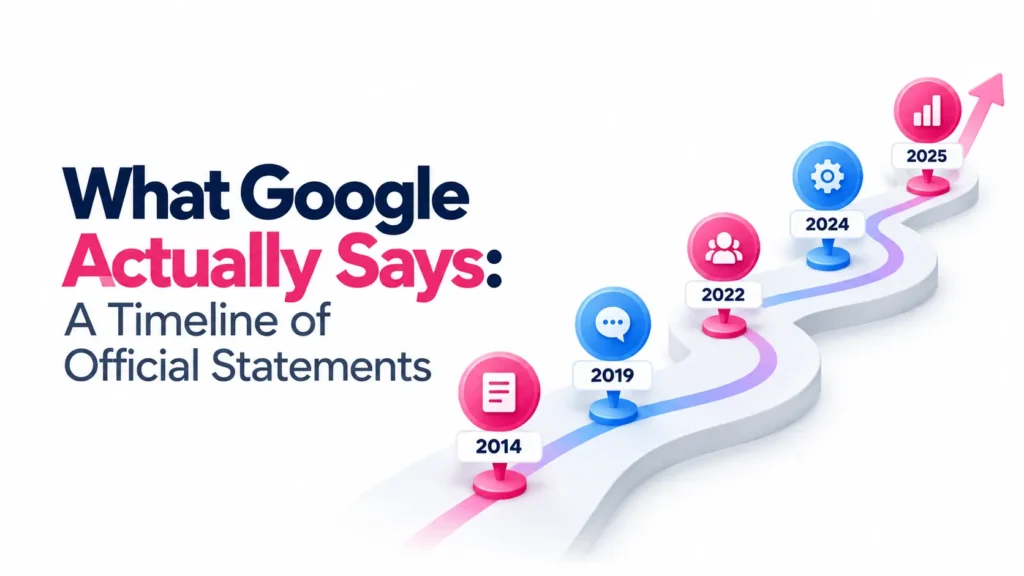
Most articles about what Google says about E-E-A-T quote a single line and stop there. The fuller picture comes from reading Google’s statements in order, because each one clarifies the one before it.
2014: E-A-T appears in the rater guidelines
E-A-T was already part of the rater guidelines by 2014, a point Google’s Hyung-Jin Kim referenced in a 2022 keynote. Expertise, authoritativeness, and trustworthiness guided how raters judged page quality, and at that stage the concept lived inside a handbook for human evaluators rather than in any public ranking documentation.
2019: Google explains the proxy approach
In an October 2019 post on X, Danny Sullivan explained that E-A-T isn’t a technical signal Google can measure directly the way it measures speed. He added that Google uses a variety of signals as a proxy for how humans would judge E-A-T, so in that looser sense it could be called a ranking factor. That was an early explanation, and Google’s current documentation is more explicit that E-E-A-T itself isn’t a specific ranking factor.
2022: A VP of Search weighs in, then the extra “E” arrives
At SMX Next in November 2022, Google’s VP of Search, Hyung-Jin Kim, described E-A-T as a template for rating sites and said, “We do it to every single query and every single result.” He was describing how quality concepts guide Google’s work, not a score calculated for each page. A month later, Google added Experience to the framework, creating E-E-A-T and placing trust at its center.
2024: “Not a ranking factor” and the March core update
Google refreshed its SEO Starter Guide in February 2024, listing E-E-A-T among the things site owners shouldn’t focus on as a direct lever. When some SEOs pushed back, Sullivan said plainly that E-E-A-T is not a ranking factor, that no E-E-A-T score exists, and that a self-declared expert byline doesn’t lift rankings on its own. In March, Google’s core update and new spam policies brought the helpful content system into its core ranking systems, a change Google’s ranking systems guide also records. The same announcement introduced three new spam policies covering scaled content abuse, site reputation abuse, and expired domain abuse.
2025: The rater guidelines catch up with AI
The January 2025 update gave raters a definition of generative AI along with guidance on low-effort automated content. The September 2025 edition followed with examples for rating AI Overviews and refined YMYL definitions, including a Government, Civics & Society category that now names election and voting information.
Read in sequence, these statements tell a consistent story. Google’s published guidance doesn’t describe E-E-A-T as a standalone switch or score, yet its Search team keeps saying the concept guides how the company measures quality. The contradiction disappears once you separate the concept Google aims for from the signals it measures.
How Quality Raters Use E-E-A-T (and Why They Don’t Rank Pages)
Google works with external search quality raters who review search results against a shared rulebook. The September 2025 edition of the rater guidelines runs to more than 180 pages and covers two main tasks. In Page Quality rating, raters judge how well a page achieves its purpose, while in Needs Met rating they judge how well a result satisfies the query that produced it. E-E-A-T sits at the heart of the Page Quality task, so the Google Search Quality Rater Guidelines E-E-A-T section is the best public description of what Google means by quality.
The detail most articles skip is what happens to those ratings afterward. Raters can’t raise or lower any individual site, and their scores never flow into the live ranking algorithm. Google uses the data to evaluate proposed changes to its systems instead. If raters judged a proposed change as producing less trustworthy results, for example, that feedback would help Google decide whether the change is an improvement. Rater feedback helps Google evaluate and improve its systems over time, even though raters never change rankings directly.
What raters check when they research reputation
The guidelines tell raters to look beyond what a site says about itself. They check independent reviews, news coverage, awards, references on sources such as Wikipedia, and what recognized experts say about the creator. A glowing About page should not be treated as the only evidence of reputation, especially if independent sources present a different picture.
E-E-A-T vs E-A-T: What Changed in December 2022
If you have wondered “what is Google E-A-T?” or “what is E-A-T in SEO?” the answer is the same framework minus one letter. The older spelling still appears in forums as EAT, so a question like “what is EAT in SEO?” refers to this same idea. The Google E-A-T guidelines shaped the relationship between E-A-T and SEO for years before Google added Experience in December 2022 to recognize that some of the most useful content comes from people who have lived through a topic rather than studied it. A product review from someone who used the item for six months, or practical advice from a small business owner who has handled payroll for a decade, offers something that credentials alone can’t supply.
The update also reframed the model around trust, presenting experience, expertise, and authoritativeness as contributors to trustworthiness. For content teams, the practical shift was clear: first-hand evidence such as original photos, test results, and real outcomes gained importance wherever personal experience is relevant, while specialized medical or legal topics still call for real expertise.
Which Part of E-E-A-T Matters Most?

Trustworthiness matters most, since Google places trust at the center of the model, and the rater guidelines explain that an untrustworthy page has low E-E-A-T no matter how experienced, expert, or authoritative it seems. The other three elements feed into trust instead of standing beside it as equal pillars.
The logic holds up once you look at everyday situations. A qualified doctor sharing outdated treatment advice still produces a page nobody should rely on, while an affiliate site hiding its commercial relationships may look polished yet leaves readers unable to judge its recommendations. A page doesn’t need all four elements to be useful either: a traveler’s trail report can succeed on experience alone, whereas a guide to filing taxes depends on expertise.
A few practices help readers assess credibility, in line with Google’s people-first guidance:
- A named author who takes responsibility for the content, backed by a real bio.
- Contact details and an About page that readers can actually find.
- Cited sources, original data where possible, and a visible way to correct mistakes.
- Secure infrastructure such as HTTPS, treated as a baseline rather than a selling point.
Why E-E-A-T Carries More Weight for YMYL Topics
YMYL stands for “Your Money or Your Life,” Google’s label for topics that could significantly affect a person’s health, financial stability, safety, or the welfare of society. The current rater guidelines group these topics into four areas: Health or Safety; Financial Security; Government, Civics & Society; and Other. Medical advice, investing, taxes, legal rights, and election information all sit inside those groups.
Google YMYL guidance is where E-E-A-T matters most, since raters apply a stricter E-E-A-T YMYL standard to these pages. Google’s documentation says its systems give even more weight to content aligned with strong E-E-A-T when a topic falls into this category. A casual, lightly sourced article about board games may still rank if it helps people, whereas the same standard on a page about medication dosages would struggle. For E-E-A-T and YMYL content together, plan for a higher bar on author qualifications. Source claims from topic-appropriate authorities, such as the NIH or CDC for US health topics and the CFPB for US consumer finance, then add visible review dates showing when an expert last checked the page.
Is There an E-E-A-T Score or Algorithm?
No, and Google has said so plainly: there is no E-E-A-T score, so any E-E-A-T rating from a third-party tool reflects that tool’s own methodology rather than a Google calculation. The same applies to the idea of an “E-E-A-T algorithm,” because Google’s public ranking systems guide doesn’t list a standalone E-E-A-T system, describing instead many signals that can help identify aspects of it.
| Common myth | What the evidence shows |
|---|---|
| Google assigns every page an E-E-A-T score. | Google’s Search Liaison has said no such score exists. |
| Adding an author bio boosts rankings. | Bios help readers judge expertise, but Google has said a self-declared expert byline doesn’t lift rankings on its own. |
| Quality raters can demote a website. | Raters can’t change any site’s ranking; their data evaluates algorithm changes. |
| E-E-A-T only matters for YMYL sites. | Google’s VP of Search has described it as applying to every query, although the bar rises for YMYL topics. |
| Third-party authority scores measure E-E-A-T. | Domain scores typically come from SEO tools that build their own estimates of link strength, separate from Google’s systems. |
| Changing the publish date signals freshness and trust. | A new date on unchanged content gives readers nothing new, so update facts, examples, and sources first. |
| AI-assisted content can’t show E-E-A-T. | Google judges the quality of the content rather than how it was produced, while mass-produced content made to manipulate rankings falls under its spam policies. |
Where the Google Helpful Content System Fits In
Google launched the helpful content update in August 2022 to reward people-first content and reduce the visibility of pages written mainly for search engines. In March 2024 Google moved that work into its core ranking systems, explaining that it no longer relies on one signal or system to identify helpful content. Google’s systems now use a variety of signals and approaches within core ranking to identify helpful results, including signals that can help identify aspects of E-E-A-T.
Google’s guidance on creating helpful, reliable, people-first content offers a practical lens it calls “Who, How, and Why,” which it also applies to AI-generated content. The “who” should be obvious through bylines that lead to real information about the author. The “how” should be clear, whether that means explaining a testing method or disclosing substantial use of automation where readers might reasonably wonder how the content was made. The “why” should be to help readers first, because content produced mainly to attract search visits falls outside what Google’s systems aim to reward.
Signals Google Can Measure That Line Up With E-E-A-T
Google says its systems use a mix of factors that can help identify aspects of E-E-A-T, so it helps to think about which observable E-E-A-T signals might align with each element. The table below is our practical interpretation of how content practices can align with each element. Google doesn’t publish a complete, element-by-element list of ranking signals, so treat these examples as editorial guidance rather than confirmed algorithmic factors.
| E-E-A-T element | Evidence that may align with it | What you control |
|---|---|---|
| Experience | Original images, specific details, and first-hand evidence that competing pages lack | Photos, test data, screenshots, and documented results |
| Expertise | Depth, accuracy, and consistent coverage of a subject across the site | Subject-matter writers, expert review, and well-planned topic clusters |
| Authoritativeness | Links, citations, and unlinked mentions from respected sources, plus recognition of your brand as an entity | Original research others cite, expert commentary for journalists, and consistent author profiles |
| Trustworthiness | HTTPS, accurate facts, clear ownership, outside reputation, and no deceptive practices | Contact details, editorial and corrections policies, and honest disclosures |
How to Improve E-E-A-T: A Practical EEAT Checklist
Because there is no Google E-E-A-T score to game, the work comes down to making your quality obvious to readers first. Use this EEAT SEO checklist as a set of E-E-A-T best practices drawn from the Google helpful content guidelines and the E-E-A-T quality rater guidelines.
- Show your first-hand work. Replace generic stock images with your own photos, screenshots, and data so readers can see you actually did what the page describes.
- Put real people behind every page. Link each byline to an author page that explains the person’s role, background, and profiles elsewhere, then add ProfilePage markup with a Person entity so search engines can understand who the author is. Structured data aids understanding rather than acting as an E-E-A-T boost.
- Cite primary sources. Link to original studies, official documentation, and government data instead of other blogs repeating the same claim.
- Publish trust pages. Give readers an About page, working contact details, a clear privacy policy, an editorial policy, a corrections policy, and affiliate disclosures wherever money changes hands.
- Earn reputation away from your site. Original research, expert quotes in news coverage, and genuine customer reviews build the outside evidence that raters are trained to look for.
- Keep YMYL content reviewed and dated. Have a qualified expert check health, finance, or legal pages on a schedule that fits the topic, then show the review date on the page.
- Disclose automation where readers would expect it. If AI played a substantial role in producing a page, explaining how it was used supports the “how” part of Google’s guidance.
- Update content for real reasons. Refresh facts, examples, and sources before touching the timestamp, since a new date on old content helps no one.
- Review low-value pages. Improve, consolidate, or remove pages that offer little original value or fail their intended purpose, judging each one by its usefulness to visitors and its role on your site.
How to Measure Whether Your E-E-A-T Work Is Paying Off
Google Search Console doesn’t report an official E-E-A-T score, so measurement means watching the outcomes that quality improvements tend to produce. Search Console is still the starting point, especially impressions and clicks for queries tied to your core topics, compared before and after each of Google’s core updates.
- Core update performance: Compare visibility for your key pages before and after each update, keeping in mind that visibility changes can have many causes beyond E-E-A-T.
- Reputation footprint: Track new links, citations, and unlinked mentions from respected publications, since outside recognition is the part of E-E-A-T you can’t write for yourself.
- Authorship coverage: Audit what share of your articles carry a real byline linked to a complete author page, then close the gaps on your most important pages first.
- AI citations: Check whether AI Overviews and other assistants cite your pages for your main topics, using the methods in our guide to tracking brand mentions in AI search.
Treat these as editorial health checks rather than a score. Their purpose is to highlight where your content could become more useful, transparent, and credible, which is exactly where your Google E-E-A-T optimization strategies should focus next as part of a wider E-E-A-T SEO program.
Does E-E-A-T Matter for AI Overviews and AI Search?
In practice, E-E-A-T for AI search optimization is an extension of normal SEO rather than a separate discipline. Google’s guidance on AI features in Search says the same foundational SEO practices apply to AI Overviews and AI Mode, recommending unique, helpful, people-first content. Google doesn’t publish a formula for which sources get cited, so the sensible approach is to keep creating original, well-supported content rather than chasing an undisclosed citation pattern. The September 2025 rater guidelines also added examples for rating AI Overviews themselves.
Other AI assistants use their own retrieval and source-selection methods, so they shouldn’t be assumed to follow Google’s framework. Even so, the same E-E-A-T strategies, such as clear authorship, reliable information, and original evidence, make content easier for readers and systems alike to evaluate. Search itself keeps changing, whether people use the Google search bar, AI visual search, or agentic AI tools that research on their behalf, yet each path still depends on finding sources worth trusting. The pressure on data quality in generative AI is one reason reliable, well-sourced pages matter to these tools.
Conclusion
E-E-A-T is not a standalone ranking factor or a Google score that publishers can directly optimize. Google says its systems use multiple signals to identify aspects of E-E-A-T, with strong E-E-A-T mattering most on topics that affect health, finances, safety, or society. Treating it as a checklist of isolated changes may not address the underlying quality of a page, whereas genuinely showing first-hand experience, real expertise, outside recognition, and trustworthy practices gives those signals something real to find. Start with the pages that matter most to your readers, make the people and evidence behind them visible, then let your reputation grow from work others want to cite.
Frequently Asked Questions
What does E-E-A-T stand for in SEO?
E-E-A-T stands for Experience, Expertise, Authoritativeness, and Trustworthiness. As an example, a camera review written by a professional photographer who tested the camera for a month would show experience and expertise at the same time.
Is E-E-A-T a direct ranking factor?
It works as a quality framework rather than a single ranking input. For example, typing the word “expert” into a byline doesn’t establish expertise on its own, while a page that shows real test results gives readers and search systems something concrete to judge.
Is EEAT a ranking factor for AI search?
AI search tools have their own ways of choosing sources, although clear, well-supported content is easier for anyone to evaluate. A recipe page that shows the author’s own photos, exact measurements, and cooking notes gives any reader, human or machine, more to work with than a vague page with no author.
What is the difference between E-A-T and E-E-A-T?
E-A-T covers expertise, authoritativeness, and trustworthiness, whereas E-E-A-T adds experience. A hiking guide written by someone who walked the trail last month shows the extra “E” that a desk-researched guide can’t offer.
What are examples of YMYL topics?
YMYL topics include medical conditions, medications, retirement planning, taxes, loans, legal rights, and safety information. A page explaining how to read a credit report belongs in this group, while a page reviewing video games usually does not.
Does E-E-A-T affect rankings on non-YMYL websites?
It still helps, although the expectations are lighter. A hobby blog about gardening can show experience through photos of the writer’s own plants, even though nobody expects a botany degree behind it.
Can a small or new website show strong E-E-A-T?
Yes, by focusing on real experience in a narrow area. A local bakery owner writing about sourdough starters can share daily feeding notes and photos that large recipe sites often lack.
What is an example of first-hand experience in content?
First-hand experience can be communicated in several ways, and visible evidence is one of the clearest. First-hand experience means showing proof that you did the thing yourself. Examples include original screenshots from a software setup, before-and-after photos from a renovation, or a spending log from a budgeting method you tried.
Do quality raters affect my rankings?
Quality raters review sample results so Google can judge its own updates. Think of them like restaurant diners filling in feedback cards: the cards shape future menus, but they don’t change the meal already on your plate.
Is there an E-E-A-T score I can check?
Some SEO tools offer an “E-E-A-T score,” but those numbers typically reflect each tool’s own methodology. A better check is reading your page as a first-time visitor and asking whether you would trust it enough to act on it.
How long does it take to improve E-E-A-T?
Reputation builds gradually, so there is no fixed timeline. A new author page can go live in an afternoon, while earning mentions from respected publications depends on consistent work over time.
What is the quickest E-E-A-T improvement for a blog?
Adding clear bylines linked to detailed author pages is a practical starting point when authorship is unclear. Pairing that with a visible “last reviewed” date on important guides gives readers two trust cues in one update.