


Table of Contents
Ask ten marketers what SEO is and you will get ten answers, most of them technically correct and none of them complete. Part of the confusion is that search engine optimization covers a wide range of work, from rewriting a page title to restructuring an entire website. The rest of the confusion comes from an industry that has spent two decades repeating claims Google has never made.
This guide sets out what SEO actually is, how search engines find and rank pages, and which parts of the job matter in 2026. It also separates what Google confirms from what the industry assumes, because that distinction saves more wasted effort than any tactic on this page.
| Key Takeaways SEO is the practice of making a website easier for search engines to crawl, understand and trust, so it appears when people search for what you offer. Search works in four stages: crawling, rendering, indexing and ranking. A problem at any stage stops everything after it. The work splits into three pillars: on-page content, technical foundations and off-page authority. Roughly 68% of US Google searches now end without a click, so visibility and brand demand matter alongside raw traffic. Google states plainly that E-E-A-T is not a ranking factor and that no ideal word count exists, yet both myths still shape how most teams work. Meaningful results usually take three to six months, and competitive terms take longer. |
What Is SEO? A Clear Definition of Search Engine Optimization
SEO stands for search engine optimization. It is the practice of improving a website so that search engines can find it, understand it and recommend it to people searching for related topics. The aim is to earn visibility in unpaid results, which means you are not buying placement the way you would with an advertisement.
Google describes the discipline in similar terms in its own starter guide. It frames SEO as helping search engines understand your content while helping users decide whether to visit your site. The same guide is clear that no set of tactics guarantees a first position (Google Search Central).
The traffic SEO earns is called organic traffic, because it comes from unpaid results rather than advertising. Everything below is about improving website visibility in those results.
A useful way to picture it is a very large library with no librarian. Search engines send software to read every shelf, work out what each book is about, and decide which ones to hand over when somebody asks a question. SEO is everything you do to make your book easy to find, easy to read and worth recommending.
What SEO Is Not
Three misconceptions cause most of the confusion around what SEO involves. SEO is not a one-time task you tick off at launch, since search results change as competitors publish and algorithms update. It is not free either, because it costs time, skill and often tooling, even though the clicks carry no per-click fee. It is also not a set of tricks played on an algorithm, as the tactics that survive are the ones that make a site genuinely more useful.
How Search Engines Work: Crawling, Rendering, Indexing and Ranking
Search engines work in four stages, and a page has to clear each one before it can appear in results. Understanding the sequence tells you where a problem sits, which is usually faster than guessing at ranking factors.

Alt text: Diagram of the four stages of search: crawling, rendering, indexing and ranking, with the common failure point listed beneath each stage.
Stage 1: Crawling
Crawlers, also called bots or spiders, discover pages by following links and by reading XML sitemaps. Google finds the majority of pages automatically, and its guidance is that most site owners need to do nothing beyond publishing (Google Search Central). Problems appear when important pages have no internal links pointing at them, when robots.txt blocks resources by accident, or when redirect chains send bots in circles.
Stage 2: Rendering
Modern pages assemble themselves from HTML, CSS and JavaScript, so a crawler has to process all three to see what a visitor sees. If your main content only loads after a click, a hover or a script that the crawler cannot run, that content effectively does not exist for search. Server-side rendering solves this for most JavaScript frameworks.
Stage 3: Indexing
Indexing is the decision about whether a crawled page is worth storing at all. Pages get left out when the content duplicates something already indexed, when it is too thin to answer anything, or when a noindex tag survives from a staging environment. You can check what is indexed with a site: search, or more reliably through the coverage reports in Google Search Console.
Stage 4: Ranking
Ranking is the order in which indexed pages appear for a given query, and the Google algorithm decides it using a combination of signals rather than one master score. Relevance to the query does most of the work, supported by content quality, the reputation of the site and the experience of the page itself. This is also the only stage most people ever think about, which is why so much SEO effort lands in the wrong place.
How SEO Works: The Three Pillars of On-Page, Technical and Off-Page
SEO work is usually grouped into three pillars, and a site needs all three to compete. Strong content on a site crawlers cannot read goes nowhere, and a flawless technical setup with nothing worth reading goes nowhere either.
| Pillar | What it covers | Who usually owns it |
|---|---|---|
| On-page SEO | Content optimization, search intent, keywords, meta tags, header tags, internal links, images and URL structure | Content and SEO teams |
| Technical SEO | Crawlability, rendering, indexing controls, site speed, mobile experience, structured data, security | Developers with SEO input |
| Off-page SEO | Backlinks, brand mentions, reviews, citations and branded search demand | SEO, PR and marketing together |
On-Page SEO: Making the Content Worth Ranking
On-page work starts with matching search intent rather than stuffing keywords. Someone searching “best running shoes” wants a comparison, while someone searching “buy Nike Pegasus 41” wants a product page. Serving the wrong format loses the ranking no matter how well the page is written.
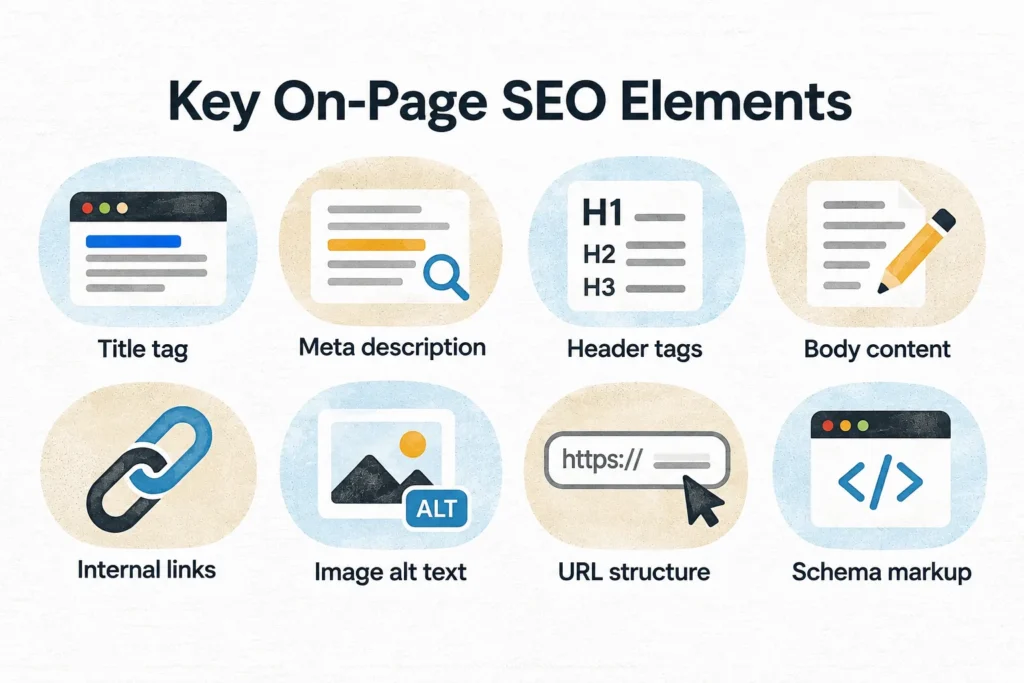
The elements worth attention on each page are straightforward:
- Title tag: unique to the page, clear about what it offers, and written to earn the click rather than to repeat a keyword
- Meta description: a short summary that influences click-through, though Google often writes its own from the page content
- Header tags: used to structure the page so readers can scan it and skip to what they need
- Body content: original, accurate, and more useful than whatever currently ranks for the query
- Internal links: connecting related pages with anchor text that describes the destination
- Image alt text: a short description of what the image shows, which helps both screen readers and search engines
- URL structure: readable words rather than random identifiers, since parts of the URL can appear as breadcrumbs in results
- Schema markup: structured data that helps search engines classify the page and makes it eligible for richer result formats
Technical SEO: Removing the Obstacles
Technical SEO is the work that lets everything else function, and Google’s own trends analyst once summarised the priority bluntly by telling site owners to make the site crawlable. The essentials are a logical site structure, fast and stable pages, and a mobile experience equal to desktop. After that come correct canonical tags, an accurate XML sitemap, and HTTPS across the whole site.
Core Web Vitals sit inside this pillar and measure three parts of the page experience: how quickly the main content loads, how quickly the page responds to input, and how much the layout shifts while loading. They are a modest ranking input, but they describe real frustrations that cost you visitors regardless of rankings. Off-Page SEO: Building Authority You Do Not Control
Off-page SEO covers the signals that come from the rest of the web, and link building remains the best known part of it. A link from a relevant, trusted site carries far more weight than a hundred links from directories nobody reads, so quality genuinely beats quantity here.
You will also see third-party scores such as domain authority quoted as if they were Google metrics. They are not. Tools like Moz and Ahrefs calculate them from their own link indexes to estimate competitiveness, which makes them useful for comparison and useless as a target in themselves.
The wider set of off-page signals includes unlinked brand mentions, customer reviews, consistent business listings, and the volume of people searching for your brand by name. You can influence all of these through public relations, useful research, partnerships and good service, but you cannot control them the way you control a title tag.
Why SEO Matters When Most Searches End Without a Click
The case for SEO has changed, and pretending otherwise leads to disappointment. Search volume keeps growing, but a shrinking share of it leaves Google at all.
SparkToro’s 2026 study found that 68.01% of US Google searches ended without a click in the first four months of the year, up from 60.45% in 2024 (SparkToro). Google has confirmed it processes more than five trillion searches a year so the pool is enormous even as the click-through share falls.

This does not make SEO pointless, but it does change what you optimise for. Ranking still decides whether your brand appears in the answer at all, and whether an AI summary cites you. It also decides whether the high-intent searches that do click reach your site instead of a competitor’s.
The advantages that survive this shift are worth naming:
- Intent that no other channel matches, because somebody searching for your service has already decided they need it
- Compounding returns, since a page that earns rankings and links keeps working long after it is published, unlike a paid campaign that stops the day the budget does
- Presence inside AI answers, which are assembled from the same crawled and indexed pages that rank in traditional results
- Better economics over time, as the cost per acquisition falls once positions are established, though the upfront investment is real
SEO vs SEM vs PPC: What Each Term Actually Means
These three terms get used interchangeably and should not be. SEM is the umbrella, and SEO and PPC are the two halves underneath it.
| SEO | PPC | |
|---|---|---|
| What it is | Earning unpaid placement in search results | Buying placement through an auction |
| Cost model | No cost per click, but real cost in time and skill | You pay each time somebody clicks the ad |
| Speed | Weeks for early movement, months for meaningful results | Visibility the day the campaign goes live |
| Durability | Positions persist with maintenance | Visibility stops when the budget stops |
| Best suited to | Long-term demand capture and brand authority | Testing offers, seasonal pushes and immediate leads |
For most businesses the practical answer is to run both channels together. Paid search covers the gap while organic positions build, and the keyword data from those campaigns shows which terms actually convert. That tells you where to invest months of content work before you commit to it.
Is GEO or AEO a Separate Discipline From SEO?
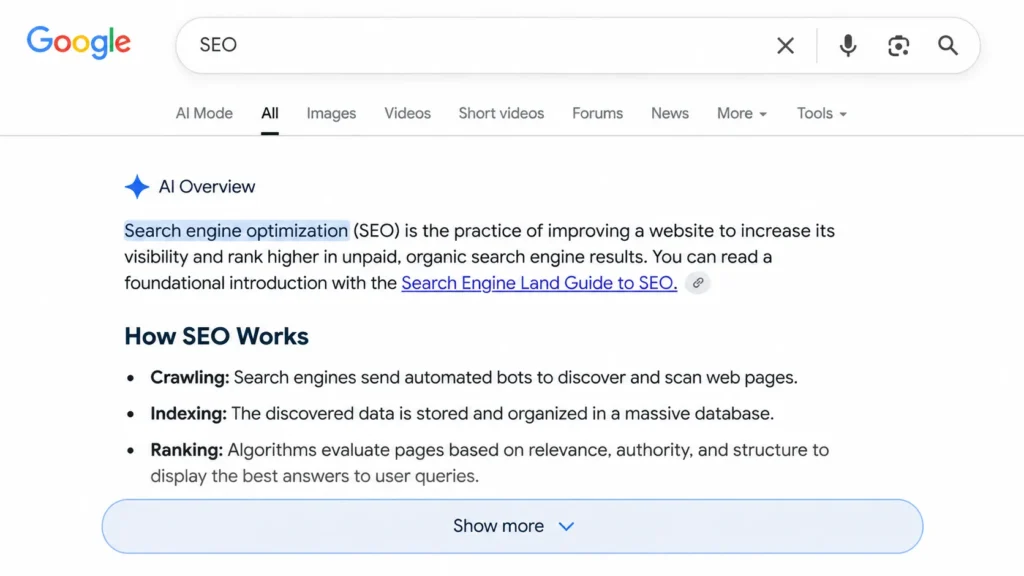
Generative engine optimization and answer engine optimization describe optimising for AI answers, and they are extensions of SEO rather than replacements for it. The underlying requirement has not changed, since an AI answer is assembled from pages that were crawled, indexed and judged useful.
The scale of the shift is worth putting in context. Google said at I/O 2026 that AI Mode has passed one billion monthly users, with queries more than doubling each quarter (Nasdaq). Clickstream data from Datos and SparkToro tells the other half of the story, putting all AI tools combined at under 2% of desktop web visits. The same panel had Google recovering to 94.3% of US search share by March 2026 (PPC Land).
Both numbers are true, and together they argue against abandoning either surface. What earns a citation in an AI answer is close to what has always earned rankings: content that answers a specific question clearly, on a site that is crawlable and credible.
Three habits help more than any new checklist:
- Answer the question directly in the first two sentences of a section, then expand underneath
- Use tables, clear headings and specific figures, because extractable formats get quoted
- Cite named sources and dates, since claims that can be verified are the ones that get reused
Types of SEO: The Main Specializations
Beyond the three pillars, SEO splits into specializations that each carry their own challenges. Most practitioners eventually pick one or two and build a career around them.
| Specialization | What makes it different |
|---|---|
| Local SEO | Google Business Profile management, consistent name-address-phone data, reviews and map pack visibility |
| Ecommerce SEO | Category and product pages, faceted navigation, product variants, reviews and product schema at scale |
| Enterprise SEO | Large sites and organisations, where governance, stakeholder alignment and development queues matter as much as tactics |
| International SEO | Multiple languages and regions, hreflang implementation, and engines such as Baidu, Yandex and Naver |
| News SEO | Speed of indexing, Top Stories and Discover eligibility, news-specific structured data and paywall handling |
| Content SEO | Topic research, editorial planning, content clusters and updating existing pages that have started to slip |
Ranking Factors: What Google Confirms Versus What the Industry Repeats
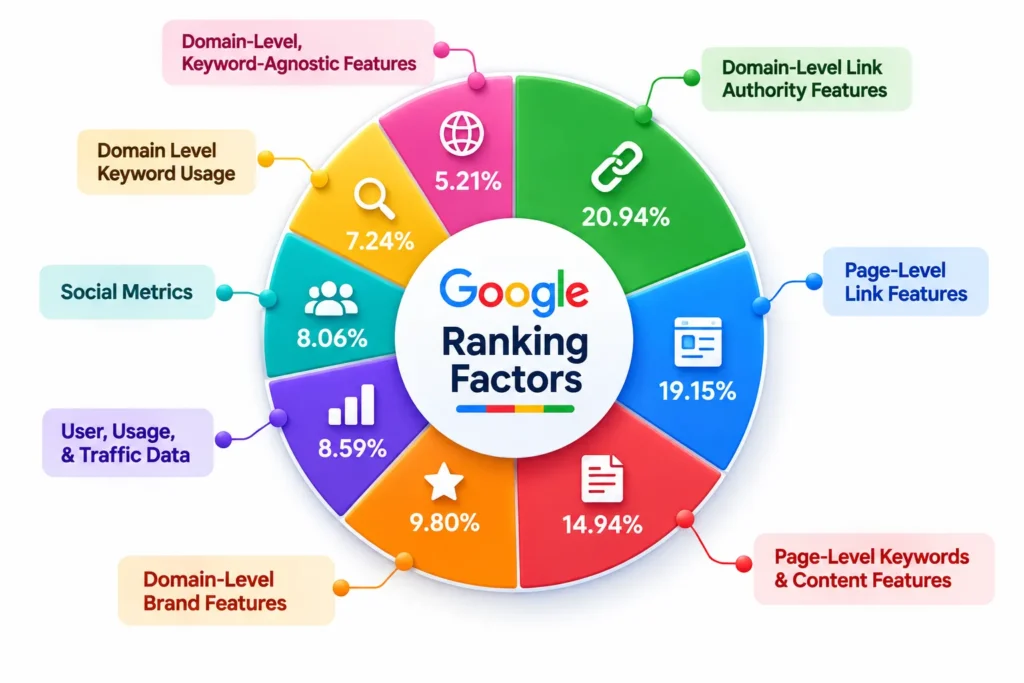
The claim that Google uses 200 ranking factors has been repeated for over a decade, and Google has never published such a list. Signals overlap, shift in weight by query type, and change constantly, so treating any list as fixed rules leads teams to optimise for things that do not matter.
Google’s own starter guide includes a section on what site owners should stop worrying about, and it contradicts advice you will still find on competing pages today.
| Common claim | What Google actually says |
|---|---|
| E-E-A-T is a ranking factor | It is not. E-E-A-T comes from the Search Quality Rater Guidelines, which describe how human raters evaluate results, not how the algorithm scores pages. |
| Longer content ranks better | There is no minimum or maximum word count for ranking purposes, and no magical target. |
| Meta keywords still help | Google Search does not use the keywords meta tag. |
| Duplicate content carries a penalty | Content reachable at several URLs is inefficient but is not a manual action. Copying other people’s content is a different matter. |
| Headings must run in order | Semantic heading order helps screen readers, but out-of-order headings do not hurt in Google Search. |
| Keywords in the domain boost rankings | Keywords in the domain or URL path have hardly any effect beyond appearing in breadcrumbs. |
| Your TLD affects rankings | The TLD matters only when you are targeting a specific country, and even then it is a low-impact signal. |
Every statement in the right-hand column comes from Google’s SEO Starter Guide (Google Search Central). Reading that page once will save you more time than most paid courses.
So What Does Influence Rankings?
The things worth your attention are less exciting than a factor list, and there are only five of them. Content that matches what the searcher wanted, a site that crawlers can reach and render, and internal links that connect related pages. Then genuine authority earned from other sites, and pages that load quickly on the devices people actually use. Everything else is refinement on top of those five.
How to Do SEO: A Step-by-Step Process for Beginners
SEO becomes manageable when you treat it as a sequence rather than a list of tasks. Most SEO strategies fail not because the techniques are wrong but because they are applied out of order. These seven steps work whether you are optimising a new site or reviving one that has stalled.
- Set up measurement first. Connect Google Search Console and an analytics platform before you change anything, because without a baseline you cannot tell improvement from coincidence.
- Run a technical check. Confirm that important pages are indexed, that nothing critical is blocked, that the site loads quickly and that HTTPS is in place. Fixing these first means later work is not wasted.
- Research keywords and intent. Identify the terms your audience uses, then look at what currently ranks for each one, since the existing results tell you which format the query expects.
- Map keywords to pages. Give each target term one page rather than several, which prevents your own pages from competing with each other for the same query.
- Create or improve the content. Write for the person searching, cover the question fully, and add the specifics that only your business can provide, such as your own data, processes or examples.
- Build internal links and earn external ones. Link new pages from relevant existing ones, then earn outside links through research, useful tools, coverage and genuine relationships.
- Measure, then revisit. Check performance after a few months, refresh pages that have slipped, and remove content that serves nobody.
How to Measure SEO Performance in a Zero-Click World
Rankings alone are a poor measure of success, and traffic alone is becoming one too. Measure across four levels instead, so you can see both whether the work is landing and whether it matters commercially.
| Level | What to track | What it tells you |
|---|---|---|
| Visibility | Impressions, average position, share of SERP features, appearances in AI Overviews | Whether you are being seen at all |
| Traffic | Organic sessions, clicks, landing page performance | Whether visibility turns into visits |
| Engagement | Click-through rate, scroll depth, repeat visits, pages per session | Whether the page delivered what was promised |
| Business | Leads, sales, revenue, assisted conversions, cost per acquisition | Whether any of it pays for itself |
Two adjustments matter more in 2026 than they did a few years ago. Watch impressions alongside clicks, because rising impressions with flat clicks usually means you are being summarised rather than ignored. Track branded search volume too, since people who meet your brand inside an AI answer often search your name afterwards instead of clicking a link.
How Long Does SEO Take to Show Results?
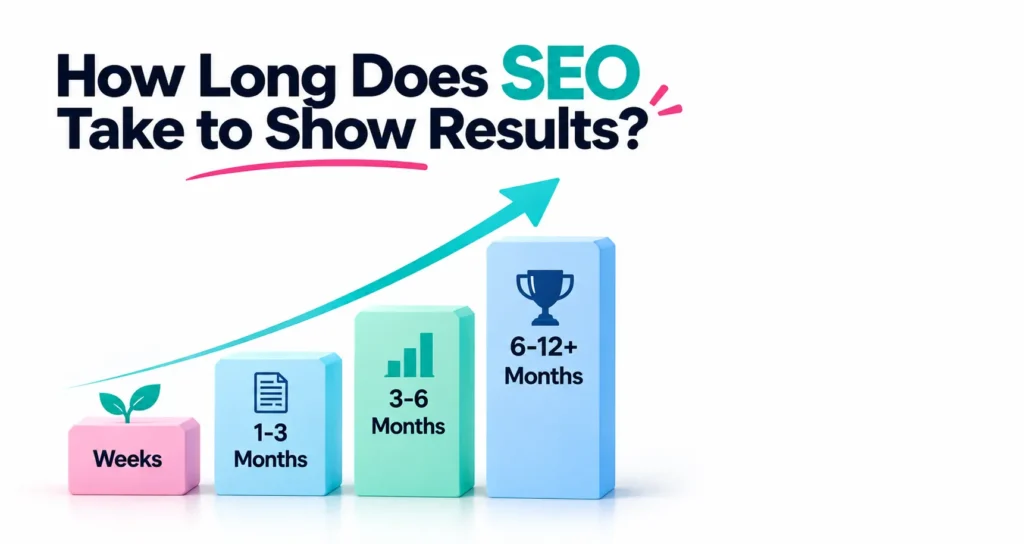
Expect early movement within weeks and meaningful results in three to six months, with competitive terms taking longer. Google’s own guidance is that some changes register within hours while others take months. It also suggests waiting a few weeks before judging whether a change had any effect (Google Search Central).
Four variables decide where you land in that range: the age and authority of the domain, how competitive your terms are, how much content already exists, and how quickly your team can ship changes. A new site in a crowded niche should plan for a year, while an established site fixing technical debt can see movement inside a month.
Be wary of anyone promising first-position rankings on a fixed date. Nobody controls the results page, and the agencies that guarantee positions are usually targeting terms nobody searches for.
Common SEO Mistakes That Waste Time and Budget
- Chasing volume over intent, which brings visitors who were never going to buy anything
- Publishing constantly without maintaining anything, so old pages decay while new ones compete with them
- Targeting the same keyword with several pages, which splits signals instead of concentrating them
- Treating SEO as a launch task, then wondering why rankings drift a year later
- Buying links in bulk, which risks manual action for a signal that carries little weight. White hat link building is slower and survives algorithm updates
- Ignoring what Search Console already shows, particularly queries where you rank on page two and a better title could move you up
- Optimising for an algorithm rather than a reader, which produces pages that technically cover a topic and help nobody
Essential SEO Tools for Beginners and Professionals
Start with the free tools, since they carry first-party data no paid platform can replicate. Paid tools add competitor visibility and scale, but they estimate what Search Console reports directly.
| Tool | What it does | Cost |
|---|---|---|
| Google Search Console | Shows the queries you appear for, indexing status, and technical issues Google has found | Free |
| Google Analytics | Tracks what visitors do once they arrive and which pages drive outcomes | Free |
| Bing Webmaster Tools | The same function for Bing, which also feeds several AI search products | Free |
| PageSpeed Insights | Reports Core Web Vitals using both lab and real-user data | Free |
| Ahrefs, Semrush or Moz | Keyword research, backlink data, rank tracking and competitor analysis | Paid, with limited free tiers |
| Screaming Frog | Crawls your site the way a search engine would and surfaces structural problems | Free up to 500 URLs |
| Yoast or Rank Math | Handles titles, meta tags, sitemaps and schema markup inside WordPress without touching code | Free, with paid tiers |
How to Learn SEO and Build a Career in It
SEO has no standard qualification, so practitioners learn by reading primary sources and running their own experiments. The fastest route is a site of your own where mistakes cost nothing.
Start with Google Search Central, since it is the only documentation written by the people who build the ranking systems. Moz’s beginner guide covers the fundamentals clearly (Moz), and Search Engine Land maintains a long-running guide alongside daily industry coverage (Search Engine Land).
Roles range from SEO executive through specialist, strategist and manager to head of SEO. Salaries vary widely by country, by industry, and by whether you work in-house, at an agency or freelance. Any specific figure you read is tied to one market and one year, so check local data rather than trusting a global average.
Final Thoughts: Where to Start With SEO
SEO rewards patience and punishes shortcuts, which is why the fundamentals have outlasted every tactic built to game them. Make the site crawlable, write pages that answer real questions better than the alternatives, earn a reputation worth citing, and measure what actually matters to the business.
If you are starting this week, do three things. Connect Search Console and look at what you already rank for, fix whatever is stopping pages from being indexed, and pick one page you care about and make it the best answer on the results page for its query. Everything else in this guide builds on those three.
Frequently Asked Questions
What does SEO stand for?
SEO stands for search engine optimization, which is the practice of improving a website so that search engines can crawl it, understand it and show it to people searching for related topics.
How does SEO work in simple terms?
Search engines crawl the web to discover pages, render them to see what a visitor would see, index the ones worth storing, and then rank them for each query. SEO is the work of making your pages easy to crawl, clearly relevant, and credible enough to be recommended. The same principles apply across Google, Bing, Yahoo, DuckDuckGo and regional engines such as Yandex and Baidu, because they all follow that sequence.
What are the three types of SEO?
The three types are on-page SEO, technical SEO and off-page SEO. On-page covers content and page elements, technical covers crawling, indexing and site performance, and off-page covers backlinks, brand mentions and reputation. All three are needed, since strength in one rarely compensates for weakness in another.
Can I do SEO myself?
Yes, and particularly so on a smaller site where the wins are straightforward. The fundamentals are well documented, the essential tools are free, and most early gains come from fixing obvious problems rather than advanced tactics. Larger sites and competitive markets usually need specialist help.
Is SEO free?
There is no cost per click, but SEO is not free. It costs time, skill and often paid tooling, and content and development work carry real budget. The difference from advertising is that the results persist after the spending stops.
Is SEO still worth it with AI search?
Yes, and for a structural reason rather than a hopeful one. AI answers are assembled from pages that search engines have crawled and indexed, so the same work that earns rankings also earns citations. Clickstream data still shows Google handling the overwhelming majority of search activity, with AI tools accounting for a small share of web visits.
How much does SEO cost?
Costs vary by market and scope, from a few hundred dollars a month for a small local site to five figures for enterprise programmes. What matters more than the number is what it buys: strategy, content production, technical fixes and reporting. Ask any provider for a breakdown before comparing prices.
What is the difference between SEO and SEM?
SEM, or search engine marketing, is the umbrella term covering both organic and paid search. SEO is the organic half, and PPC is the paid half. When someone uses SEM to mean only paid advertising, they are using the term loosely.