



Table Of Contents
Last updated: 8 September 2026. Reviewed monthly and after any significant announcement.
UK AI regulation news today, in one line: the UK still has no AI Act, no single AI regulator, and no AI bill before Parliament. AI is regulated in the context in which it is used, by whichever regulator already covers that context.
That has been the answer through every UK AI regulation update since 2023, and 2025 did not change it. What 2025 did was make the direction permanent: the promised AI bill slipped, and on 21 October 2025 the government published a Blueprint for AI regulation built around sandboxes instead.
This page carries the full 2025 record in date order, the current 2026 position, and a 2025 vs 2026 vs 2027 comparison so you can see what actually moved.
Key Takeaways
- No UK AI Act exists. The 2023 white paper’s five principles are still non-statutory in 2026.
- The big 2025 update was 21 October: DSIT’s Blueprint for AI regulation and the AI Growth Lab call for views, which replaced an AI bill as the immediate vehicle.
- The May 2026 King’s Speech confirmed the shift, announcing a Regulating for Growth Bill with sandboxing powers and no standalone AI bill.
- The one change that altered legal duties for ordinary businesses took effect on 5 February 2026: the Data (Use and Access) Act 2025 automated decision-making provisions.
- Looking to 2027: EU high-risk obligations, further AI Growth Lab sectors and the ICO’s statutory AI code are the three dates to plan around.
UK AI regulation news today: where things stand
The UK has no AI-specific regulation or legislation covering AI as a technology. Instead, AI is regulated by how it is used, through existing legal frameworks such as financial services legislation, and no single AI regulator exists (House of Commons Library, AI regulation in the UK, 10 June 2026).
Two governments have now reached the same conclusion. The March 2023 white paper, A pro-innovation approach to AI regulation, set five cross-sector principles for existing regulators to apply: safety, security and robustness; appropriate transparency and explainability; fairness; accountability and governance; and contestability and redress. None were put on a statutory footing. In February 2025, the Labour government said most AI systems should be regulated at the point of use and that existing expert regulators are best placed to do it.
The 2024 manifesto and King’s Speech had promised binding regulation for the handful of companies developing the most powerful AI models. That legislation has still not appeared.

Most UK AI regulation updates are strategy, funding, or guidance. Only one so far changed the law that applies to a typical company.
UK AI regulation news 2025: the full year in date order
2025 was the year the UK decided not to legislate. Here is every significant UK AI regulation update from that year, in the order it happened.
| Date | UK AI regulation update |
|---|---|
| 13 Jan 2025 | AI Opportunities Action Plan published, 50 recommendations, all accepted by government |
| Feb 2025 | AI Safety Institute renamed the AI Security Institute, narrowing focus toward national security |
| Feb 2025 | Government states most AI systems should be regulated at the point of use by existing regulators |
| Feb 2025 | AI Playbook for the UK Government launched for public sector use of AI |
| 25 Feb 2025 | Copyright and AI consultation closes after around 11,500 submissions |
| 4 Mar 2025 | Artificial Intelligence (Regulation) Private Members’ Bill reintroduced in the House of Lords |
| Apr 2025 | AI Growth Zone selection process opens |
| May 2025 | Ofgem issues guidance on AI use in the energy sector |
| 11 Jun 2025 | Spending Review commits over £2bn to AI, including £500m for a Sovereign AI Unit and £240m for the AI Security Institute |
| 19 Jun 2025 | Data (Use and Access) Act 2025 receives Royal Assent |
| Jun 2025 | Reports confirm the first UK AI Bill will not arrive before the second half of 2026 |
| Jul 2025 | UK Compute Roadmap published |
| Sep 2025 | North East AI Growth Zone announced (Blyth and North Tyneside) |
| 21 Oct 2025 | DSIT publishes its Blueprint for AI regulation and opens the AI Growth Lab call for views, responses due 2 January 2026. Regulatory Innovation Office publishes its One Year On report the same day |
| Oct 2025 | DRCF issues a call for views on agentic AI. Skills England publishes its AI skills report |
| 12 Nov 2025 | Cyber Security and Resilience Bill introduced to Parliament |
| Nov 2025 | Budget adds up to £250m for compute and up to £100m for an advanced market commitment. North Wales and South Wales AI Growth Zones announced. Delivering AI Growth Zones white paper and AI for Science Strategy published |
| 3 Dec 2025 | Liz Kendall tells the Science, Innovation and Technology Committee she is thinking in terms of specific areas rather than an all-encompassing AI bill |
| 18 Dec 2025 | AI Security Institute publishes its Frontier AI Trends Report. MHRA opens its call for evidence on regulating AI in healthcare |
| 19 Dec 2025 | Home Office action plan sets out intent to ban nudification apps |
UK AI regulation October 2025 update

October is the month that mattered. On 21 October 2025, DSIT published its Blueprint for AI regulation, which effectively replaced the AI Bill as the immediate legislative vehicle. Its centrepiece was the AI Growth Lab: cross-economy regulatory sandboxes where specific rules can be temporarily and conditionally relaxed for licensed firms testing AI, with red lines around consumer protections, safety provisions and fundamental rights.
The consultation ran until 2 January 2026 and asked which specific regulatory barriers should be addressed. Successful pilots could then be made permanent through updated guidance, codes of practice or statutory amendments.
Two related items landed the same day and the same month. The Regulatory Innovation Office published its One Year On report on 21 October, covering progress across space, drones, healthcare and engineering biology. Separately in October 2025, the Digital Regulation Cooperation Forum issued a call for views on agentic AI, asking what practical uncertainties businesses face when deploying autonomous systems.
If you are searching 20 October 2025 or 28 October 2025 specifically: the announcement you are looking for is almost certainly the 21 October Blueprint. Nothing separate was announced on either of those dates. Coverage and analysis of the Blueprint ran through the rest of that month, which is why nearby dates show up in search. Treat 21 October 2025 as the reference point.
UK AI safety regulation news 2025
AI safety was the strand that visibly narrowed during 2025. In February 2025, the AI Safety Institute was renamed the AI Security Institute, refocusing on national security threats rather than the broader definition of safety used around the 2023 Bletchley summit.
The government had committed to establishing the institute as a statutory body, with funding confirmed at the June 2025 Spending Review at £240m. The funding arrived. The statutory powers did not, and as of the Commons Library briefing in June 2026, the institute still had no statutory footing.
Commentators noticed the change in tone. Analysis published at the end of 2025 described the government’s focus moving away from AI safety in favour of growth and national security.
UK AI policy news 2025: money, not rules
The other half of the 2025 story is that AI policy was overwhelmingly about investment and infrastructure rather than regulation:
- AI Growth Zones: Culham (pilot, January 2025), North East (September 2025), North Wales and South Wales (November 2025), each receiving up to £5m of targeted funding
- Sovereign AI Unit: up to £500m, working with the British Business Bank
- Compute: a commitment to a twentyfold expansion of the AI Research Resource by 2030/31, set out in the UK Compute Roadmap
- Skills: £48m Tech Expert programme, plus Skills England’s AI skills report
By January 2026, DSIT’s One Year On progress report recorded 38 of the 50 Action Plan commitments as met, with 12 in progress.
2025 vs 2026 vs 2027: what actually changed
This is the comparison worth keeping. The pattern is easy to miss when you read year by year.
| # | 2025 | 2026 (now) | 2027 (expected) |
|---|---|---|---|
| Is there an AI Act? | No | No | No AI Act expected |
| Is a bill in play? | Promised, repeatedly delayed | No AI bill in the May 2026 King’s Speech; Regulating for Growth Bill instead | Growth Bill passage; targeted measures possible |
| Main legal change for businesses | None | DUA Act ADM provisions in force 5 Feb 2026 | ICO statutory AI and ADM code |
| Government’s main tool | Strategy, funding, growth zones | Sandboxes (AI Growth Lab) | Sandbox findings converted via secondary legislation |
| AI Security Institute | Renamed, funded £240m | Still no statutory powers | Statutory footing only if a vehicle appears |
| Copyright and AI | Consultation closed Feb 2025, ~11,500 responses | March 2026 report: no preferred way forward | Further evidence gathering; no TDM exception for now |
| EU AI Act pressure on UK firms | Act in force, phasing | Digital Omnibus provisional agreement May 2026 | High-risk obligations from 2 Dec 2027 (standalone), Aug 2028 (embedded) |
| Regulator activity | Strategic approaches published | 19 regulators asked to publish AI innovation plans and report annually | Annual regulator reporting cycle begins |
The one-line read: 2025 was announcements, 2026 was the first real legal change plus a decision not to legislate, and 2027 is when the deferred deadlines land, mostly European ones, plus the ICO code.
UK AI regulation updates today: what is actually in force
Strategy documents are not law. Here is what binds a UK organisation deploying AI right now.
| Instrument | What it covers | Enforced by | In force since |
|---|---|---|---|
| UK GDPR + Data Protection Act 2018 | Any AI processing personal data: lawful basis, fairness, transparency, DPIAs | ICO | 2018 |
| DUA Act 2025 ADM provisions | Solely automated decisions with legal or similarly significant effect | ICO | 5 Feb 2026 |
| Online Safety Act 2023 | Algorithms distributing illegal or harmful content; AI chatbots in scope | Ofcom | 2023 onward |
| Equality Act 2010 | Discriminatory outcomes from AI in recruitment, pricing, services | EHRC, tribunals | 2010 |
| FSMA, FCA Handbook, PRA Rulebook | AI in financial services: model risk, resilience, Consumer Duty | FCA, PRA | Existing |
| Medical Devices Regulations 2002 | AI as a medical device | MHRA | Existing |
| Sexual Offences Act 2003 (as amended) | Non-consensual intimate deepfakes of adults | Police, CPS | 6 Feb 2026 |
The practical takeaway: your UK AI compliance obligations are data protection obligations plus your sector’s existing rulebook. If you were waiting for an AI Act to tell you what to do, the answer has been sitting in the UK GDPR the whole time.
The February 2026 ADM change cuts both ways. It broadens when solely automated decisions are permitted, which is deregulatory, while attaching a safeguards regime instead of the old near-prohibition. If Article 22 blocked an automation project, that block may no longer apply. If you already automate decisions, your safeguards, human review route, and contest mechanism now need documenting against the new provisions.
Which regulator covers you
With no central AI regulator, the first question is not “what does the AI law say” but “whose remit am I in”. Most organisations sit in at least two.
| If you… | Your regulator | What they have published |
|---|---|---|
| Process personal data with AI (almost everyone) | ICO | AI and data protection guidance; Explaining decisions made with AI; ADM guidance pending |
| Operate in financial services | FCA / PRA / Bank of England | AI update; joint strategic approach; June 2026 frontier AI cyber statement |
| Run an online service or chatbot | Ofcom | Strategic approach to AI; open letter on generative AI and the Online Safety Act |
| Build AI-enabled medical devices | MHRA | Software and AI as a medical device; AI Airlock sandbox |
| Compete in a digital market | CMA | AI strategic update; foundation models reports; agentic AI and consumers (March 2026) |
| Deploy AI affecting workers | HSE, EHRC | HSE regulatory approach to AI; Equality Act duties |
| Provide legal services | SRA | AI Growth Lab participation; approved the first AI-native law firm |

The layer everyone reads about is the one with no legal force. The layer that binds you is the oldest one.
The 2026 headline: a growth bill, not an AI bill
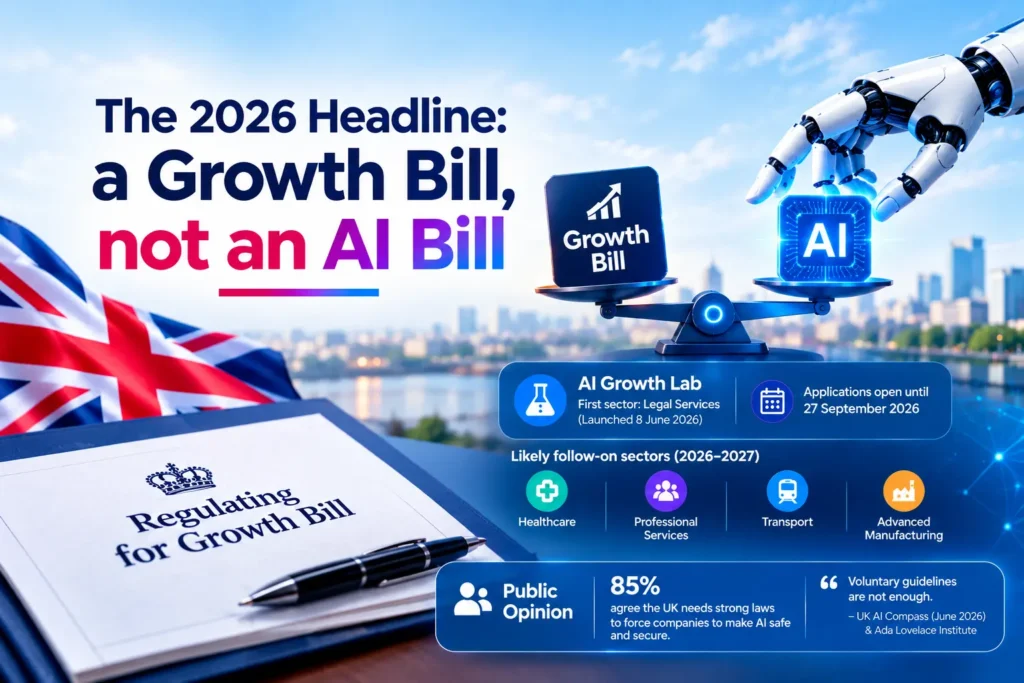
The most consequential UK AI regulation news of 2026 is something that did not happen. The King’s Speech on 13 May 2026 contained no standalone AI bill. It announced a Regulating for Growth Bill, creating cross-economy sandboxing powers that let ministers temporarily adjust or suspend specific rules for technology testing, and strengthening the Growth Duty on regulators.
Read that carefully, because it inverts what most people assume “AI regulation” means. This is legislation to make rules easier to relax, not legislation that creates new AI obligations.
The AI Growth Lab is that choice in practice. It launched on 8 June 2026 with legal services as the first sector, jointly led by the Ministry of Justice and DSIT, with applications open until 27 September 2026. Healthcare, professional services, transport and advanced manufacturing are flagged as likely follow-on sectors through 2026 and 2027.
Public opinion is running the other way. The UK AI Compass study, reported in June 2026, found 85% of respondents agreed the UK needs strong laws to force companies to make AI safe and secure, and that voluntary guidelines are not enough. Ada Lovelace Institute polling has found similar support for independent regulation, which it describes as out of step with delays to legislation.
What UK businesses should do now?
- Build an AI register. Every AI system in use, including tools embedded inside SaaS products you already licence. Third-party AI inside a CRM or HR platform is the most commonly missed category.
- Re-check automated decisions against the February 2026 rules. Identify solely automated decisions with legal or similarly significant effect, then document safeguards, human review, and the contest route.
- Read your own regulator’s AI plan. Nineteen regulators were asked in January 2026 to publish one. Yours is more specific to your sector than any general guide.
- Assess EU exposure separately, on the 2027 timetable. If any output reaches EU users, classify against the EU AI Act.
- Watch consultations, not legislation. With no bill in play, UK AI policy is made through consultations, codes and sandbox pilots.
Conclusion
The honest summary of UK AI regulation news today is that the story since 2025 has been consistent: announcements, funding and sandboxes rather than statute. 2025 delivered the Blueprint instead of a bill. 2026 delivered the first real legal change, on automated decision-making, plus a King’s Speech that confirmed no AI Act is coming. 2027 is where the deferred deadlines sit, and most of them are European.
So stop planning around a UK AI Act. List your AI systems, check your automated decisions against the February 2026 rules, read your regulator’s plan, and handle EU exposure on its own timetable. The rules that bind you already exist, and they are mostly not called AI rules.
Frequently asked questions
Is there a UK AI Act?
The UK has no AI-specific legislation covering AI as a technology, and as of September 2026, no AI bill is before Parliament.
What was the main UK AI regulation news in 2025?
The 21 October 2025 Blueprint for AI regulation and the AI Growth Lab call for views. It replaced the AI Bill as the immediate vehicle and shifted UK AI policy toward regulatory sandboxes.
What happened with UK AI regulation in October 2025?
DSIT published its Blueprint for AI regulation on 21 October 2025 and opened a call for views on the AI Growth Lab, with responses due by 2 January 2026. The Regulatory Innovation Office published its One Year On report the same day, and the DRCF issued a call for views on agentic AI that month.
Has the UK AI bill been dropped?
Not formally. The commitment to binding rules for the most powerful models has never been withdrawn or introduced. Reports in June 2025 confirmed no bill before the second half of 2026; in December 2025 the Technology Secretary indicated she was thinking about specific areas rather than one comprehensive bill, and the May 2026 King’s Speech contained no AI bill.
Who regulates AI in the UK?
There is no single AI regulator. The ICO covers AI processing personal data, the FCA and PRA cover financial services, Ofcom covers online services and chatbots, the MHRA covers AI medical devices, and the CMA covers competition and consumer issues.
What changes for UK AI regulation in 2027?
Three things to plan around: EU AI Act high-risk obligations from 2 December 2027 for standalone systems, further AI Growth Lab sectors converting pilots into permanent change through secondary legislation, and the ICO’s statutory code of practice on AI and automated decision-making.
Does the EU AI Act apply to UK companies?
It can. It applies to AI systems placed on the EU market, used in the EU, or whose output is used in the EU. It is not part of UK law and the UK does not intend to replicate it, so UK firms selling into Europe run both frameworks in parallel.

