
Table of Contents
A browser agent security risk is any exposure created when an AI system drives a real browser using a real person’s permissions. The agent reads untrusted web content, holds live authenticated sessions, and acts at machine speed, and those three properties combine into a threat class that browser vendors have not solved and that most enterprise security stacks cannot even observe.
The evidence stopped being theoretical some time ago. In June 2026, a University of Washington team tested seven agentic browsers and found that four of them let a malicious site use the agent to break the same-origin policy, the boundary that has separated one website’s data from another’s for three decades. This guide covers what actually goes wrong, why your existing controls miss it, how to rank your own exposure, and what to fix in what order.
Key Takeaways
- The root cause is architectural, not a bug: a language model cannot reliably tell an instruction from data when both arrive as text, so any web page the agent reads is potential input to its decision-making.
- University of Washington researchers found four of seven tested agentic browsers allowed same-origin policy bypass, with a working proof-of-concept attack against ChatGPT Atlas.
- Separate the agent’s browser from the employee’s browser. Nothing else on this list matters if the agent still carries the user’s whole session with it.
- AI browser extensions are the quiet half of the problem: LayerX’s 2026 extension report found AI extensions three times more likely than ordinary extensions to hold cookie access.
- Vendor claims about model robustness are not the question to ask. Ask whether the product ships both a content-scanning layer and an action-blocking layer.
What is a browser agent security risk?
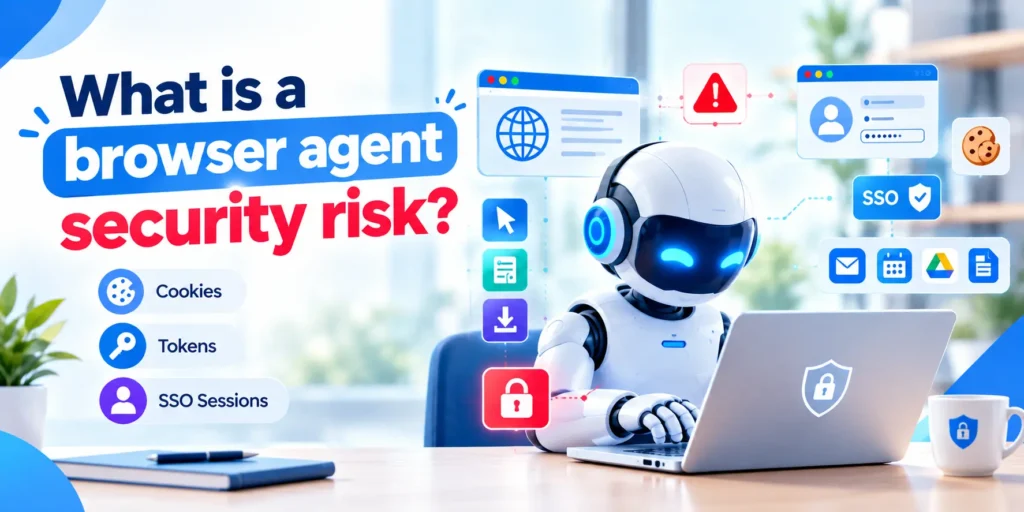
A browser agent security risk is a threat that exists because an AI agent operates a browser with delegated human authority. A browser agent takes a natural language instruction, interprets it with a large language model, and then navigates pages, fills forms, clicks buttons, and downloads files across any site the browser can reach. Traditional automation follows a script. An agent reasons about what it sees and decides the next action itself, which is precisely why it can be argued into the wrong one.
The agent reads untrusted web content, holds live authenticated sessions, and acts at machine speed, and those three properties combine into a threat class that browser vendors have not solved and that most enterprise security stacks cannot even observe.
That combination changes what a mistake costs. The agent doesn’t just get one login wrong; it holds every cookie, token, and SSO session the browser has open, so a single bad decision reaches as far as the person’s entire digital footprint. Every page, email, document, or calendar invite it reads along the way becomes something it might act on, not just something it summarizes. And because it decides and executes in the same breath, there’s no pause where a human’s instinct for a suspicious page would normally kick in.
This is the reason a chatbot risk and a browser agent risk are not the same size. A chatbot tricked by injected text produces a bad answer. An agent tricked by the same text performs bad actions with real credentials across multiple systems.
Why browser agents break the security model your stack was built on
Existing controls sit at the wrong layer. DLP, CASB, EDR, and network monitoring all inspect outputs: traffic, files, processes, API calls. Browser agents make their decisions above that layer, inside a browser tab, on natural language, and then produce outputs that look completely ordinary. Even the familiar “Search Google or type a URL” box is now a place where agent actions can begin.
Consider a research task for a sales team. One page in the agent’s path carries hidden instructions telling it to open the already-authenticated CRM tab, collect customer records, paste them into a form, and submit. Every observable signal in that sequence is a legitimate user browsing, copying, and submitting a form from a trusted process over standard HTTPS.
The same-origin policy no longer holds
The most consequential 2026 finding is that the browser’s oldest safety boundary degrades when an agent sits above the page. In the University of Washington work, presented as Agentic Browsers and the Same-Origin Policy by Franziska Roesner and David Kohlbrenner, researchers tested Brave Leo, ChatGPT Atlas, Chrome with Gemini, Claude for Chrome, Edge with Copilot, Firefox AI Mode, and Perplexity Comet in early 2026. Their conclusion was blunt: in several of these products, the same-origin policy is effectively reduced to the strength of the agent’s prompt injection defenses. A separate arXiv paper published in June 2026 built SOPBench to measure the problem systematically and found agentic browsers violate the policy both under attack and in ordinary use.
The claim worth remembering: the same-origin policy is enforced by the browser against scripts. A browser agent is not a script. It reads one origin and writes to another as a normal part of being helpful, which is why no browser setting switches this behaviour off.
Identity controls pass agent traffic straight through
Agents authenticate through the sessions that already exist. OAuth and SAML treat an authenticated entity as trustworthy for the lifetime of a session, a model that assumes the entity’s behaviour is stable. An agent’s behaviour changes with every prompt it reads, including prompts an attacker wrote.
The 7 browser agent security risks that matter in 2026
1. Indirect prompt injection
Indirect prompt injection is the delivery mechanism behind almost every documented browser agent attack. An attacker places instructions in content the agent will read during legitimate work: a web page, a shared document, an email, a calendar invite, a URL fragment, even pixels in an image. The agent processes that content and executes the embedded instruction with the user’s permissions.
OWASP now treats this as an agent-specific problem rather than a chatbot one. Its Top 10 for Agentic Applications, released for 2026 by the OWASP GenAI Security Project, opens with ASI01 Agent Goal Hijack, followed by ASI02 Tool Misuse, ASI03 Identity and Privilege Abuse, and ASI06 Memory and Context Poisoning. That reordering matters: the framework’s own authors treat hijacked objectives, not leaked text, as the top agentic risk.
Vendors say the same thing in public. When ChatGPT Atlas launched, OpenAI’s chief information security officer described prompt injection as a “frontier, unsolved security problem.” In February 2026, OpenAI shipped Lockdown Mode, an opt-in setting that disables live web access, Deep Research, Agent Mode, image display in responses, and file downloads specifically to cut data-exfiltration paths from prompt injection. Shipping a mode that turns the agent off is an honest admission about where the state of the art sits.
Measured success rates vary by product and setup, and the published numbers are not directly comparable, but none of them are small.
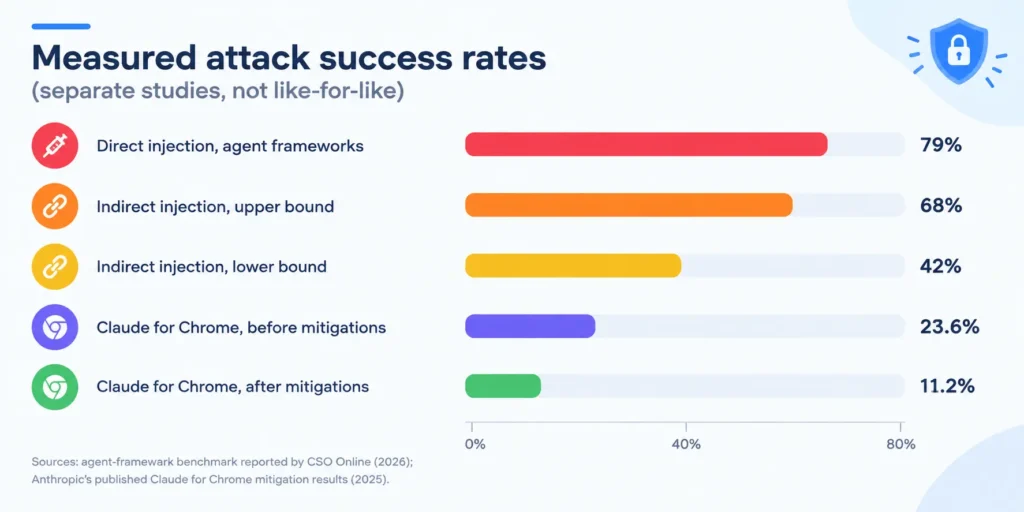
Different benchmarks, different agents, different attempt budgets. The useful read is the range, not the ranking.
A benchmark reported by CSO Online in 2026 ran 3,168 adversarial trials against two open agent frameworks and found indirect injection succeeding between 41.67% and 68.16% of the time, with direct injection above 79% across every tested configuration. Anthropic’s own published work on Claude for Chrome reported mitigations cutting attack success from 23.6% to 11.2%, which is real progress and still more than one attempt in ten.
2. Cross-origin data synthesis
This is the same-origin failure expressed as an attack. The agent reads content in one tab and reproduces or acts on it in another, and because it is the agent moving the data rather than a script, nothing in the browser’s security model objects. Zenity Labs demonstrated the pattern at Black Hat USA 2026 with a vulnerability family it called PleaseFix, showing that a request as ordinary as summarising an email could lead to Gmail data exfiltration and downstream account takeover in connected services.
3. Session and identity inheritance
When an agent runs in an employee’s everyday profile, it holds every live session simultaneously: email, CRM, HR, finance, source control. That inheritance is what converts a single successful injection into a breach. The attacker never needs a password, because the instructions are carried out by something already inside.
4. Excessive agency and irreversible actions
Agents inherit destructive permissions along with read permissions. Deletions, payments, sent messages, granted OAuth scopes, and changed access all execute at the same speed as a harmless summary, and most of them cannot be undone. OWASP’s ASI Top 10 answers this with the principle of least agency: autonomy should be earned per task, not granted by default.
Two practical frameworks are worth adopting here. Simon Willison’s lethal trifecta says an agent becomes an exfiltration tool when it simultaneously has access to private data, exposure to untrusted content, and a way to communicate externally. Meta’s Agents Rule of Two, published in October 2025, turns that into a deployment rule: within a single session, an agent should hold no more than two of those three properties, and if it genuinely needs all three, a human approves the action.
5. AI extensions and the browser supply chain
The extension layer is where most organisations are actually exposed, and it gets far less attention than the headline AI browsers. LayerX’s Enterprise Browser Extension Security Report 2026 found that 99% of enterprise users run at least one extension and about a quarter run more than ten, while roughly 15% have an AI extension installed.
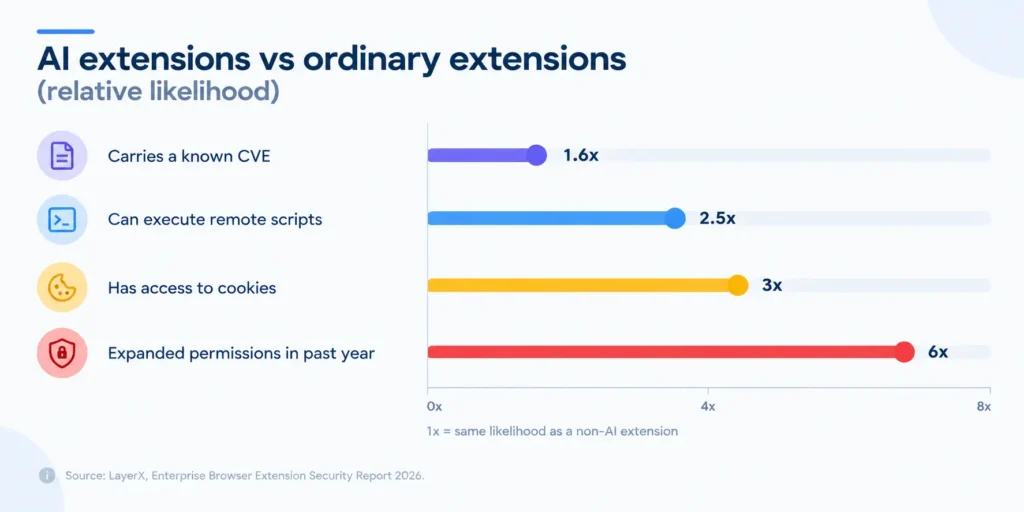
Permission creep is the part teams miss: LayerX reports 34% of all extensions expanded their permissions within twelve months, and AI extensions did so six times more often.
An extension that quietly widens its permissions after approval defeats a one-time review. Allowlists need recertification dates, not just an approval log.
6. Credential, token, and password vault exposure
Agents need OAuth tokens and API keys, and those become the target. A stolen token survives a password reset, often sidesteps MFA, and looks like ordinary automated traffic. The 2026 disclosures pushed this further: Zenity’s Comet research showed a poisoned calendar invite leading to local file access and password-manager workflows, with the user still receiving the benign output they asked for. Perplexity issued a fix in February 2026, but the pattern generalises well beyond one product.
7. Shadow AI and quiet compliance drift
Adoption of browser agents is bottom-up. LayerX’s State of AI Usage Report 2026 found that nearly half of enterprise AI activity runs through personal rather than corporate accounts, and that more than 6% of enterprise AI conversations already contain sensitive data. Traffic through personal accounts bypasses SSO, so it never appears in identity logs, never reaches retention controls, and produces exactly the audit gap that HIPAA’s audit-control requirements and GDPR’s rules on automated decision-making assume does not exist.
Gartner’s position, published in December 2025, was that CISOs should block AI browsers for the foreseeable future until enterprise-ready versions ship. Whether or not you agree with a full block, the underlying point is uncontroversial: the governance layer arrived after the adoption did.
Why DLP, CASB, EDR, and firewalls cannot see any of this
Each control was built for a different actor. The table below is the fastest way to explain the gap to a leadership team.
| Control | What it inspects | Why it misses browser agent activity |
|---|---|---|
| DLP | Network egress and file movement | Data is assembled inside the browser runtime before any egress rule applies |
| CASB | SaaS API boundaries | The agent moves data between tabs at the page level, not through proxied APIs |
| EDR | Process and endpoint behaviour | The browser is a legitimate signed process doing legitimate things |
| Firewall / SWG | Domains and TLS traffic | Standard HTTPS to sites the user is allowed to visit |
| IdP / SSO logs | Authentication events | The agent reuses a session that was already authenticated by a human |
| Enterprise browser | Policy inside the browser | Sees clicks and pages, not the reasoning that produced them |
The one signal that survives is behavioural. Agents differ from humans in velocity, breadth, and timing: dozens of actions per minute, several applications aggregated inside one short window, activity at hours the user does not work. Identity threat detection tuned against a per-user baseline is currently the most viable detection surface, because agents share every other protocol and credential with legitimate users.
How to rank your own exposure before you buy anything
Most of the risk is decided by configuration, before an attacker appears. Score your deployments against these settings, in rough order of impact.
| Configuration choice | Risk | Why |
|---|---|---|
| Agent runs in the employee’s primary profile | Critical | Inherits saved passwords, live sessions, autofill, history |
| Broad OAuth scopes (full mailbox, whole drive) | High | One stolen token exposes everything, not the task’s data |
| Irreversible actions with no confirmation | High | Converts a bad decision into an unrecoverable one |
| Unvetted or auto-updating extensions | High | Shares the browser with the agent and can widen permissions later |
| No per-action logging tied to a human | High | No investigation, no audit defence |
| Personal-account AI access on managed devices | Medium | Invisible to SSO and DLP |
| Read-only agent on public data, isolated profile | Low | Nothing sensitive to inherit |
Then classify each use case into three tiers.
Approve read-only work on public data with standard monitoring.
Restrict work touching non-sensitive corporate data to isolated profiles, scoped credentials, enhanced logging, and quarterly recertification.
Block or gate anything touching regulated data, production systems, or autonomous decisions, until compensating controls exist and have been tested.
How to reduce browser agent security risk without banning the technology
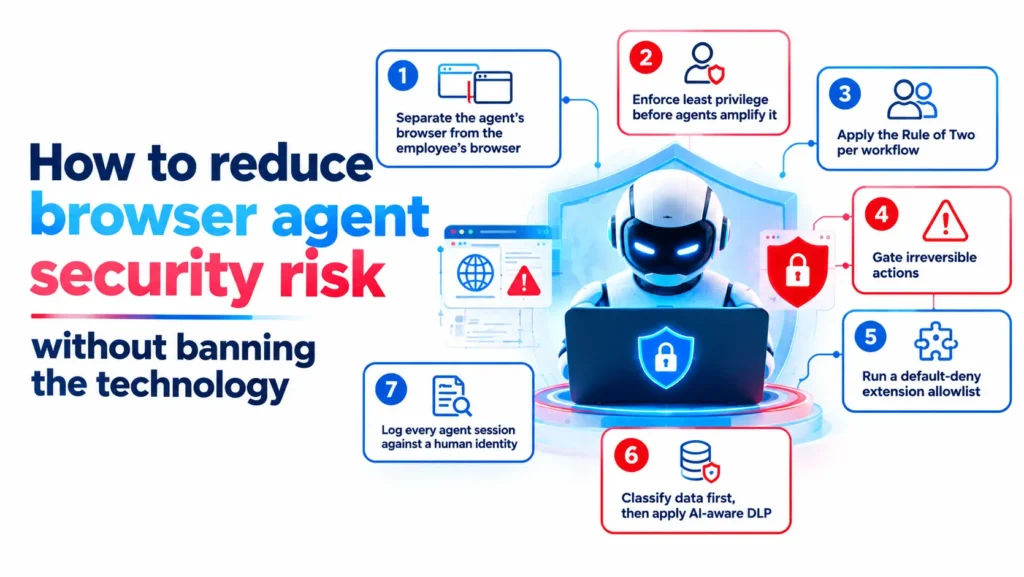
The controls below are ordered by risk removed per unit of effort, and each one costs something in convenience. That trade is worth naming out loud, because it is where these programmes usually stall.
- Separate the agent’s browser from the employee’s browser. Session inheritance multiplies every other risk, so remove it first. A dedicated profile or an ephemeral, containerised session gives the agent only what the task needs. Cost: the agent can no longer lean on saved logins.
- Enforce least privilege before agents amplify it. Agents exercise years of accumulated permission sprawl at machine speed. Replace standing grants with task-scoped credentials and short-lived tokens. Cost: tokens need re-granting.
- Apply the Rule of Two per workflow. If a session mixes untrusted content, sensitive data, and outbound action, insert a human. Cost: some workflows stop being fully autonomous, which is the point.
- Gate irreversible actions. Payments, bulk deletions, outbound messages, OAuth grants, and access changes pause for a person. Everything read-only stays autonomous. Cost: slower tasks, far smaller blast radius.
- Run a default-deny extension allowlist with recertification. Given the permission-creep data, approval must expire. Cost: an ongoing review queue.
- Classify data first, then apply AI-aware DLP. Controls cannot protect what has never been labelled. Differentiate by sensitivity rather than blocking by tool name.
- Log every agent session against a human identity. Record what the agent saw, what it did, which credentials it used, and who initiated the work. Autonomous is not anonymous, and this is what turns an incident into a defensible record.
A browser agent security audit you can run in a week
- Inventory where agents already run. Check for AI browsers, agent extensions, sidebar copilots, and agent frameworks across the fleet. Proxy logs, OAuth authorisation logs, and browser extension inventories are the fastest three sources. Expect to find more than was sanctioned.
- Map what each agent can reach. For every agent, list the authenticated sessions, OAuth grants, API keys, and saved credentials available to it. The gap between reachable and required is your exposure number.
- Test with a benign injection. Put harmless hidden instructions on a page you control, point the agent at it, and see whether they get followed. One afternoon of this tells you more than any vendor datasheet.
- Check attribution. Confirm you can trace any agent action back to the human who requested it. If you cannot, that is the next priority regardless of everything else on this list.
- Read the vendor security documentation and ask the layered-defense question. Do not accept “our model resists prompt injection” as an answer. Ask whether the product ships a content-scanning layer that inspects page content before the model sees it and an action-blocking layer that stops form submissions, credential entry, and file transfers at execution regardless of what the model decided. An attacker should have to beat both.
Repeat quarterly. Agent capabilities change faster than annual review cycles, and a configuration that was safe in March can be a liability by September.
What good looks like for the next 12 months
The research direction is encouraging even though the products are not there yet. The SOPGuard work published on arXiv in June 2026 showed that same-origin enforcement can be extended to agentic browsers with a runtime overhead in the low single digits, which suggests the boundary is recoverable through engineering rather than only through policy. Meanwhile, OWASP’s agentic framework, Meta’s Rule of Two, and vendor features such as Lockdown Mode all point the same way: constrain what the agent is allowed to hold in one session, and stop relying on the model to be un-trickable.
Until that architecture ships by default, containment is the strategy. An agent that reads untrusted content while holding somebody’s credentials is a target, so give it a browser with nothing worth stealing.
Conclusion
Browser agent security risk condenses to one sentence: an autonomous system reading attacker-controlled content while holding a human’s credentials is a target, and the industry has not solved the underlying confusion between instructions and data. The 2026 research record, from the University of Washington’s same-origin findings to Zenity’s zero-click disclosures, makes that concrete rather than speculative.
You cannot train the risk away, but you can contain it. Separate the browsers, scope the credentials, gate the irreversible actions, cap what one session can hold, and log every step against a human. Those five moves shrink the blast radius enough to keep the productivity without accepting the exposure.
Frequently asked questions
Does browser isolation alone stop prompt injection?
No. Isolation shrinks what an attacker can reach, not the chance of a successful injection. A sandboxed agent can still fall for hidden instructions inside its own session. It just has less to steal once it does. Pair isolation with content scanning and action-blocking, not instead of them.
How is agent risk different from a compromised browser extension?
A malicious extension needs its own foothold: a bad update, a fake tool, a permission grant nobody read closely. An agent needs none of that. It reads a normal web page during a normal task and gets redirected mid-task. The extension is a planted threat. The agent is a legitimate feature turned against itself.
What does a failed same-origin bypass attempt look like in logs?
Mostly, it doesn’t look like anything. The agent’s cross-tab action rides on a real session, over standard HTTPS, through a signed browser process. DLP sees normal egress. CASB sees a normal SaaS call. EDR sees a normal process. The only place it shows up is in agent-specific session logs, if you’re capturing what the agent read and where it acted, tab by tab.
Is logged-out mode a real fix or just reduced usefulness?
It’s a trade, not a fix. Logged-out mode removes the credentials an attacker would hijack, so a successful injection has nothing to exfiltrate. But it also strips the agent of the access that made it useful in the first place: email, CRM, saved logins. Treat it as a control for high-risk tasks, not a default setting.
Can prompt injection be fixed?
Not by the model alone, on current evidence. OpenAI has publicly described it as unsolved, and independent testing keeps finding that hardened defenses degrade under repeated attempts. What works is defense in depth: scan content before the model reads it, block dangerous actions at execution, restrict what any single session can hold, and log everything.
What is the single highest-return change?
Stop running agents in the profile that holds the employee’s working life. Every other risk on this page is amplified by session inheritance, and removing it is a configuration change rather than a procurement cycle.