


Table of Contents
AI News April 8 2026 was a huge day for the tech world. Major companies rolled out significant updates all at the same time. These announcements show that tech brands are moving away from simple chatbots. They are building deeply integrated software networks for real business operations. For readers, this marks the end of just asking AI simple questions and the beginning of digital workers managing workflows from the inside out. This shift changes the tools programmers build, how companies scale, and how internet traffic moves data.
This news report covers the day’s main stories. Every fact comes directly from official corporate press releases and trusted news sites. The biggest stories include Meta’s launch of the new Muse Spark model. New data also show that a large amount of automated AI traffic is visiting web pages.
Here is the factual breakdown of the updates driving AI News April 8 2026, top stories and what these changes mean.
Today’s AI Headlines at a Glance
| Company | Key Announcement | Why It Matters |
| Meta | Launched Muse Spark, its first major AI model under Meta Superintelligence Labs | Signals a new direction for Meta’s AI strategy |
| Intel & SambaNova | Announced an AI hardware collaboration | Aims to improve AI performance and lower infrastructure costs |
| UCLA Researchers | Published a deep learning-based medical diagnostics study | Shows AI’s growing role in healthcare research |
| Gartner | Warned of rising AI memory and storage costs | Highlights the financial impact of AI infrastructure growth |
Top Headlines From AI News April 8 2026
Meta Unveils Its First Major AI Model Under Alexander Wang
Meta released a major new private model called Muse Spark. This is the first big project from Meta Superintelligence Labs since the company hired Scale AI founder Alexandr Wang to run its AI team. The tool went live right away inside the Meta AI assistant app and on the official website. It has a built-in shopping tool that looks at social media trends on Instagram, Facebook, and Threads to help users find products.
This launch shows a big change in Meta’s business plan. For years, Meta gave its Llama models away as free code. Muse Spark is completely closed and secret. This setup helps Meta protect its data and make money directly through ads and shopping. While Muse Spark is very good at making images, Meta says it still lags behind other top models at difficult coding tasks.
The launch also shows how quickly competition is changing among leading AI companies. Rather than focusing only on open models, companies are investing in AI systems that support consumer apps, enterprise software, and long-term business growth.
AI Companies Announce New Partnerships and Investments
Hardware brands and cloud networks signed major deals to lower the high cost of running advanced AI software.
Intel and SambaNova announced a joint hardware plan that splits heavy computer work across different chips. Standard graphics cards handle the initial data, SambaNova processors run fast text generation, and Intel Xeon 6 chips manage the main action logic.
This multi-chip setup helps businesses bypass chip shortages. It makes running automated tasks much cheaper and faster. In other news, the data center firm Firmus reached a 5.5 billion valuation as it expands its facilities in Asia. Also, Accenture bought the cloud data firm Keepler to grow its tech services in Europe.
Breakthroughs in AI Research and Development
Academic labs and research groups published breakthroughs in medical tools and robotic reliability.
UCLA researchers published a study in Light: Science & Applications about a portable medical testing tool powered by deep learning. The small reader measures three heart biomarkers on a single paper strip. It matches the accuracy of full laboratory machines by using neural networks to correct sensor errors.
Enterprise AI Adoption and Business Updates
Market research firms published studies showing a major jump in automated internet traffic along with a spike in computer chip costs.
A study by data provider BrightEdge showed that automated AI requests grew fast. They now make up nearly 15 percent of all global web traffic. This data proves that automated bots are increasingly searching the web and buying products for human users.
While this automation reduces office work, it poses a major challenge. BrightEdge found that over 80 percent of business websites block these tools because of old security settings. This keeps companies hidden from the automated helpers that shoppers use.
Gartner reported that strong investment in AI infrastructure and data center expansion is driving significant inflation in memory prices (“memflation”). The firm forecasts DRAM prices to increase by 125% and NAND flash prices by 234% in 2026, with meaningful price relief not expected until late 2027.
Why These AI Developments Matter
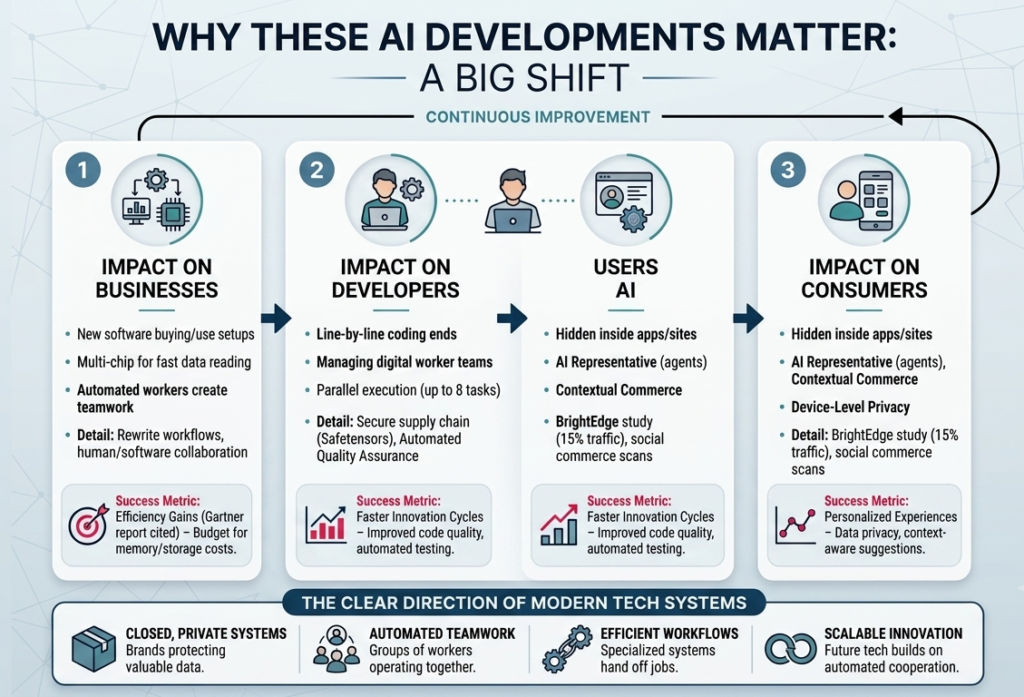
The high volume of AI tech development news on April 8-9, 2026, shows a big shift in the tech world. Companies are moving away from basic tools like simple chatbots. Now, they are building private software networks, better chips, and automated digital workers that run directly inside business systems. These updates change how companies, programmers, and everyday people use digital tools.
Impact on Businesses:
New tech setups change how companies buy and use software. Moving to multi-chip setups helps businesses read large data sets much faster. However, using automated digital workers introduces new challenges in the office. Companies cannot just plug these tools in and expect instant wins. To get real value, bosses must completely change their daily setups. They need to rewrite their workflows so human workers and automated software can work together like real teammates. At the same time, a Gartner report warns that AI infrastructure spending is pushing up the cost of memory and storage chips a cost pressure that’s already reshaping how enterprises budget for adaptive network security rollouts. As more companies expand their data centers to support AI workloads, hardware prices continue to rise. This means IT managers need to plan their budgets carefully to avoid unexpected costs when deploying and scaling AI systems.
Impact on Developers:
New software workspaces completely change the daily job of computer programmers. Software developers are stopping line-by-line coding. They are moving into roles where they manage and direct large teams of digital workers.
Parallel Execution Flows: Rather than writing one file at a time, programmers can now tell groups of up to eight digital workers to build, write, and test separate pieces of code all at the same time.
Securing the Software Supply Chain: The open source community is using a safer file type called Safetensors. This format fixes a major safety flaw. It ensures that when programmers share data or download model files across large networks, bad code cannot hide inside the files.
Automated Quality Assurance: Programmers are connecting software testing tools directly to their workspace. This setup allows digital workers to run tests on their own. The tools can check for bugs and take screenshots to make sure everything looks right before the new code goes live.
Impact on Consumers:
For everyday users, the newest tech is hiding right inside their favorite apps and shopping sites, usually running silently in the background. These AI tech developments news April 7-8 2026 highlight how companies are moving away from basic chatbots toward integrated digital workers.
The AI Representative: A BrightEdgeAI News April 8 2026 web study shows that AI agents now account for nearly 15 percent of total website traffic which is pushing businesses to test their API and search infrastructure against these automated visitors. The report suggests that more people are using AI assistants to search for information, compare products, and make buying decisions online. As AI agents become a bigger part of the customer journey, businesses need to ensure their websites are accessible to these automated systems as well as human visitors.
Contextual Social Commerce: New private models can scan social networks to learn what styles people like. This allows apps like Instagram and Facebook to show highly accurate shopping suggestions directly in users’ chats.
Device-Level Privacy: New compact dictation tools can transcribe voice notes without requiring an internet connection. This lets people use fast typing tools on their phones without uploading private voice files to giant companies’ cloud services.
The Clear Direction of Modern Tech Systems
These big tech updates show us exactly where digital tools are headed. First, the days of tech brands giving away large-scale models for free as public tests are ending. Major tech companies are actively choosing closed, private systems. This choice helps them protect their valuable data and find clear ways to make money through shopping and ads.
Second, the tech world is moving fast toward automated teamwork. Success no longer depends on a human asking a chatbot a single question. The future relies on groups of digital workers operating together. These tools can hand off jobs from one specialized system to another to finish large projects without a human needing to watch every single step.
Conclusion
The structural updates in AI News April 8 2026, prove that technology has evolved far beyond simple chatbots. Succeeding in this new marketplace requires shifting toward private, multi-layered networks in which closed-weight models connect directly to specialized physical infrastructure. Businesses must establish clear governance to manage these parallel systems effectively.
Furthermore, this rapid shift alters the computing and financial demands of daily work. Companies must balance software efficiency with rising hardware memory costs to protect their training data. Staying aligned with these updates ensures that enterprise networks scale safely while keeping human leaders in full control of strategic outcomes.
Read More: AI News Today December 2025 Top Stories You Should Know
FAQs
What happened in AI News April 8 2026?
Tech companies stopped focusing on simple chatbots. They built private software networks and smart digital assistants to handle hard office jobs.
What was Meta’s biggest AI announcement?
Meta came out with Muse Spark, which is its first major private, closed AI model. Meta usually gives its software code away for free, but this new model is a secret. It features smart shopping tools that look at social media trends to help people find products right inside their chats.
Which industries were most affected by the AI announcements on April 8, 2026?
Healthcare, enterprise software, cloud computing, and AI infrastructure saw some of the biggest developments announced on April 8, 2026.
What was the biggest AI trend highlighted on April 8, 2026?
The biggest trend was the shift toward private AI models, specialized hardware, and enterprise-focused AI solutions instead of standalone chatbots.
How did AI announcements on April 7-8 2026 differ from earlier updates?
The April 7-8 2026 announcements marked a clear shift from open-source experiments to closed, enterprise-grade AI systems designed for business operations.
What were the biggest AI tech developments on April 8-9, 2026?
Key developments included Meta’s Muse Spark launch, Intel & SambaNova’s hardware collaboration, UCLA’s medical diagnostics breakthrough, and Gartner’s warning about rising AI infrastructure costs.
Why is AI News April 8 2026 considered a turning point?
Because multiple companies announced major shifts on the same day, signaling the end of simple chatbot tools and the rise of digital workers integrated into enterprise workflows.

