



Looking for the biggest ai news today december 2025? December 2025 changed the AI conversation. Companies stopped asking if AI works. They started asking how well it works, at what cost, and for whom.
This month’s top AI stories cover a big model race. There’s also record funding and new federal rules. Plus, we have major product launches and many security warnings. Here’s what actually happened, with the numbers behind it, and what to do about it. If you want the full picture of what happened in AI this December, this is it.
OpenAI and Google Went Head to Head
This was one of the biggest Google AI news moments of December 2025. Google launched Gemini 3 in November. OpenAI responded quickly, using an internal “code red” push to speed things up.
On December 11, OpenAI released GPT-5.2. The model matched or beat human experts on 70.9% of tasks across 44 professions. It completed that work about 11 times faster than a human expert, at under 1% of the cost. On SWE-Bench Pro, a benchmark for real software engineering, it scored 55.6%. Error rates dropped 30% compared to the previous version.
OpenAI also released GPT-5.2-Codex, built specifically for software engineering. It can handle context windows of up to 400,000 tokens. It also supports over 50 programming languages. It’s designed for large refactors and security analysis, not just quick code snippets.
Google’s response came through Search itself. Gemini 3 Flash became the default model across Search and the Gemini app worldwide. It scored 81.2% on MMMU Pro, a multimodal reasoning benchmark, and 78% on SWE-bench Verified. It runs three times faster than Gemini 2.5 Pro and costs $0.50 per million input tokens. Google now processes more than 1 trillion tokens a day through its API.
What this means for teams evaluating a model:
- Compare published benchmark scores.
- Check per-token cost.
- Look at latency for your specific workload.
Do all this before migrating anything to production.
A model that wins on one benchmark won’t always win on your use case.
Big Product Moves You Shouldn’t Miss
Beyond the model race, December brought some of the biggest consumer and entertainment deals of the year.
Disney invested $1 billion in OpenAI. They signed a three-year licensing deal. This deal allows Sora, OpenAI’s video generation tool, to create videos with over 200 characters from Disney, Marvel, Pixar, and Star Wars. This makes Disney the first major studio to license its characters for AI video generation. Disney accused Google of “massive” copyright theft. They said Google’s AI tools used Disney content without permission. This shows the rising tension between studios and AI companies. They disagree on using copyrighted material for training and creation.
Google announced a 2026 launch for its new smart glasses, this time powered by Gemini AI. Google Glass failed about ten years ago. Now, the company thinks better AI and a sleeker design will help it succeed. This puts Google into direct competition with Meta’s Ray-Ban smart glasses, which already have a head start.
OpenAI also launched a major update to ChatGPT’s image editing features, powered by the new GPT-Image-1.5. It allows for quicker, more accurate edits. This keeps important details in a photo intact. So, creative changes and practical edits are easier to make right in ChatGPT.
Open-Source Models Started Beating Paid Ones
This might be the most disruptive shift of the month. Open-source models began to match and even outperform proprietary systems on real benchmarks.
DeepSeek V3.2 scored 93.1% on AIME 2025, a serious math reasoning test, the same level as GPT-5. A higher-compute version, V3.2-Speciale, scored 96.0% on the same test and 99.2% on HMMT. That variant also earned gold-medal scores on the IMO, IOI, ICPC World Finals, and CMO exams. This was without any training specific to those competitions.
Mistral launched Mistral Large 3. This model has 675 billion parameters and 41 billion active ones. It was trained on 3,000 NVIDIA H200 GPUs. It’s shipped under the Apache 2.0 license. This means businesses can use it commercially without restrictions.
Alibaba’s Qwen3-Coder captured 20.7% of code generation API traffic within weeks of release. Over the same period, Claude’s share in that market dropped from 46.3% to 32.3%. The Qwen2.5 family became the most downloaded model series on Hugging Face by the end of 2025.
Apple Bet on Local Processing, Not the Cloud
Here’s the biggest Apple AI news for December 2025. Apple took a different path. While many companies focused on cloud infrastructure, Apple invested elsewhere.
macOS Tahoe 26.2, released in December, added RDMA support over Thunderbolt 5. This lets one Mac access another’s memory directly. It doesn’t need to go through the CPU. Developers connected four Mac Studios. This gave them 1.5 terabytes of shared memory. The connections ran at 80Gbps. The setup cost about $40,000. It ran models with up to 1 trillion parameters. Plus, it used under 500 watts, while a similar Nvidia setup needed nearly 960 watts.
This matters for anyone concerned about sending data to remote servers. Apple targets privacy-focused users and small teams. They offer strong AI capabilities without relying on the cloud.
Data Centers and Power Became the Real Bottleneck
Global data center dealmaking hit $61 billion in 2025, already ahead of 2024’s total after just eleven months. The US led the volume, with Asia-Pacific close behind, and private equity funded much of it.
Alphabet acquired Intersect Power for $4.75 billion. This is the first time a major tech company has directly bought a renewable energy developer. Intersect manages $15 billion in energy assets. This includes 2.2 GW of solar and 2.4 GWh of battery storage. They expect to add 10.8 GW more by 2028.
The reason for this spending spree is simple: power is running out. Data centers already use 4.4% of total US electricity, and that could hit 12% by 2028. Some places, such as Northern Virginia, now have to wait seven years for new electricity access. Speed-to-power has become as important as speed-to-market.
The US Introduced Its First Major AI Policy Framework
On December 11, the Trump administration signed an executive order. This order created a national AI policy framework. It’s the most significant federal move since the Biden-era order. The order directed the Attorney General to set up an AI Litigation Task Force within 30 days, aimed at challenging conflicting state AI laws. In 2025, over 1,000 AI-related bills were introduced in US states. The administration said this patchwork was hurting US competitiveness.
Government adoption sped up too. OpenAI landed a $200 million contract with the Pentagon that lasts until July 2026. Also, federal agencies can access ChatGPT Enterprise for just $1 a year via a GSA deal. Anthropic teamed up with US and UK AI safety institutes to test its models. This included government red-teamers checking Claude’s safety systems before deployment.
Real usage numbers back this up. In the first year of its AI program, the Department of Veterans Affairs processed over 400 million documents, or roughly 10 billion pages. It now handles 8 to 10 million pages a day. Federal AI contracts reached $38.3 billion in fiscal year 2025. A new rule starts on December 29. Any contractor working with the government must show data provenance and continuous monitoring. If they don’t, they could be cut from federal deals.
Regulatory obligations at a glance
This section covers the most important US and EU AI regulation news for December 2025.
| Level | Primary focus | Typical requirement | Real example from December |
| Federal | National security, systemic risk | Risk assessments, safety-test documentation, public reporting | New Dec 29 rule requiring contractors to prove data provenance and continuous monitoring |
| State | Consumer privacy, local rights | Consent notices, disclosure rules, data-handling limits | Over 1,000 state AI bills introduced in 2025, now facing a federal challenge |
| Industry | Ethical standards, operational integrity | Third-party audits, vendor due diligence, sector certifications | GSA’s $1-a-year ChatGPT Enterprise deal needs agencies to meet their AI maturity standards. |
A starting compliance checklist
If your company builds or deploys AI systems that touch US users, this is a reasonable place to start:
- Inventory your models: list what’s in production and pre-production, and tag each by data sensitivity and user impact.
- Run a risk assessment on anything that could plausibly meet federal or state thresholds, and document known limitations.
- Assign a compliance owner internally, and prepare basic incident-response and disclosure templates. Without this ownership piece, most AI governance efforts stall before they start.
- Review vendor contracts to confirm they cover reporting obligations tied to new rules.
None of this replaces legal advice. Think of this as a starting checklist, not a full guarantee. Talk to a qualified regulatory counsel for anything related to your obligations.
The EU Kept Its AI Act Enforcement Moving
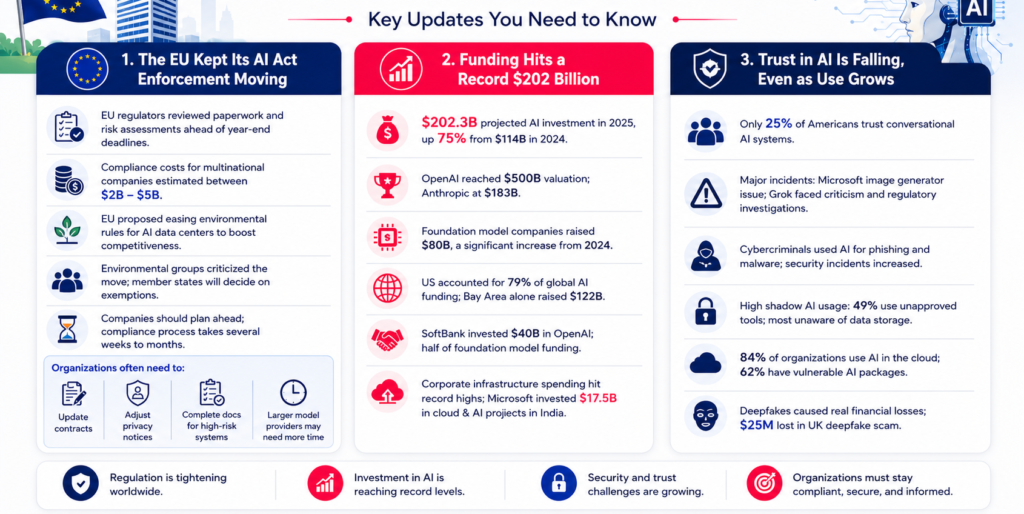
Here’s the latest EU AI Act news for December 2025.
Europe’s AI Act enforcement stayed active in December. Regulators checked paperwork and reviewed risk assessments before the year-end deadlines. Compliance costs from the Act will likely be between $2 billion and $5 billion for multinational companies. The European Commission suggested easing environmental rules for AI data centers. This is meant to increase competitiveness. However, environmental groups criticized the move. They are concerned that it weakens protections. After the debate, each member state will choose whether to use these environmental exemptions.
Companies selling in the EU should plan for this process. It usually takes several weeks to a few months.
Organizations often need to:
- Update contracts
- Adjust privacy notices
- Complete documentation for high-risk systems
Larger model providers may need more time to comply.
Funding Hits a Record $202 Billion
Investors are projected to put $202.3 billion into AI in 2025, a 75% jump from $114 billion in 2024. AI captured close to half of all global tech funding, up from 34% the year before.
OpenAI reached a $500 billion valuation, the highest ever for a private company. Anthropic followed at $183 billion. Together, these two companies represent about 10% of all unicorn value worldwide. Foundation model companies alone raised $80 billion, a significant increase from their 2024 total.
The US accounted for 79% of global AI funding, with the Bay Area alone raising $122 billion. SoftBank topped this year’s funding by investing $40 billion in OpenAI. This investment makes up half of all the money raised by foundation model firms. Corporate infrastructure spending reached new heights, even as venture deals made headlines. For example, Microsoft announced a record $17.5 billion investment in cloud and AI projects in India.
Trust in AI Is Falling, Even as Use Grows
Some of the month’s biggest microsoft ai news today december 2025 stories came from trust and safety issues. Approximately 25% of Americans say they trust conversational AI systems. This figure is significant, given how fast adoption is moving elsewhere.
Some of that distrust has real causes. Microsoft paused its image generator. It created misleading historical and political content. This decision caused a loss of billions in market value. xAI secured $20 billion in new funding. Grok, its chatbot, faced criticism for allowing users to generate sexualized images of women and minors. This led to investigations by UK and EU regulators.
Security incidents grew. A Brazilian cybercrime group used large language models. They automated phishing campaigns and translated malware scripts. Almost half of workers use AI tools that their employers haven’t approved. Most of them are unaware of how their data is stored. Eighty-four percent of organizations use AI tools in the cloud. Also, 62% have at least one vulnerable AI package. Researchers found malware in AI models on Hugging Face. It exploits a known weakness in the Pickle file format used by PyTorch. This is the kind of exposure that adaptive, zero-trust network security models are designed to catch before it spreads.
Deepfakes have caused direct financial damage. The UK engineering firm Arup lost $25 million after criminals used deepfake video of senior executives on a fake call. Ferrari avoided a similar scam because an employee asked a security question only the real CEO could answer.
The Human Side of the AI Shift
Not every reaction to AI this month was about products or policy. In the UK, more young workers are moving from traditional office jobs to skilled trades. They are choosing careers in plumbing and construction. Many think that hands-on, physical work is harder for AI to replace than desk jobs. Colleges are already reporting rising enrollment in trade programs as a result. It’s a small but clear sign. Public fear about AI jobs is now shaping real career choices, not just making headlines.
What’s Next: Agentic AI and Quantum Computing
Two trends are quietly setting up the next phase of the AI story.
Agentic AI refers to AI systems that can plan and take multi-step actions. They also use memory to do tasks with less human help. This trend is changing the industry’s focus. It is moving from basic chatbots to AI that can operate on its own.
Quantum computing is entering the conversation too. IBM believes that in 2026, a quantum computer may finally surpass classical systems. This might happen in real-world tasks. Big advances could follow in drug development, materials science, and financial optimization. The two fields are starting to merge. Tools like Qiskit Code Assistant help generate quantum computing code with AI support.
What This Means Going Into 2026
December showed a clear shift in the AI industry. It moved from proving what AI can do to proving its value. Now, the focus is on its cost, safety, and fairness for those affected.
Efficiency is the new competitive battleground. Raw compute scaling is reaching its limits. Edge AI is shifting from a niche concept to a practical choice. This means models now run locally, not just in large data centers. More countries want AI sovereignty. They are either creating their own models or using foreign models on local systems. This way, data stays within their borders.
A simple action plan for the next 90 days
- First 30 days: Audit the AI models or tools your team uses. Include those adopted informally by staff. Flag anything handling sensitive data.
- Next 30 days: If you’re a developer or in a product team, test on-device or regional processing. This applies to any feature that handles personal data. It helps reduce exposure to cross-border data rules.
- In the final 30 days, if you’re checking new hardware or model vendors, compare their claims to your workload. Don’t just trust vendor numbers. Also, include power and cooling costs in your infrastructure decisions.
FAQs
What was the biggest AI product launch in December 2025?
GPT-5.2, released December 11, was the most significant model launch. It matched or beat human experts on 70.9% of tasks across 44 professions and worked roughly 11 times faster at under 1% of the cost. Disney’s $1 billion Sora licensing deal was the biggest entertainment-industry AI story of the month.
Are open-source AI models actually competitive with paid models now?
Yes, on several key benchmarks. Open-source models often match the performance of top proprietary systems in coding and logic tests. Mistral’s Large 3 model has 675 billion parameters and is available under the Apache 2.0 license.
What changed in US AI regulation this month?
In 2025, more than 1,000 AI bills have been introduced in various states. To manage these conflicting local laws, President Trump signed an executive order on December 11 that established a national AI policy framework and a dedicated task force.
How much money went into AI in 2025?
Investors spent $202.3 billion globally, a 75% increase over 2024. OpenAI reached a $500 billion valuation, and Anthropic reached $183 billion, together representing about 10% of all unicorn value worldwide.
What are the biggest AI security risks right now?
The biggest risks include unauthorized employee use of AI tools, malware hidden in AI models on platforms like Hugging Face, and deepfake-based fraud, such as a $25 million loss at a UK engineering firm from an AI-generated video scam.
What is agentic AI, and why does it matter?
Agentic AI refers to systems that can plan and carry out multi-step tasks on their own, rather than just responding to single prompts. In 2026, a key AI trend will emerge. Companies will shift from AI that just answers questions to systems that can work on their own.
Will quantum computing affect AI development?
IBM predicts that 2026 might be the first year a quantum computer beats classical systems in solving real-world problems. AI tools are now helping to write quantum computing code. The two fields are already coming together.
What should a company do first if it hasn’t started AI compliance work yet?
Start with a basic inventory: list every AI model or tool in use, tag each by data sensitivity, and assign someone internally to own compliance tracking. This alone puts most companies ahead of where they were at the start of December.

