

Table of Contents
I’ve watched three device cycles come and go: the smartphone boom, the wearables wave, and now this. What’s different this time is the money. Meta, Apple, Google, and Neuralink are collectively pouring tens of billions into technology built to make your phone feel optional. AR glasses that overlay directions onto your actual vision. Brain interfaces that translate thought into text. Ambient AI that acts before you ask.
Smartphones have run the show for over a decade. That run is showing real cracks, and it’s exactly why tech giants envision future beyond smartphones as the next real computing platform. This piece looks at why, what’s actually replacing the phone, and what still stands in the way.
Why Smartphones Are Starting to Feel Outdated
The smartphone market has hit a wall. Years of fast progress have slowed to a crawl, and a lot of people in the industry are asking whether we’ve already hit peak smartphone. It’s a big part of why tech giants envision future beyond smartphones instead of pouring more money into the same form factor.
Slowing innovation in hardware
Global smartphone shipments dropped 4% in 2023, the fourth straight year of decline. Nearly five billion people already own one, which is over half the world’s population. There just aren’t many new buyers left.
Design has hit a ceiling too. Manufacturers have squeezed screens for size and slimness until there’s barely room left to innovate. Counterpoint Research’s 2023 survey backs this up: 58% of respondents said new phone designs feel unoriginal and unexciting. Screens can’t grow much without hurting portability. Touch interfaces still can’t deliver real haptic feedback. Voice recognition still stumbles in noisy rooms.
Upgrade fatigue is real
People are holding onto phones longer. The average upgrade cycle stretched from 24 months in 2016 to 31 months in 2023. A 2023 Deloitte survey found 64% of users think recent phone models offer only minor upgrades, not real change.
Consumers care less about AI than manufacturers assume. A CNET survey found only 11% of US smartphone owners upgrade specifically for AI features, down 7 points from the year before. What actually drives purchases: price (62%), battery life (54%), and storage (39%). AI marketing hasn’t cracked the buying decision yet.
The AI-to-interface mismatch
Here’s the real friction point. AI assistants have gotten dramatically smarter since the early Siri era, but they’re still stuck behind small touchscreens. Trying to run a genuinely capable AI system through a phone screen is a bit like having a conversation through a keyhole. It technically works. It’s not how the technology wants to be used.
The direction is clear enough: fewer apps, fewer menus, more AI just handling things. Setting plans with friends. Writing shopping lists. Taking meeting notes, without anyone typing a word. The bottleneck isn’t the AI anymore. It’s the interface built around a decade-old form factor.
The Rise of AI-First Devices
Tech giants see the future beyond smartphones here. They envision AI-first devices that integrate intelligence directly into the hardware. This isn’t just an add-on; it’s the main design principle.
What makes a device AI-native
AI-native devices handle intelligence right on the device. They don’t rely fully on a distant server. An AI-native camera app sees what’s in a photo right away. There’s no setup required. Retrofitted AI, by comparison, usually needs manual configuration to do the same job.
These devices interpret context, environment, and intent to feel more natural in use. Processing locally, at the edge, cuts both lag and privacy exposure. Chipmakers like Qualcomm are now shipping tiny processors that fit in eyeglass frames. Telecoms are also adding AI to hardware from the start, not as an afterthought. IDC projects that this shift alone could push global smart glasses shipments past 80 million units a year by the end of the decade.
AI assistants are already replacing apps
This shift is measurable, not theoretical. About one in three consumers who used AI tools have switched from at least one app to an assistant like ChatGPT. They say it’s faster and more convenient. An even larger share expect to rely on AI assistants more than apps within a year.
OpenAI now lets third-party services connect directly to ChatGPT. So, you can book travel on Expedia, create a Spotify playlist, or check Zillow listings all in one chat. Deutsche Telekom’s AI Phone lets users activate Perplexity with one button. They can book dinner or translate speech instantly, no apps needed.
The assistant isn’t just a shortcut to the app anymore. Increasingly, it’s replacing the need for the app entirely. This is putting real pressure on how developers think about cross-platform app development itself, since the “next” interface may not be an app at all.
Voice and gesture as new inputs
In 2023, about 4.2 billion devices worldwide had voice assistants. By 2024, that number is expected to reach around 8.4 billion. In France, an estimated 36% of people use a voice assistant daily.
Gesture control is gaining momentum. Apple Vision Pro utilizes hand and eye tracking. BMW’s Gesture Control lets drivers adjust settings without touching a button. The strongest devices now combine these movements with voice to handle complex tasks. Samsung’s Galaxy line uses Google’s Gemini assistant. With it, you can search for flights, compile results, and even draft an email, all from one spoken request.
Key Technologies Making Smartphones Optional
Wearables: rings, pendants, and smartwatches
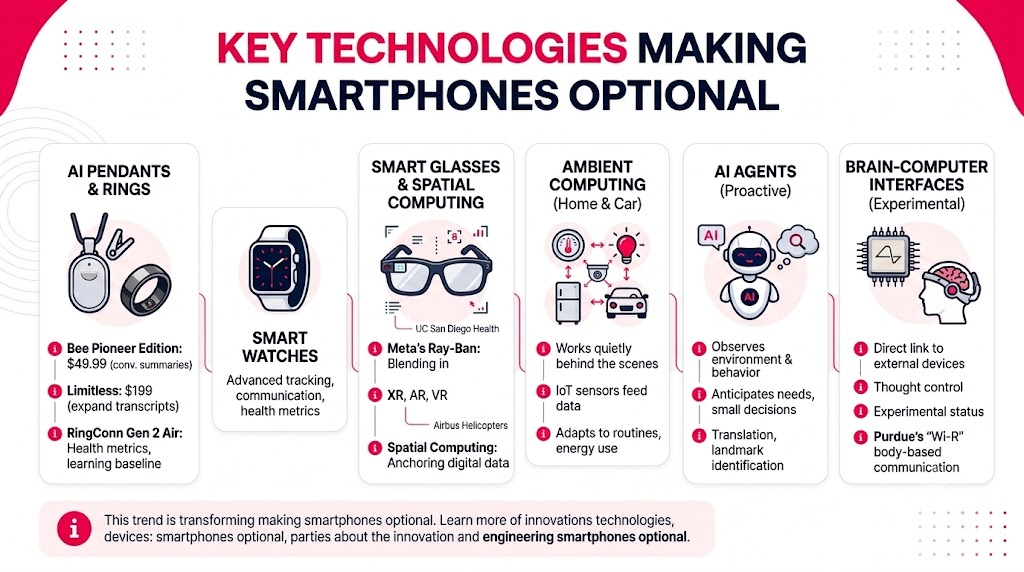
AI pendants have moved well past novelty status:
- Bee Pioneer Edition: $49.99, clip-on, captures conversations and builds daily summaries with no subscription fee
- Plaud NotePin: HIPAA-compliant recording aimed at professionals, with transcription and mind-map generation
- Limitless Pendant: $199, featuring nested bullet-point summaries and expanding transcripts, with optional subscription tiers
- Omi: $89, open app ecosystem built around conversation analysis
Smart rings like the RingConn Gen 2 track health metrics while learning a wearer’s personal baseline over time.
Smart glasses and spatial computing
Smart glasses were one of the standout categories at CES 2025, with ZDNet alone reviewing eight separate models. This product line is part of XR, or extended reality, which includes AR, VR, and mixed reality devices. Meta’s Ray-Ban smart glasses reached two million sales by February 2025. This shows that people prefer tech that blends in, not stands out.
The bigger shift is spatial computing: anchoring digital information to physical locations. Surgeons at UC San Diego Health use this to view patient data mid-procedure without looking away. Airbus Helicopters uses Vuzix glasses for hands-free scanning on the factory floor.
Ambient computing at home and in the car
Ambient computing works quietly behind the scenes. It learns your habits and makes small decisions on its own. It leans heavily on IoT, a network of sensors and devices that feeds it data. Thermostats, refrigerators, and lighting systems are now linked. They adapt to your routines and reduce energy use with little help from you.
AI agents that anticipate needs
Wearable AI agents are shifting from reactive to proactive. They don’t wait for a command. Instead, they observe behavior and the environment to make small decisions. For example, they can translate a street sign or identify a landmark on their own.
Brain-computer interfaces, still early
Brain-computer interfaces (BCIs) create a direct link between brain activity and external devices. Neuralink and other companies are creating chips that let users control devices with their thoughts. However, this technology is still experimental. Non-invasive methods are being studied. Purdue University’s “Wi-R” research looks at how devices can communicate through the body. Both approaches are far from mainstream, but their development marks a significant trend.
How AI Devices Are Already Changing Daily Life
Work
AI meeting tools, such as Fireflies, automatically transcribe and summarize discussions. They also connect easily with Slack and Salesforce. Gong says that users with AI sales coaches engage 18% more. Plus, conversation length doubles. Microsoft’s 365 Copilot boosts productivity. It connects context across emails, files, and chats. This means it pulls relevant info in seconds, so you don’t have to search through long documents manually.
Health
Healthify, India’s biggest health platform, helps over 40 million users. Together, they’ve lost more than 25 million pounds with AI-driven coaching. A Stanford University study showed that using AI coaching with a human coach led to 70% more weight loss per user than using AI alone. This suggests that combining both methods may work better than just automation.
Communication
Telefónica, Ericsson, and MATSUKO have shown that holographic calls can work on regular smartphones. They use IMS Data Channel technology to send a caller’s face and torso as a live hologram. This move to immersive interaction matches the growing trend of voice-first communication. Voice assistants are becoming more popular in markets worldwide.
Learning
AI, along with AR and VR, is personalizing education. It adjusts difficulty and pacing in real time. This change is based on how students perform, not on a set curriculum.
Entertainment
AI is reshaping personalization in entertainment too. Natural language processing (NLP) helps AI characters and voice interactions in games and apps feel more natural. It makes conversations seem less scripted and more real. More than 70% of consumers want personalized recommendations. Streaming platforms that offer this deeper personalization have boosted sales by about 30%. They consider factors like time of day, weather, and viewing history.
The Real Barriers Slowing This Down
This transition is not a smooth path. Several significant obstacles keep smartphones dominant even as the alternatives mature.
Always-on devices raise significant privacy concerns. About 41% of users fear being recorded without their consent. This worry was proven true in 2020 when Amazon mistakenly shared Alexa recordings with the wrong people. When geolocation data is included, security risks increase significantly. This is exactly the kind of gap AI governance policy is still catching up to.
Battery life still doesn’t work. AI processing is power-hungry, forcing a tradeoff between using AI features and getting through the day. Apple’s Vision Pro runs for about two hours per charge. Lithium-ion capacity has only improved roughly 5% a year for the past decade, nowhere near fast enough to catch up with AI’s power demands.
Social acceptance is still shaky. For wearable AI to go mainstream, it has to look and feel normal, not like a gadget. Technical glitches and reduced face-to-face interaction remain real sticking points for a lot of people. There’s also a broader digital wellbeing backlash working against adoption. A growing share of users are actively trying to cut screen time, not add another always-on device to their day.
App ecosystems don’t talk to each other yet. On-device redaction and anonymization are needed to keep sensitive data safe, and building that securely across fragmented platforms is genuinely hard. Ecosystem lock-in makes this worse. Apple, Meta, and Google want their hardware, software, and AI to work well together. This focus slows down efforts for a true cross-platform standard.
Cost keeps this out of reach for most people. Device accuracy and reliability concerns compound with price. Higher-income users adopt wearables more often. This raises questions about who benefits first.
What to Realistically Expect by 2027
Probable:
- Wearable AI in rings, earbuds, and watches that augment phones rather than replace them
- Continued enterprise adoption of AR in manufacturing, healthcare, and logistics, where the ROI is already proven
- Ambient AI in homes and cars becoming more predictive with less manual setup
- Smart glasses reaching a wider audience as prices come down and designs normalize
Possible:
- Meaningful battery breakthroughs through solid-state or hybrid power systems
- Early regulatory frameworks for BCIs and always-on recording devices
- A visible consumer pushback that forces companies to build genuine offline, privacy-first modes
Unlikely by 2027:
- Smartphones disappearing outright: they’ll coexist with new devices for years
- Mass consumer adoption of brain implants outside medical use cases
- Full resolution of the privacy concerns tied to always-on AI
Conclusion
The smartphone isn’t dying overnight, but its grip is loosening. This is exactly why tech giants envision future beyond smartphones: AI-native wearables, smart glasses, and ambient computing aren’t just extra features bolted onto old devices. They offer a new way to interact with technology. This approach focuses on anticipation, not just taps and swipes.
The obstacles are real: privacy, battery life, cost, and a public that remains skeptical. But the direction is set. Phones will remain important for complex tasks. Meanwhile, wearable tech will handle small, everyday interactions that once needed a screen. The real test isn’t whether the technology works. It’s about earning enough trust to replace habits formed over a decade of smartphones.
FAQs
Why do tech giants envision future beyond smartphones instead of just improving phones?
The smartphone business model is slowing down. Upgrade cycles are getting longer. Hardware innovation has slowed down. AI functions better as an ambient layer rather than an app on a small screen. Betting on new form factors is how tech giants compete for the next computing platform.
Will smartphones actually disappear?
They will not disappear anytime soon, but you should expect a gradual unbundling instead. Cameras are shifting to glasses, health tracking is going to rings, and AI is becoming part of ambient systems. Phones will still be here for complex tasks for years to come.
What’s actually replacing the smartphone right now?
Nothing fully replaces the smartphone yet. AI pendants, smart glasses, and wearable AI are enhancing phones today. They manage small, specific tasks instead of taking over completely.
Are AI-first devices actually better than smartphones?
For narrow tasks like note-taking, translation, or hands-free navigation, the answer is often yes. For complex work like editing documents or web browsing, smartphones remain superior. It’s a tradeoff, not a clean upgrade.
What’s the biggest barrier to AI wearables going mainstream?
The biggest barriers are battery life and privacy, in that order. Devices that run out of power in a few hours or raise “surveillance” worries have a hard time gaining everyday trust.
Is it worth buying an AI pendant or smart glasses right now?
If a specific task, like meeting notes or hands-free translation, genuinely fits your routine, the cheaper devices ($49 to $199) are low-risk. Wait on the premium AR headsets until battery life and pricing improve.
Will AI assistants fully replace apps?
The transition isn’t complete, but the trend is real. Close to a third of AI users have already replaced at least one app with an AI assistant, and that number is climbing.
What’s the biggest signal that tech giants envision future beyond smartphones as inevitable?
The spending. Billions are invested each year in AR, wearables, and ambient AI research. This spending only makes sense if companies believe smartphones won’t always be the main device.

