


Table of Contents
Seeing a competitor above your website on Google can be frustrating, especially when you believe your page has better content.
But rankings are not based on one factor. A competitor may be ahead because its page matches the search intent better, covers the topic more fully, has stronger relevant links, or has fewer technical problems.
Google says its ranking systems use many signals and can evaluate pages at the page level while also using some site-wide signals. So having a strong website does not mean every page will rank above every competitor. Google’s guide to Search ranking systems explains how these systems work.
If you are asking why is my competitor ranking higher than me, the answer is usually found by comparing the two ranking pages, not by looking at your website alone.
What Is a Good SEO Ranking?
A good SEO ranking depends on your goal and the query.
For a valuable commercial keyword, appearing on page one can be meaningful. For another query, a position near the top may still produce little traffic if search demand is low or the SERP contains many other features.
Instead of focusing only on position, track:
- Organic clicks
- Impressions
- Click-through rate
- Conversions
- Relevant keyword positions
- Search visibility
- SERP features
- Revenue or leads from organic search
Position one is not automatically a successful SEO outcome.
A page ranking fifth for a high-value query may be more useful to your business than a page ranking first for a low-value query.
Why Is My Competitor Ranking Higher Than Me?
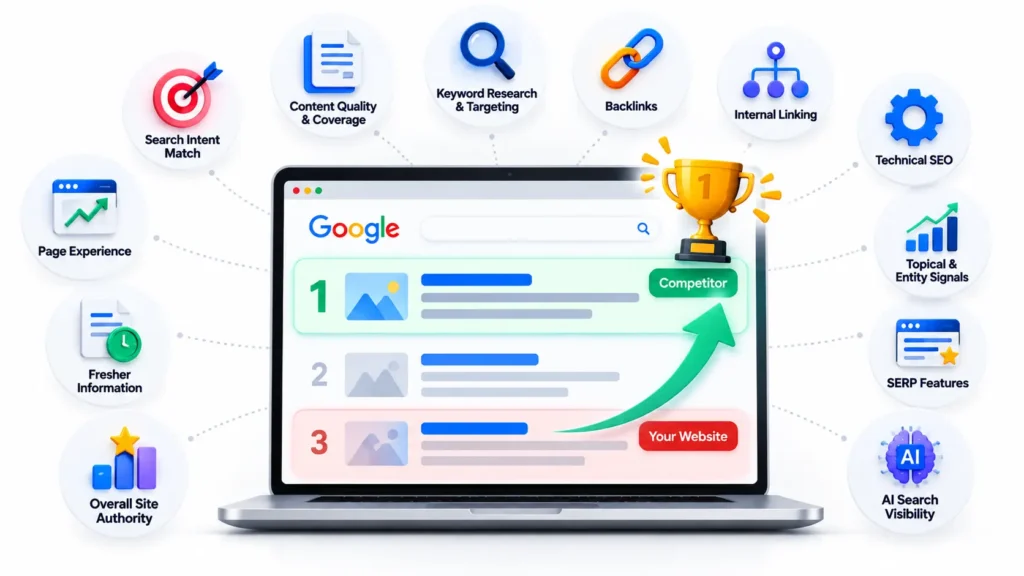
Your competitor may have an advantage in one or more areas:
- Better search intent match
- More complete content quality and topic coverage
- Stronger keyword research and on-page targeting
- More relevant backlinks
- Stronger internal linking
- Better technical SEO
- Better page experience
- Fresher information
- Stronger topical and entity signals
- Better visibility in SERP features
- Better overall site authority for the topic
- Greater visibility across modern AI search experiences
The important part is finding which gap actually exists.
Do not assume that the competitor with more backlinks is automatically better. Do not assume that a longer article will win either. Your goal is to find the specific advantage that helps the competing page satisfy the search better.
12 Reasons Your Competitor May Be Ranking Above You
- Their Page Matches Search Intent Better
One of the first things to check is search intent optimization.
Search intent is what the searcher expects to find after entering a query. Two pages can target the same keyword but satisfy the search in very different ways.
For example, someone searching for:
“best project management software for small businesses”
may expect a comparison with features, pricing, pros and cons, and recommendations.
A page that only defines project management software may contain the keyword but still fail to satisfy the same need.
When asking why does my competitor rank higher, compare:
- Content type
- Main purpose of the page
- Questions answered
- Format used
- Depth required by the query
- Commercial or informational intent
Look at the current search engine results page before changing your content. If most ranking pages are comparison guides, tutorials, product pages, or local landing pages, that is useful evidence about the intent Google is serving.
- Their Content Covers the Topic More Completely
Your competitor may not have better writing. It may simply answer more of the important questions behind the query.
This is where content gap analysis becomes useful.
A keyword gap asks:
What keywords does my competitor rank for that I do not?
A content gap asks:
What useful information does my competitor provide that my page does not?
These are not the same thing.
For example, an article about page speed may cover the basic definition but skip:
- How to test page speed
- Core Web Vitals
- Mobile performance
- Common causes of slow pages
- Image optimization
- Server response time
- Practical fixes
Adding every missing keyword would not solve the problem. Instead, identify the missing topics that genuinely help the reader.
Google’s guidance on creating helpful, reliable, people-first content encourages original, substantial, complete information that serves the reader rather than content created mainly to manipulate rankings.
- They Have Stronger Topical Authority
A single article rarely stands alone.
Your competitor may have a group of related pages that support the topic. These pages can be connected through internal linking and a clear site structure.
Imagine two websites competing for the same keyword.
Website A has one article about technical SEO.
Website B has related pages about:
- Technical SEO audits
- Crawlability
- Indexing
- Canonical tags
- Site architecture
- Internal links
- Core Web Vitals
Website B has built much broader topical coverage.
This does not mean publishing dozens of weak articles will automatically increase rankings. The supporting content must be useful and relevant.
Google says its systems understand pages through many signals, including how pages link to each other and how relevant pages relate to queries. Its documentation on links and crawlable pages explains the role links play in discovery and understanding.
- They Target More Relevant Keywords and Search Variations
Another reason why do my competitors rank higher than me on Google may be stronger keyword targeting.
Your competitor may rank for the primary query plus several related searches.
Look for:
- Primary keywords
- Long-tail keywords
- Related questions
- Search variations
- Important entities
- Subtopics
- Problem-specific queries
But avoid turning this into keyword stuffing.
For example, if your target keyword is “technical SEO audit,” you might naturally cover related concepts such as crawlability, indexing issues, internal linking, canonical tags, and site architecture.
The goal is not to mention every variation. The goal is to make the page useful for the complete search need.
- Their Page Has Stronger Backlinks and Referring Domains
Backlinks are another area where your competitor may have a clear advantage.
But comparing the total number of backlinks is not enough.
A better backlink comparison looks at:
- Links to the exact ranking page
- Relevant referring domains
- Quality of linking websites
- Context of each link
- Anchor text
- Links to supporting pages
- Recently gained links
- Links your competitor has that you could realistically earn
Google’s ranking-system documentation confirms that its systems include link analysis and PageRank, which uses links to help understand pages and their relationships.
This is why a page with 20 highly relevant referring domains may have a different competitive position from a page with hundreds of weak or unrelated links.
Tools such as Ahrefs can help with competitor backlink research, while SEMrush and Moz provide their own competitive SEO data.
- Their Internal Linking Is Stronger
External links are only part of the picture.
Your competitor may have a better internal linking structure that connects the ranking page with other relevant pages on the site.
Check whether the competing page receives links from:
- High-value pages
- Related articles
- Topic hubs
- Category pages
- Relevant product or service pages
Also check the anchor text.
A page that is buried deep in your website with almost no contextual links may be harder for both users and search engines to understand than a page supported by a strong topic cluster.
Google’s documentation says links help Google discover pages and understand what linked pages are about, which makes internal linking an important part of site structure.
- Your Page Has Technical SEO Problems
Sometimes the content is good, but the page has technical problems.
A focused technical SEO audit should check:
- Crawlability
- Indexing issues
- Canonical tags
- Duplicate URLs
- Mobile rendering
- HTTPS
- JavaScript rendering
- Site architecture
- Internal links
- Structured data
You can use Google Search Console to check indexing and search performance, while tools such as Screaming Frog can help identify technical issues at scale.
Do not assume every technical issue causes a ranking loss. First find problems that affect crawling, indexing, accessibility, or the page experience.
Google’s own SEO documentation recommends making pages accessible to search engines and users and provides guidance on crawling, indexing, links, and page experience.
- Their Page Provides a Better User Experience
A page can have strong content and still be difficult to use.
Compare your page with the competitor’s page on:
- Mobile readability
- Navigation
- Content structure
- Page speed
- Intrusive elements
- Visual stability
- Ease of finding answers
Page speed matters, but it should not become the entire SEO strategy.
Google says Core Web Vitals are used by its ranking systems, but good Core Web Vitals scores do not guarantee top rankings. Google also recommends looking at page experience as a whole rather than focusing on one metric.
The current Core Web Vitals include:
- Largest Contentful Paint
- Interaction to Next Paint
- Cumulative Layout Shift
Use Google’s Core Web Vitals documentation to understand the current metrics and recommended thresholds.
- Their Content Is Fresher and Better Maintained
Freshness can matter when the query needs current information.
Compare your page with the competitor for:
- Publication date
- Meaningful update date
- Current statistics
- Current examples
- Broken links
- Outdated screenshots
- Old product information
- Changes in the industry
- New questions users now ask
Do not update an article just to change its date.
Google’s ranking systems include freshness systems for queries where users are expected to want recent information.
A useful update should improve the information itself.
- Their Site Shows Stronger Expertise and Trust Signals
Another possible competitor SEO advantage is stronger evidence of expertise and trust.
This can include:
- Clear authorship
- Relevant author experience
- First-hand information
- Original research
- Reliable sources
- Transparent business information
- Accurate claims
- Strong brand and entity consistency
Google describes E-E-A-T as experience, expertise, authoritativeness, and trustworthiness. Its guidance also notes that first-hand experience can matter when it is relevant to the topic.
Do not treat E-E-A-T as a single score that you can increase by adding an author bio. It is better to look at the actual evidence supporting the content.
- They Capture SERP Features That You Do Not
Sometimes the issue is not only ranking higher.
Your competitor may occupy more search visibility through features such as:
- Featured snippets
- Image results
- Video results
- Local results
- Other enhanced search appearances
For example, a competitor may rank position three but also receive a featured snippet for a related question.
Ahrefs’ documented SERP analysis process shows how SERP features can be used during competitor research.
You can also look for featured-snippet gaps. Ahrefs gives an example of finding queries where a competitor owns a featured snippet while another site already ranks in the top results.
The lesson is simple: do not analyze only the blue links. Analyze the whole SERP.
- They Have Stronger Visibility Across AI Search
Search is no longer limited to traditional organic listings.
Google now includes AI features such as AI Overviews and AI Mode. Users can also discover brands through other AI search experiences.
Google states that the same fundamental SEO practices apply to AI features. Pages need to be indexed and eligible for normal Search, and there are no special technical requirements just for appearing in AI Overviews or AI Mode.
For a modern search ranking competitor analysis, compare:
- Brand mentions
- AI citations
- Frequently cited pages
- Entity associations
- Questions your competitor answers
- Questions where your brand is absent
Ahrefs’ AI competitor analysis guide describes comparing AI visibility, mentions, AI Share of Voice, and the pages cited in AI answers.
This does not replace traditional SEO. It adds another visibility layer.
How Do You Find Out Why a Competitor Outranks Your Website?
Instead of guessing, run a search ranking competitor analysis.
Step 1: Find the Exact Competing Page
Start with the keyword where you are losing.
Record:
- Your ranking URL
- Competitor ranking URL
- Your position
- Competitor position
- SERP features
- Search intent
Do not begin by comparing your whole domain with the competitor’s whole domain.
The page ranking above you is the most useful starting point.
Step 2: Compare Search Intent
Ask:
Are both pages trying to solve the same problem?
Compare the format, depth, purpose, and type of answer.
If Google’s results are mostly guides and your page is a short landing page, the problem may be intent rather than backlinks.
Step 3: Run a Content Gap Analysis
Compare both pages for:
- Topics
- Subtopics
- Questions
- Entities
- Keyword variations
- Examples
- Supporting information
Ahrefs recommends competitor analysis when competitors are outranking you and shows how its Content Gap process can identify relevant keywords competitors rank for.
But do not copy every keyword. Keep only the terms that fit your audience and topic.
Step 4: Compare Topical Authority
Now move from one page to the wider website.
Check:
- Related pages
- Topic clusters
- Internal links
- Supporting content
- Coverage of related searches
This tells you whether the competitor’s advantage is limited to one page or supported by a wider content system.
Step 5: Compare the Backlink Profile
Run a competitor backlink check.
Focus on relevant referring domains and links to the exact ranking page.
Then ask:
Which links actually explain the competitor’s advantage?
Do not create a link-building plan from backlink quantity alone.
Step 6: Compare On-Page SEO
Perform an on-page SEO comparison for:
- Title tags
- H1
- H2s
- Main keyword
- Related terms
- URL
- Images
- Internal links
- Anchor text
- Meta description
Your goal is not to make your page look identical.
Find where your page fails to communicate its topic as clearly as the competing page.
Step 7: Check Technical SEO
Use Google Search Console to review:
- Indexing
- Search queries
- Impressions
- Clicks
- Average position
- Page performance
Then use a technical crawler when needed to inspect crawlability, redirects, canonicals, broken links, and other site-level problems.
Step 8: Compare SERP Features
Search the keyword manually.
Record:
- Featured snippets
- AI Overviews
- People Also Ask
- Images
- Videos
- Local results
Then ask whether your page could better answer one of these search features.
Step 9: Prioritize the Gaps
You do not need to fix everything at once.
A simple framework is:
| Gap | Potential impact | Effort | Action |
| Wrong search intent | High | Medium | Fix first |
| Missing important topics | High | Low/Medium | Fix first |
| Weak internal links | Medium | Low | Quick win |
| Outdated information | Medium | Low | Update |
| Technical indexing issue | High | Medium | Fix immediately |
| Relevant backlink gap | High | High | Long-term |
| Weak page experience | Medium | Medium | Improve |
This is much more useful than trying to optimize every possible SEO signal at the same time.
Competitor Ranking Gap Audit Template
Use this table when comparing your page with the page that ranks above it.
| Area | Your Page | Competitor | Gap |
| Search intent | |||
| Content format | |||
| Topic coverage | |||
| Keyword coverage | |||
| Entity coverage | |||
| Topical authority | |||
| Internal links | |||
| Referring domains | |||
| On-page SEO | |||
| Technical SEO | |||
| Page experience | |||
| Content freshness | |||
| SERP features | |||
| AI visibility |
Once the table is complete, you should have a much clearer answer to why is my competitor ranking higher than me on Google.
Case Study: How a Smaller Site Used Competitor Data to Find Ranking Opportunities
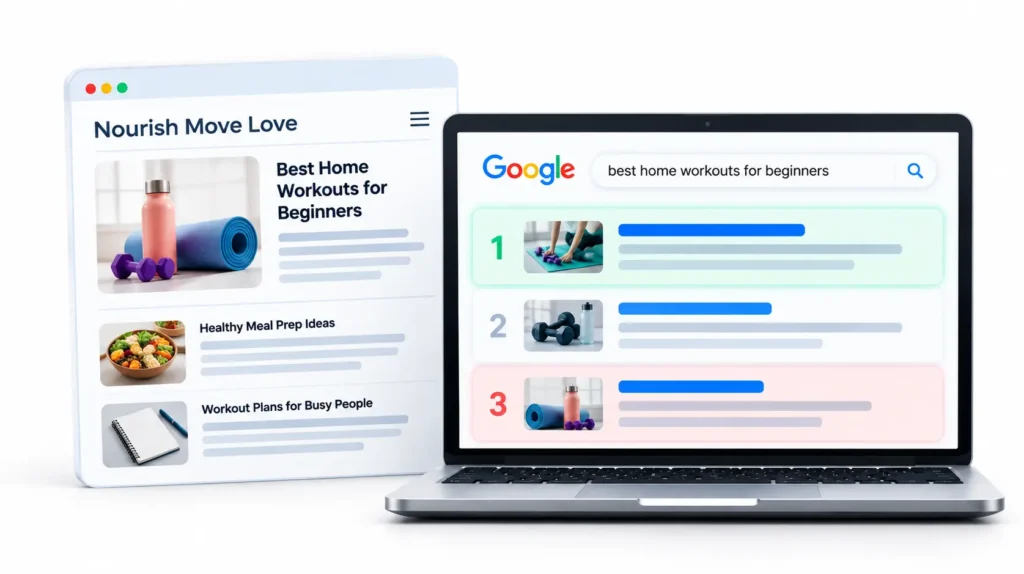
A useful real-world example comes from Nourish Move Love, a fitness website documented by SEMrush.
The site had a large amount of content but was not generating the results its owner wanted. Instead of publishing random new articles, the business used keyword research to understand what people were actually searching for.
The team also studied competing pages. For example, it checked competitor URLs, their publication dates, how they performed over time, and the other keywords those pages ranked for. When a competing article was several years old, the team saw an opportunity to create newer and better content around the topic. SEMrush’s published Nourish Move Love case study reports that the site’s average monthly organic traffic grew from about 193,000 in 2020 to about 480,000 in 2021, a 150% increase.
The important lesson is not that updating old content automatically produces a ranking increase.
The useful lesson is the process:
Research the query → study the competitor → find the weakness → create or improve content → track the result.
That is a much better approach than trying to copy every page that ranks above you.
Real-World Example: Finding Featured Snippet Gaps
Competitor research can also reveal opportunities outside the normal organic position.
Ahrefs documents a process for finding keywords where competitors own featured snippets while your page already ranks in the top results. Its example shows how a page can be improved by making the answer clearer and structuring information in a format that fits the search feature.
This creates an important point:
You do not always need to start with a keyword where you rank outside the top 100.
Sometimes the best opportunity is a page already ranking on page one that has a clear SERP-feature gap.
How to Outsmart Competitors?
The best way to outsmart competitors is not to copy everything they do.
Instead, find the specific areas where they are strong and the areas where they are weak.
A smart competitor strategy looks like this:
- Find the exact page beating yours.
- Identify the search intent.
- Compare topic and question coverage.
- Find meaningful keyword gaps.
- Compare internal links.
- Compare relevant referring domains.
- Check technical problems.
- Review SERP features.
- Look for outdated or weak information.
- Add something genuinely useful that the competitor does not provide.
The goal is better usefulness, not more words.
Google’s people-first guidance asks whether content provides substantial, complete information and original value.
Why You Should Not Simply Copy the Page Ranking Above You
A competitor’s page gives you clues, not a blueprint to duplicate.
Copying can create several problems:
- Your article may become repetitive.
- Your content may offer no new value.
- You may target irrelevant keywords.
- You may copy an outdated approach.
- You may lose your own expertise and examples.
Instead, use competitor research to answer:
What does the searcher still need that neither page explains well?
That question can reveal a better content opportunity.
Final Takeaway
If you keep asking why is my competitor ranking higher, do not start by adding more words or buying more links.
Start with evidence.
Find the exact page ranking above yours. Compare its search intent, content coverage, keyword targeting, topical authority, internal links, backlinks, technical SEO, page experience, freshness, and SERP visibility.
Then identify the gaps that actually matter.
The goal is not to become a copy of the competitor. It is to understand why competitor ranks higher, close the important weaknesses on your own page, and add information or experience that makes your result more useful.
That is how you turn a competitor ranking higher than me problem into a practical SEO improvement plan.
Frequently Asked Questions
Why is my competitor ranking higher than me?
Your competitor may have a better match for search intent, stronger content coverage, more relevant backlinks, stronger internal linking, better technical SEO, fresher information, or a better overall page experience. The exact reason should be found through a page-to-page comparison.
Why is my competitor ranking higher than me on Google even though my content is longer?
Length does not guarantee better rankings. A shorter page can satisfy the search intent more directly, provide clearer answers, have stronger authority, or offer a better experience.
Why do my competitors rank higher than me on Google?
The difference may come from several areas at once. Compare the exact ranking pages for search intent, content coverage, keywords, internal links, backlinks, technical SEO, freshness, and SERP features.
Why are competitors outranking my content?
A competitor may answer important questions that your content misses. It may also have stronger topical authority or links. Run a content gap analysis before assuming you need to publish more content.
How do I find out why a competitor outranks my website?
Start with the exact keyword and identify the URLs ranking above you. Then compare search intent, content, keywords, internal links, backlinks, technical SEO, page experience, freshness, and SERP features.
Can a competitor rank higher with fewer backlinks?
Yes. Backlink quantity is not the only consideration. Relevance, the quality of referring domains, page-level authority, content relevance, and other ranking signals also matter.
Does domain authority determine Google rankings?
No. Do not treat domain authority as a Google ranking score. Domain Authority is a third-party metric used by SEO tools. It can be useful for competitor comparison, but it is not an official Google score.
Does page speed affect rankings?
Page experience matters, and Core Web Vitals are used by Google’s ranking systems. But Google says good Core Web Vitals scores do not guarantee top rankings.
Can internal linking help me outrank a competitor?
Yes, strong internal linking can help Google discover pages and understand relationships between them. It can also help users move through related content. But internal links alone do not guarantee higher rankings.
How important are Core Web Vitals?
They are part of Google’s ranking systems and are useful measures of loading, responsiveness, and visual stability. But they are only one part of the broader page experience and SEO picture.
Can I outrank a competitor with a lower domain authority?
A third-party domain-authority score does not decide Google rankings. A page can compete by matching intent, providing better content, earning relevant links, improving technical accessibility, and delivering stronger value for the query.
How long does it take to close a ranking gap?
There is no fixed timeline. Technical fixes can sometimes be implemented quickly, while content improvements, topical authority, and link acquisition can take much longer. Track changes in Search Console and your ranking tools over time.
Why is my competitor appearing in AI Overviews but my website is not?
Google says AI Overviews and AI Mode use the same foundational SEO principles as normal Search. Your page must be indexed and eligible for Search, but meeting those requirements does not guarantee inclusion.
Should I copy the keywords my competitor ranks for?
No. Use competitor keywords as research clues. Keep terms that match your audience, topic, and search intent. Adding unrelated keywords can make the page less useful.
What should I fix first when a competitor ranks above me?
Start with high-impact gaps that you can prove. Search intent and missing important content are often worth checking before spending large amounts of time on lower-impact changes. Then investigate technical issues, internal links, authority, and SERP opportunities.