



Table of Contents
In July 2026, global tech rules changed. Governments finally realized that writing standard laws takes too long to keep up with fast-moving software. This AI governance news update tracks the actual choices made at the UN Global Dialogue in Geneva, new steps from UNESCO, and the White House’s June orders. We also look at the immediate problems these rules are causing for hospital tech teams.
This summary skips the deep philosophical debates to look at how these new frameworks work in the real world. You will see how leaders are relying on voluntary agreements with tech firms, why wealthy nations want to send computer hardware to developing countries, and why local managers are struggling to turn global treaties into daily workplace rules.
Timeline of Recent AI Governance Updates
| Date | Event |
| June 2026 | White House issues Executive Order on AI Innovation and Security |
| July 6–7, 2026 | UN hosts the first Global Dialogue on AI Governance in Geneva |
| July 8, 2026 | U.S. Mission to Geneva outlines its approach to international AI governance |
| August 2, 2026 | Key obligations under the EU AI Act begin taking effect |
AI Governance News Today: Top Global Developments
UN Hosts the First Global Dialogue on AI Governance
The United Nations opened its first big meeting on AI rules in Geneva on July 6, 2026. This gathering brought together government leaders, tech firms, and researchers to discuss how countries can safely adopt new software.
UN Secretary-General António Guterres said AI is developing faster than governance systems can adapt, making international cooperation essential for managing AI risks.
The biggest debate during the opening days was about fairness. Poorer countries explained that they lack access to the expensive computer chips and servers needed to build advanced AI. This leaves them reliant on tools made by wealthy nations.
At the same time, a panel of scientists warned that current government tracking tools are far too slow to monitor how fast AI models are learning new skills.
UNESCO Calls for Stronger International AI Cooperation
UNESCO Director-General Audrey Azoulay emphasized that countries should move beyond voluntary AI ethics principles and build practical governance systems that protect human rights while encouraging innovation.
UNESCO points out that most large AI programs are built using data from Western nations. This design choice frequently ignores or erases regional cultures. To fix this imbalance, they are advising countries to pass laws requiring tech companies to respect local languages and to protect regional history from being crowded out by global software.
U.S. Mission in Geneva Backs Global AI Governance
White House advisor Katie Strickland shared the American plan for managing tech risks at the Geneva meeting. The U.S. wants to use business incentives and direct teamwork rather than creating slow, strict government licensing boards.
The plan relies on a simple idea: let government departments use AI tools early in real offices. The U.S. believes this hands-on testing will reveal bugs and safety issues much faster than waiting for politicians to write rules. The delegation also offered to share its technology setups with friendly trading partners to build stronger business ties.
White House Announces New AI Innovation and Security Measures
President Trump signed Executive Order 14409 to handle national tech security. Rather than building a brand-new government agency, this order uses existing defense networks and the National Security Agency (NSA) to monitor software threats.
The order gives the NSA 60 days to create a secret testing system to flag the most powerful commercial AI programs.
The policy operates like a business deal:
- Tech companies can volunteer their software for a government safety check.
- The government gets 30 days to test the software for security holes before the public can buy it.
- The order explicitly bans federal agencies from making these checks mandatory or forcing companies to get a government permit to sell AI.
- For the first time, the order directs the Attorney General to prioritize prosecuting criminals who use AI-driven automated agents to hack into computers or steal data a threat category that zero-trust, adaptive network architectures are specifically built to contain.
Healthcare Industry Urges Better AI Governance
Doctors are quickly adopting new AI writing tools to save time, but hospital rules are failing to keep up with workplace reality. New industry surveys show that 63% of healthcare companies have no written rules for AI use. Even worse, doctors and nurses are using unapproved apps on their own in nearly half of the hospitals surveyed.
This lack of oversight is creating legal problems. Patients are starting to sue hospitals because automated audio tools recorded their private doctor visits without explicit permission. Medical experts also worry that busy doctors blindly trust the software, leading them to miss dangerous prescribing or dosing errors when they skim automated patient files.
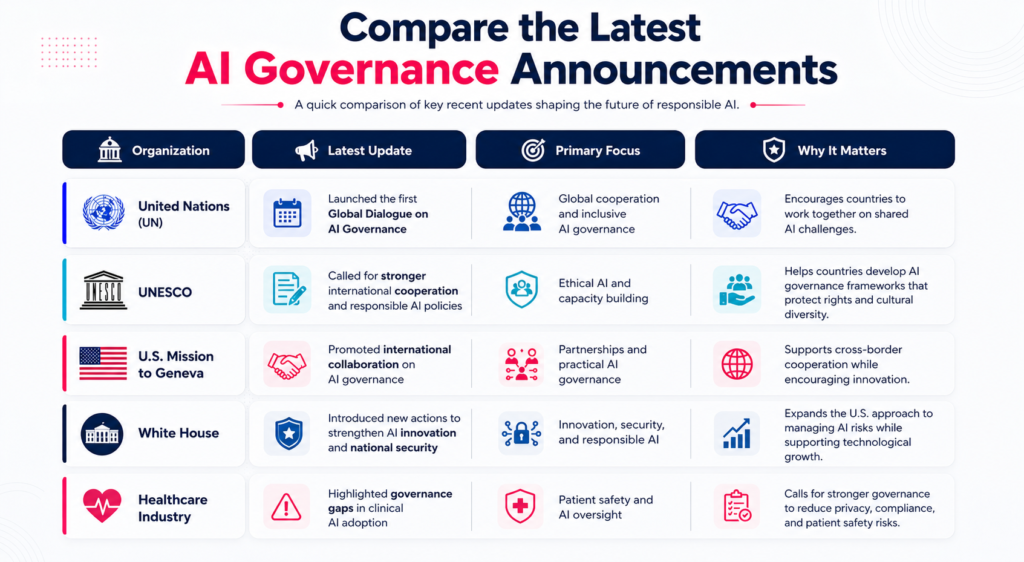
Compare the Latest AI Governance Announcements
| Organization | Latest Update | Primary Focus | Why It Matters |
| United Nations (UN) | Launched the first Global Dialogue on AI Governance | Global cooperation and inclusive AI governance | Encourages countries to work together on shared AI challenges. |
| UNESCO | Called for stronger international cooperation and responsible AI policies | Ethical AI and capacity building | Helps countries develop AI governance frameworks that protect rights and cultural diversity. |
| U.S. Mission to Geneva | Promoted international collaboration on AI governance | Partnerships and practical AI governance | Supports cross-border cooperation while encouraging innovation. |
| White House | Introduced new actions to strengthen AI innovation and national security | Innovation, security, and responsible AI | Expands the U.S. approach to managing AI risks while supporting technological growth. |
| Healthcare Industry | Highlighted governance gaps in clinical AI adoption | Patient safety and AI oversight | Calls for stronger governance to reduce privacy, compliance, and patient safety risks. |
Enterprise AI Governance News: What Businesses Should Know
New Enterprise Tech Governance Frameworks Shift to Live Tracking
Yearly software checks no longer work well. Tech leaders are finding that an old-school compliance list is an empty help when automated software tools change how they act overnight.
Because of this, modern tracking tools work a lot like a black box recorder on an airplane. These tools constantly monitor how code connects to internal company files and outside networks. They write down every single database search and tool choice right when it happens. This change means auditors do not spend time reading what the program was supposed to do. They check the live logs to see what it did during the workday.
Managing Evolving Risk and Compliance Standards
The clock is ticking for anyone doing business in European markets. The European Union’s major technology law takes full effect on August 2, 2026. If a business ignores these rules, the fines can cost up to 35 million euros or 7% of total global sales.
The biggest headache for legal teams right now is an internal problem called “shadow tech.” Workers often use unapproved, free machine learning web apps to write simple emails or check computer code without telling their bosses. This gap mirrors a broader pattern across the industry many business websites still run on outdated security settings that end up blocking even legitimate automated AI traffic. To avoid giant fines before the August deadline, businesses are running network scans. They want to find these hidden apps and build a master list of every single tool running on the office Wi-Fi.
The Strategy for Responsible Tech Adoption
Company boards are tired of technology committees pointing fingers at each other when a program crashes. Lately, businesses are putting software safety rules directly into the job description of the Chief Executive Officer. This shift gives one specific person clear legal accountability if things go wrong.
Safe adoption comes down to basic security filters:
- Smart IT teams are installing internal firewalls that automatically strip out private customer data or trade secrets before an employee’s prompt ever hits an outside server.
- For high-stakes decisions, like hiring or budget cuts, companies use a simple rule: the software can recommend an action, but a human must click the final button.
- This split setup ensures automated tools speed up research without exposing the company to major privacy lawsuits.
Measuring the Practical Business Impact
Putting these guardrails in place costs time and money, but ignoring them is much worse. Industry surveys show that over half of businesses using generative tools have already dealt with a major leak, a text error, or bad data output.
A straightforward technology policy keeps a company out of court and actually speeds up work. When engineers and lawyers agree on data boundaries in advance, the development team can launch new automated features within days rather than waiting months for legal clearance.
Key Takeaways From This Week’s AI Governance News
| Takeaway | What It Means for Leadership |
| Global Collaboration Is Increasing | Rich nations are shifting plans by sending actual computer hardware to developing countries. This lets poorer nations build matching tracking setups. |
| Governments Balance Safety and Growth | Politicians are cutting quick, voluntary deals with tech bosses. These agreements allow programmers to test systems while maintaining strict privacy rules. |
| Enterprises Tighten Internal Programs | Firms are dropping yearly checks in favor of live software monitors that work like black box recorders. The tools log code choices as they happen. |
| Board Oversight Becomes a Main Focus | Chief Executive Officers now bear direct legal responsibility for software safety. Tech managers must keep signed, timed records of all health checks. |
| Healthcare Groups Call for Stricter Rules | Hospital tech teams want local firewalls that strip out private patient names and chart information before any data reaches an external web tool. |
Conclusion
Staying up to date on the latest AI governance news is essential for any modern organization, as tech safety rules evolve faster than ever. Leaders in both government and business now see that old tracking habits fail to keep up with smart code. True safety requires clear executive blame, live software tracking, and quick local filters. Setting these strict paths early keeps data secure while letting tech teams build new tools in just a few days.
FAQs
What is AI governance?
It means using rules and tools to keep software safe and legal. This setup ensures programs treat people fairly and protect private data.
What is the latest AI governance news today?
At the July 2026 UN talks in Geneva, leaders began using live tools to watch how software acts. Also, European officials pushed some deadlines out to late 2027 so firms have more time to get ready.
What is enterprise AI governance?
It is the method a company uses to control its own software. Businesses run live monitors to block data leaks and stop staff from downloading unapproved web apps.
Why is board oversight important for AI governance?
New programs can rewrite their own code overnight. If that software breaks privacy laws, company directors now face direct legal trouble for the glitch.
What were the major announcements from the UN Global Dialogue on AI Governance?
Rich countries plan to send computer gear to poorer nations so everyone can use the same tracking tools. Also, scientists warned that old tech audits move too slowly to catch fast updates.

