


Table of Contents
Generative AI depends on enormous amounts of training data to learn patterns, generate content, and respond to users. But the data that makes systems such as GPT-4, Claude, Gemini, DALL-E, Midjourney, and Stable Diffusion capable also creates major generative AI data challenges.
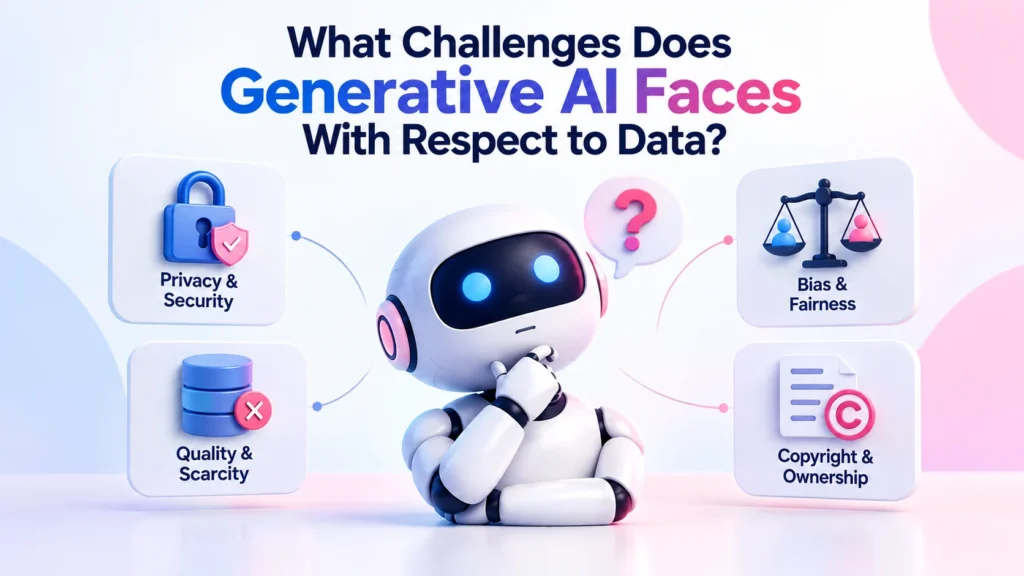
So, what challenges does generative AI faces with respect to data? The biggest problems are, privacy/security, quality/scarcity, bias/fairness, and copyright/ownership
| Main challenge | What it includes |
| Privacy & Security | Data privacy, sensitive information, data leakage, poisoning, security, compliance, and machine unlearning |
| Quality & Scarcity | Poor data quality, limited high-quality human data, fragmented data, outdated information, data drift, and model collapse |
| Bias & Fairness | Demographic bias, cultural and geographic imbalance, language gaps, stereotypes, and underrepresentation |
| Copyright & Ownership | Copyright, licensing, consent, provenance, attribution, creator compensation, and ownership of AI-generated outputs |
What Are the Main Generative AI Data Challenges?
The main AI data challenges are:
- Poor Data Quality
- Data Scarcity and Availability
- Data Bias and Lack of Diversity
- Regulatory Compliance and Data Privacy
- Copyright, Data Licensing, and Consent
- Data Provenance and Traceability
- Data Labeling and Curation
- Fragmented and Unstructured Data
- Data Drift and Outdated Information
- Data Poisoning and Data Contamination
- Model Memorization, Data Leakage, and Hallucination
- Synthetic Data and Model Collapse
These challenges can affect every stage of the AI data lifecycle, from collecting and preparing a training dataset to evaluating, deploying, monitoring, and updating a generative AI system.
The problem is therefore not simply finding more data. Organizations must also determine whether data is accurate, representative, current, legally usable, secure, accessible to the right systems, and suitable for evaluating model performance.
1. Privacy and Security Challenges

Generative AI systems can process huge amounts of information, including personal, confidential, proprietary, and sensitive data. This creates risks throughout the AI data lifecycle, from collection and training to deployment and retrieval. Stored chat logs and AI browser agents add further exposure; see our guides to AI chatbot conversation archives and browser agent security risks.
Data Privacy and Regulatory Compliance
Data privacy concerns generative AI because training datasets can contain personal or sensitive information.
Potentially sensitive data may include:
- Names
- Addresses
- Medical information
- Financial records
- Private communications
- Account information
- Identifying documents
- Biometric or other sensitive information
Generative AI creates several privacy challenges. Personal information may enter a dataset during web scraping, user interaction, data sharing, fine-tuning, retrieval, or application use. Models can also potentially memorize, reproduce, or infer sensitive information.
A real-world example occurred at Samsung in 2023, when employees reportedly entered confidential company information, including source code and internal meeting material, into ChatGPT. The incident showed how easily sensitive business data can enter an external generative AI system through ordinary employee use.
NIST’s Generative AI Risk Management Profile warns that training may involve personal data and that models can potentially leak or infer sensitive information. It specifically identifies data memorization as a privacy risk.
Organizations must also follow regulations such as GDPR, CCPA/CPRA, India’s DPDP Act, HIPAA, and the EU AI Act, depending on their location and use case. These requirements can affect how organizations collect, process, store, access, and protect AI data.
In healthcare, generative AI systems may process patient records, clinical notes, or other protected health information (PHI). Under HIPAA, organizations must apply appropriate safeguards when handling this information. For example, a healthcare provider using an AI tool to summarise clinical notes needs to consider how patient data is transmitted, stored, accessed, and used by the AI system.
The data security risks generative AI creates also extend beyond training. Sensitive enterprise information can enter AI applications through prompts, retrieval systems, APIs, or connected databases.
OpenAI says business data submitted through its ChatGPT Enterprise, Business, Edu, Healthcare, Teachers, and API offerings is not used to train its models by default. Anthropic similarly states that commercial Claude inputs and outputs are not used for training by default unless customers explicitly opt in.
Data Poisoning and Data Contamination
Data poisoning attacks generative AI by deliberately introducing malicious, misleading, or manipulated examples into training data.
An attacker might attempt to:
- Insert incorrect information
- Manipulate labels
- Create malicious examples
- Influence model behavior
- Introduce hidden patterns
This is different from ordinary poor-quality data because poisoning is intentional.
Data contamination creates another problem. Training datasets can increasingly contain AI-generated material, duplicated content, or information that has already been produced by another model.
That can create feedback loops between models and datasets, making it harder to distinguish reliable human-generated information from synthetic or manipulated content.
Model Memorization and Data Leakage
Data leakage in generative AI can occur when sensitive information becomes accessible through model outputs or connected systems.
NIST notes that generative models may reveal sensitive information present in training data and can also infer sensitive information by combining information from different sources.
Research has demonstrated that this risk is not purely theoretical. Carlini et al. showed that GPT-2 could reproduce memorized training data, extracting verbatim sequences that included names, contact information, and other text from the model. The study demonstrated how information present in training data can sometimes be recovered through carefully designed queries.
This creates a difficult balance. Organizations want models to learn useful information from large datasets, but they also need safeguards that prevent private or confidential information from being reproduced.
Data leakage can also occur outside the foundation model itself. Prompts, RAG systems, vector databases, APIs, logs, and connected enterprise applications can all become potential sources of sensitive-data exposure.
Machine Unlearning and the Right to Erasure
Privacy creates another challenge after a model has already been trained.
Deleting a person’s information from a database is relatively straightforward. Removing that information from a trained model can be much harder.
This is known as machine unlearning. It involves attempting to remove the influence of specific data from a trained model without necessarily retraining the entire system from scratch.
The issue becomes particularly important when privacy laws give individuals rights to have personal information deleted or erased. Organizations therefore need to consider not only how data enters an AI system, but also how it can be removed when required.
2. Data Quality and Scarcity Challenges
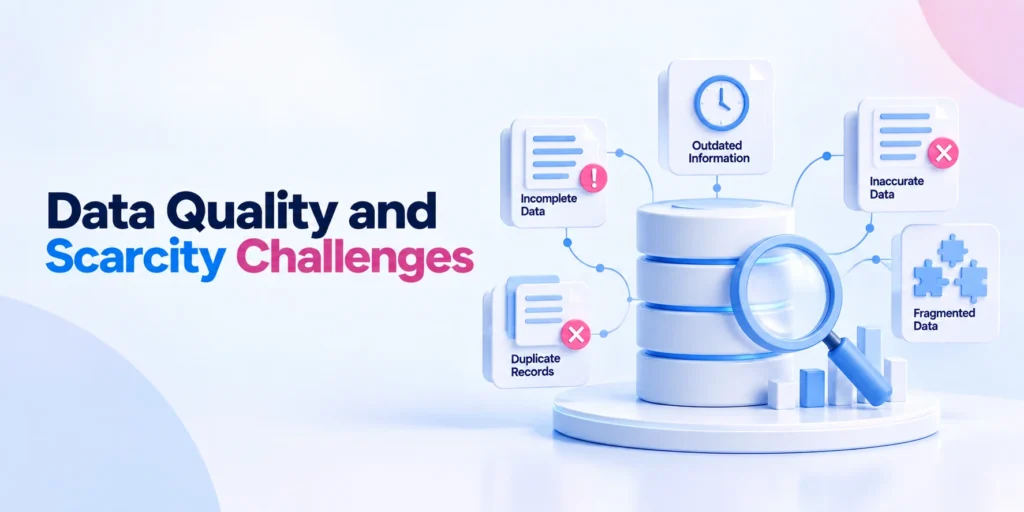
Generative AI requires large quantities of data, but quantity alone does not guarantee useful training. Organizations must deal with inaccurate data, limited high-quality human content, poor labeling, fragmented information, and data that becomes outdated.
Poor Data Quality
Data quality issues in generative AI are among the most fundamental problems. A model can process huge quantities of information, but volume does not compensate for inaccurate, duplicated, incomplete, irrelevant, or inconsistent data.
Common data quality problems include:
- Incorrect information
- Duplicate records
- Missing information
- Noisy data
- Mislabeled examples
- Outdated content
- Conflicting sources
- Poorly formatted data
- Inconsistent metadata
For an LLM, low-quality text can reinforce unreliable patterns. For a Diffusion Model, poor image metadata or low-quality images can affect what the model learns. Similar issues can affect GANs, VAEs, and multimodal systems.
Data quality also matters after training. Poor source data can affect retrieval systems, fine-tuning datasets, evaluation benchmarks, and RAG pipelines. A model may therefore produce unreliable results even when the underlying model architecture is technically strong.
This is why data curation for AI models, data cleaning, and data validation matter before training begins.
The issue is significant enough that IEEE P4141, PAR approved 4 June 2026, currently has an active standardization project specifically addressing data quality assessment and labeling consistency for generative AI foundation-model pre-training, including quality metrics, deduplication, multimodal alignment, and annotation consistency.
Gartner also identifies data quality as a major consideration for AI-ready data and notes that GenAI has unique requirements around quality, labeling, diversity, trust, and lineage.
Data Scarcity and Availability
Generative models need large-scale training data and enough relevant data for their tasks. This creates data scarcity for generative models, especially in specialized fields, languages, and regulated industries.
High-quality human-created data isn’t unlimited. Stanford’s 2026 AI Index reports that researchers continue to raise concerns about data bottlenecks and the sustainability of scaling through increasingly large datasets. One projection cited by the report estimates that available high-quality human text and web data could face depletion between 2026 and 2032, depending on assumptions.
The problem is especially difficult when organizations need:
- Domain-specific data
- Medical or financial datasets
- Proprietary business information
- Rare examples
- Low-resource language data
- Fresh real-world information
Data availability can also be restricted by licensing, privacy requirements, contractual limitations, or organizational access controls. A dataset may exist but still be unavailable for training because an organization lacks legal or technical permission to use it.
Low-resource languages can be especially difficult because they often have less high-quality digital training data available. This can limit model performance and representation across languages, even when large datasets exist for higher-resource languages.
Large datasets also require infrastructure to store, process, clean, deduplicate, and manage data. This increases demands for:
- Data storage
- Computing resources
- Data processing pipelines
- Network bandwidth
- Scalable infrastructure
More data does not automatically produce a better model if it is redundant, irrelevant, or unreliable. This makes training data limitations generative AI a practical barrier.
Data Labeling and Curation
Data labeling challenges generative models because useful training examples often need classification, annotation, ranking, transcription, filtering, or human review.
For example, a multimodal dataset may require humans to determine:
- What an image contains
- Whether a response is accurate
- Whether content is harmful
- Which answer is better
- Which category an example belongs to
That creates costs around labor, consistency, expertise, and quality control.
Data curation for AI models is equally important because simply collecting more information can increase noise rather than improve performance.
Gartner’s AI-ready-data guidance 2024 highlights sufficient volume, semantics and labeling, quality, trust, diversity, and lineage as important characteristics of data prepared for AI use cases.
Fragmented and Unstructured Data
Businesses often have plenty of information but still lack usable AI data.
Enterprise information may be distributed across:
- CRM systems
- ERP platforms
- Databases
- PDFs
- Emails
- Spreadsheets
- Cloud storage
- Internal knowledge bases
- Legacy applications
These systems may use different schemas, formats, permissions, and naming conventions.
As a result, data integration becomes a major machine learning challenge. The model may not have access to the complete context required to generate a reliable answer.
These integration problems can also create infrastructure challenges. Generative AI applications may require scalable data pipelines, metadata systems, vector databases, and observability tools to process and retrieve information efficiently as data volume grows.
Data Drift and Outdated Information
Even accurate training data eventually becomes old.
Products change. Regulations change. Prices change. Scientific knowledge develops. Businesses update their policies.
This creates data drift in generative AI and makes static training data less suitable for tasks requiring current information.
One common solution is Retrieval-Augmented Generation (RAG), where a model retrieves relevant external information instead of relying entirely on what it learned during training.
Applications that depend on current information may also require real-time or streaming data pipelines instead of slower batch updates. Without timely data delivery, even a well-designed RAG system can return outdated information.
This distinction matters:
- Data quality asks whether information is accurate.
- Data freshness asks whether it is still current.
- Data drift asks whether the underlying distribution has changed over time.
Keeping these concepts separate is essential for effective data lifecycle management AI.
Synthetic Data and Model Collapse
Synthetic data can help address data scarcity, privacy restrictions, and expensive data collection. It can be generated using systems such as GANs and VAEs, and can support data augmentation for generative AI.
Forrester describes synthetic data as particularly useful when real-world data is unavailable, unusable, or highly regulated. It also warns that achieving the right balance between fidelity, privacy, and freedom from bias can be difficult.
But synthetic data isn’t a universal solution.
Research published in Nature demonstrated that recursively training models on generated data can lead to model collapse, where important information from the original data distribution is progressively lost.
Stanford’s 2026 AI Index similarly notes that synthetic data has not yet replaced real data in pre-training and that data quality, deduplication, and curation remain important.
3. Bias and Fairness Challenges
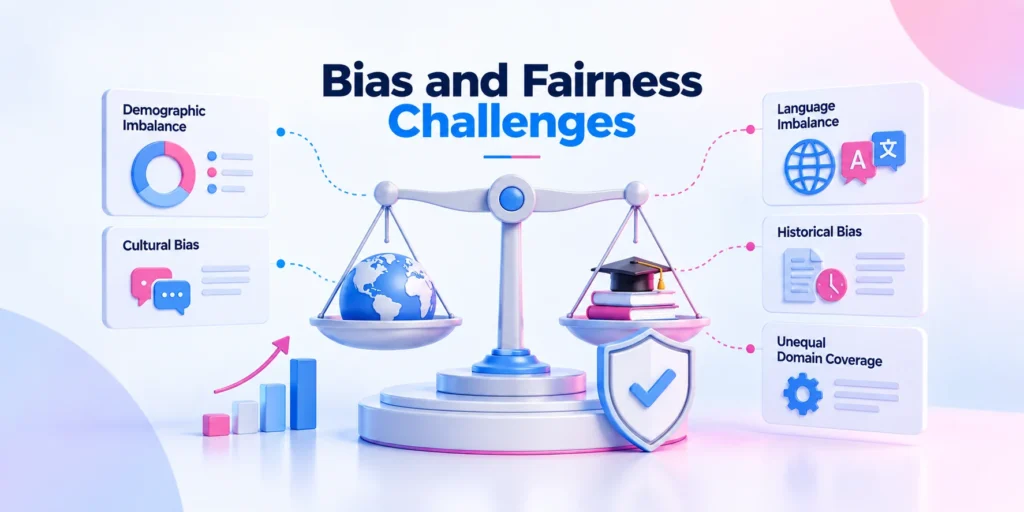
Generative AI does not learn from data in a vacuum. If training datasets contain systematic demographic, cultural, geographic, historical, or linguistic imbalances, models can reproduce or amplify those patterns.
Data Bias and Lack of Diversity
Data bias in generative AI occurs when training data contains systematic imbalances or reflects historical, demographic, cultural, geographic, or linguistic bias.
A 2023 Bloomberg analysis of Stable Diffusion states that generated images for different occupations show significant gender and racial differences in their representations. Women and people with darker skin tones were underrepresented in images associated with some higher-paying occupations and overrepresented in others. The results show how patterns in training data can influence the representations generated by an AI system.
This creates several forms of data diversity deficit:
- Demographic underrepresentation
- Geographic imbalance
- Cultural bias
- Language imbalance
- Historical bias
- Unequal domain coverage
The problem affects text, images, audio, and other modalities.
Diversity also needs to be considered in evaluation data. A model can appear accurate when tested on a narrow dataset but perform poorly when exposed to different languages, populations, regions, or real-world conditions.
How does data quality affect generative AI? Quality determines whether the model learns useful patterns. How does data diversity affect generative AI fairness? Diversity determines how broadly those patterns represent the people, languages, and situations the model is expected to serve.
Google’s AI Principles specifically call for rigorous testing and safeguards to mitigate unintended outcomes and unfair bias, alongside privacy, security, and intellectual-property protections.
4. Copyright, Licensing, and Ownership Challenges
Generative AI has created some of the most difficult questions around training data because organizations must determine not only what data they can access, but also what they have the legal and ethical right to use.
Copyright, Data Licensing, and Consent
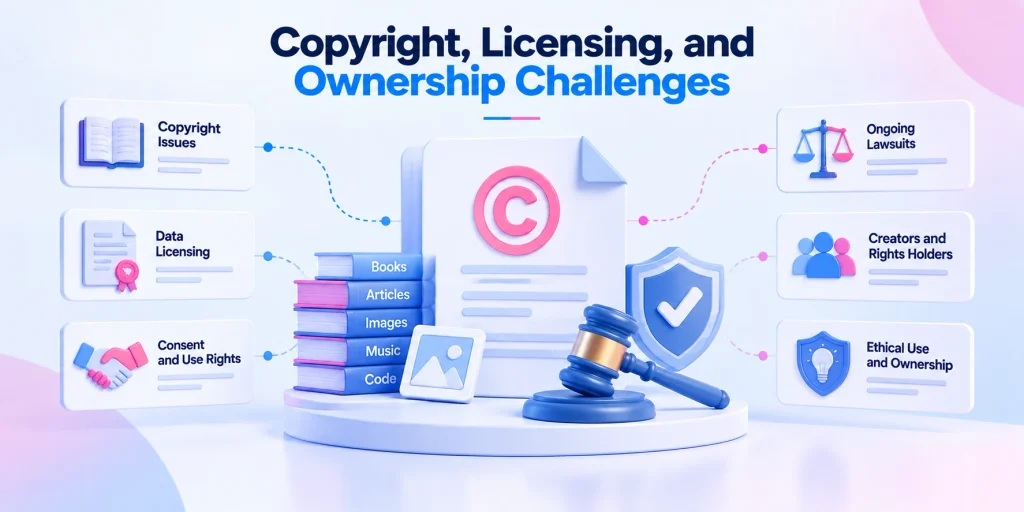
Another major issue is determining whether organizations have the right to use particular information for AI training.
Copyright issues training data can arise when datasets contain protected books, articles, images, code, music, or other creative works.
This makes data licensing for AI training, Fair Use, copyright, consent, and ownership important parts of data ethics.
These questions have also led to lawsuits involving AI companies and creators, publishers, authors, artists, and other rights holders.
The New York Times sued OpenAI and Microsoft over the alleged use of copyrighted Times content in AI development. Bartz v. Anthropic involved authors’ claims concerning the use of books to train Claude and resulted in a $1.5 billion settlement approved in 2026. Getty Images v. Stability AI and Kadrey v. Meta have also become important cases in the debate over copyright and AI training.
OpenAI’s current training-data disclosure says its development data includes publicly available information, third-party data, and user or researcher-provided information. Google’s AI Principles similarly state that responsible AI development should promote privacy and security while respecting intellectual property rights.
The challenge is therefore not simply “does the data exist?”
It is:
Can the data legally and ethically be collected, licensed, processed, and used for AI training?
Data Provenance and Traceability
Data provenance in AI means being able to determine where data came from, how it was collected, what happened to it, and how it entered the AI pipeline.
Without reliable provenance, organizations may struggle to answer:
- Who created the data?
- Where was it collected?
- Was consent obtained?
- Was it licensed?
- Was it modified?
- Was it generated synthetically?
- Which model or dataset used it?
This makes data lineage, metadata, source tracking, and audit trails important elements of data governance for generative AI.
Provenance also matters for copyright and creator rights. If an organization cannot identify where training data came from, it may struggle to verify licensing conditions, respond to rights-holder requests, or determine whether particular works were included in a dataset.
Strong data governance also requires secure access controls. Organizations need to control who can access, modify, retrieve, or use sensitive datasets for training and AI applications. Encryption, auditing, role-based permissions, and clear data-access policies can help protect data throughout the AI lifecycle.
The challenge is becoming more important as model transparency declines. Stanford’s 2026 AI Index reports that several leading frontier-model developers no longer disclose key details such as dataset sizes and training duration.
Attribution and Creator Compensation
Copyright is not the only concern for creators.
There are also questions about attribution and compensation. Creators may want to know whether their work was included in training data, how it was used, and whether they should receive credit or payment when their work contributes to a commercial AI system.
This creates a wider debate around data licensing models for generative AI. A system may legally obtain access to information under one arrangement while creators may still question whether the terms provide sufficient transparency, attribution, or compensation.
For businesses building or adopting generative AI, these questions make data sourcing and licensing policies increasingly important.
Who Owns AI-Generated Outputs?
Copyright questions do not end with the training data.
Organizations also need to consider who owns or can commercially use AI-generated text, images, code, and other outputs.
The answer can depend on the jurisdiction, the human contribution involved, and the terms governing the AI system. In some situations, an AI-generated work may not receive the same copyright protection as a work created substantially by a human.
This means organizations should not assume that generating content with an AI system automatically gives them unrestricted ownership or exclusive rights.
How Can Organizations Overcome Generative AI Data Challenges?
Organizations can reduce these generative AI challenges by treating data as part of the model-development process rather than an afterthought. The right approach depends on the specific risk, from poor data quality and bias to privacy, provenance, and outdated information.
| Challenge | Recommended fix | Example tool |
| Poor data quality | Validate datasets, remove errors and duplicates, and set measurable quality rules before training or retrieval. | Great Expectations |
| Data scarcity | Combine high-quality human data with carefully validated synthetic data and targeted data collection. | NVIDIA NeMo Curator |
| Data bias & lack of diversity | Test datasets and model outputs for demographic gaps and improve underrepresented data. | IBM AI Fairness 360 |
| Privacy & PII | Detect, remove, or mask personally identifiable information before it enters AI workflows. | Microsoft Presidio |
| Sensitive data security | Use role-based access controls, encryption, secure environments, and access audits for confidential AI data. | Microsoft Purview |
| Data provenance | Record where data came from, how it was changed, and how it moves through the AI pipeline. | C2PA |
| Copyright & licensing | Review copyright, licensing, consent, and permitted-use requirements before training or fine-tuning. | Rights-management systems |
| Data labeling | Use clear annotation guidelines, label validation, and human review for ambiguous cases. | Label Studio |
| Fragmented & unstructured data | Standardize formats and organize disconnected datasets before training or retrieval. | NVIDIA NeMo Curator |
| Outdated data & data drift | Monitor changes in data and refresh datasets when information becomes outdated. | Great Expectations |
| Data poisoning & contamination | Screen incoming datasets and validate sources to identify suspicious or manipulated data. | NVIDIA NeMo Curator |
| Model memorization & leakage | Limit sensitive training data and test models for unwanted reproduction of training information. | Privacy testing tools |
| Current information gaps | Use RAG to connect models to trusted, up-to-date sources instead of relying only on static training data. | Microsoft Azure AI Search |
| Synthetic data & model collapse | Validate synthetic data against real-world distributions and avoid repeatedly training on low-quality synthetic outputs. | NVIDIA NeMo Curator |
| High-risk AI use | Keep human review in place for sensitive decisions, critical outputs, and expert-level data validation. | Human-in-the-loop workflows |
Microsoft’s Responsible AI framework emphasizes fairness, reliability and safety, privacy and security, inclusiveness, transparency, and accountability.
The ACM likewise emphasizes principles including transparency, auditability, fairness, security, privacy, and accountability for AI systems.
The World Economic Forum has also highlighted the need for governance models that allow data from different sources to be shared while protecting individual rights and distributing risks appropriately.
For organizations operating in the European Union, GDPR adds another layer of requirements. The European Data Protection Board has stated that the use of personal data in AI model development and deployment must be assessed under GDPR principles, including lawful processing, legitimate interest, transparency, and anonymization.
Gartner’s research similarly identifies data accuracy and privacy among the leading challenges organizations report when implementing GenAI. In its 2024 survey, 46% cited data accuracy as a potential challenge, compared with 39% for data privacy and 30% for cost.
Frequently Asked Questions
What are the major challenges faced by AI?
The major challenges faced by generative AI can be grouped into four areas: privacy and security, data quality and scarcity, bias and fairness, and copyright and ownership. These include data leaks, poor-quality or outdated data, limited training data, bias and underrepresentation, data poisoning, copyright disputes, licensing issues, and questions about data ownership and consent.
Can generative AI work without large datasets?
Foundation models generally require very large datasets during pre-training, but techniques such as few-shot learning, zero-shot learning, fine-tuning, and retrieval can reduce the amount of task-specific data required. They do not eliminate the broader need for high-quality training and evaluation data.
How does poor data quality affect generative AI?
Poor-quality data can cause models to learn inaccurate, duplicated, biased, or irrelevant patterns. This can reduce output quality and contribute to unreliable or unsupported responses.
Why is data privacy important for generative AI?
Generative AI systems can process personal, confidential, or proprietary information during training, prompting, retrieval, or deployment. Strong privacy controls help reduce the risk of unauthorized access, memorization, inference, and data leakage.
How can organizations prepare data for generative AI?
Organizations can prepare data by cleaning and deduplicating datasets, validating quality, improving diversity, documenting provenance, checking licensing, protecting sensitive information, maintaining metadata, and monitoring data freshness and drift. RAG can also help applications use current information without relying entirely on static training data.
What are the negative effects of generative AI?
Generative AI can produce misinformation, biased or inaccurate content, privacy violations, copyright issues, and data leakage. It can also be misused to create harmful or misleading content.