


I found a mixed public picture of Gramhir.pro. Public descriptions say it’s a browser-based AI image tool. You can use text prompts and choose styles. There’s both free and paid access. However, they don’t give a clear price list or consistent speed and quality benchmarks.
That makes Gramhir .pro worth testing for quick concepts, marketing visuals, product mockups, and social content. Still, the decision should depend on prompt accuracy, consistency, text rendering, image quality, workflow controls, and licensing.
Gramhir.pro AI: Quick Overview
| Evaluation area | What to check before choosing it |
|---|---|
| Evaluation area | Publicly reported or testable detail |
| — | — |
| Best fit | Concept art, marketing visuals, social media assets, and product mockups |
| Input workflow | Browser-based prompt workflow; style and image controls are described publicly |
| Speed | A public description says generation takes “a matter of seconds,” but gives no reproducible timing benchmark |
| Pricing | One third-party listing reports $0 Free, $15 Pro, and custom Enterprise, but for Instagram analytics rather than a confirmed AI-image plan |
| Commercial use | A public description associates commercial licensing with paid or enterprise access; verify the current license |
| Main risks | Test text rendering, anatomy, product accuracy, consistency, watermarks, and export limits yourself |
What is Gramhir.pro AI Image Generator?
Gramhir Pro is positioned as an AI image generator that turns text descriptions into visual content. You can describe the subject, setting, mood, composition, and style, then refine the result with more prompts or settings.
This text-to-image workflow can help with creative ideas, social content, campaign concepts, and product visuals. Review the image before publishing. Check for accuracy, consistency, resolution, editing effort, and usage rights.
How text-to-image generation works
I checked three public descriptions before writing this section. Gramhir Pro is a browser tool. It turns written prompts into images. Users can control styles and make variations or regenerate images.
The exact model architecture is unclear. One public page calls it GAN-based, but that does not confirm that the current system is. Treat GANs, diffusion models, and foundation models as terms to verify, not as confirmed facts about Gramhir.pro. For a broader look at how AI companies are moving, see our roundup of recent AI industry developments.”
How to use Gramhir.pro: a practical workflow
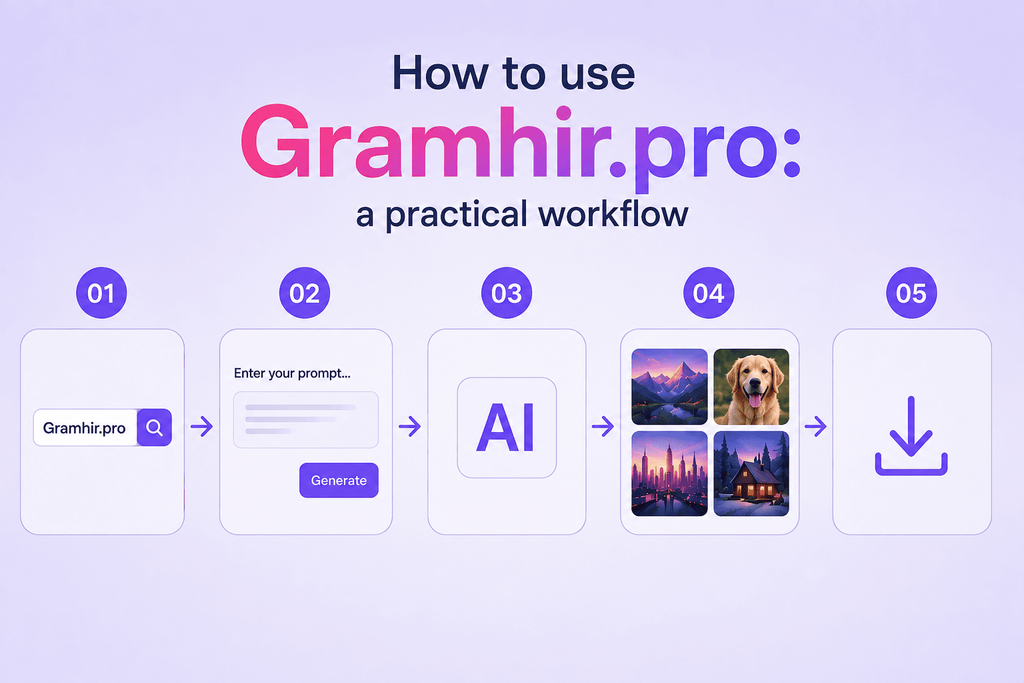
1. Start with the image objective
Define where the image will appear before writing the prompt. A product page, Instagram post, blog header, presentation, and print asset need different sizes and layouts.
2. Describe the subject and setting
State what should appear in the image, where it is located, and what should receive visual emphasis. Include the intended perspective, background, lighting, and mood.
3. Add style and composition controls
Choose a style that fits the project. You can pick from photorealistic photography, digital painting, anime, watercolor, 3D render, or minimalist illustration. If available, also set the aspect ratio, color palette, camera angle, and detail level.
4. Generate a small set of variations
Compare variations rather than judging the first output in isolation. Check for prompt adherence, composition, unwanted objects, distorted details, and brand consistency.
5. Refine one variable at a time
Change the lighting, background, subject position, or style separately. This makes it easier to identify which prompt instruction improved or weakened the result.
6. Edit and verify before publishing
Use a design tool to correct typography, crop the image, adjust color, remove artifacts, and add final brand elements. Then verify the plan’s commercial usage rights and export restrictions.
Prompt engineering examples
Product photography prompt
Studio shot of a matte-black reusable bottle on pale stone. Soft light comes from the left, creating a subtle shadow. The background is neutral, and the bottle is centered. It shows realistic texture, with space above for a headline. No logo or extra objects are included.
Social media prompt
A clean editorial background for a technology announcement, deep blue and teal palette, abstract flowing shapes, high contrast, generous negative space on the right for copy, modern professional style, 4:5 aspect ratio.
Human portrait prompt
Editorial portrait of an adult in a softly lit indoor space. The subject has a natural expression and realistic skin texture. They wear simple, neutral clothing. The composition is balanced, and the hands are outside the frame. No text or watermark is included.
These prompts are starting points, not guarantees. Better prompts improve control, but they cannot remove every model error.
Image quality: what to evaluate
A visually attractive preview is not enough. Evaluate outputs at the size and context in which they will be used.
- Composition: Is the subject positioned correctly, with enough negative space?
- Edge definition: Are outlines clean around hair, products, clothing, and objects?
- Texture accuracy: Do materials such as glass, metal, fabric, and skin look plausible?
- Lighting: Are shadows, reflections, and highlights coherent?
- Color: Does the palette match the brief or brand?
- Resolution: Does the export remain useful after cropping or resizing?
- Consistency: Can several generations maintain the same visual direction?
- Editing burden: How much correction is required before publication?
This review treats these as practical evaluation criteria, not as a claimed benchmark score. Use the same checks when comparing tools.
Text rendering and typography
Text rendering matters for posters, packaging, ads, thumbnails, infographics, and branded social content. Check every letter, word, line break, and space. If the wording must be exact, add it later in a design application.
A useful test set includes a short headline, a product label, a number, a logo-like word, and text placed over a busy background. Record whether the output is readable without correction.
Human anatomy and portrait generation
Human anatomy needs its own check. Errors in hands, faces, body proportions, and group scenes can ruin an otherwise good image. Test portraits, full-body images, hands holding objects, and crowded scenes when relevant.
For people-focused projects, human review is essential. Do not use an unverified output for medical, safety-critical, identity-sensitive, or highly realistic applications merely because it looks convincing at thumbnail size.
Product photography and e-commerce visuals
AI generation can help teams explore product photography concepts, seasonal backgrounds, campaign directions, and product mockups. It is most useful when the goal is to communicate an idea quickly.
A generated mockup may not match the real product. Check its size, materials, labels, logos, closures, and reflections. Use approved product photos or 3D assets when accuracy matters.
Speed, processing, and workflow fit
Measure generation speed under the same conditions each time. Record the prompt type, number of variations, resolution, queue conditions, and time to a usable result. One fast result does not show typical performance.
Also assess the surrounding workflow:
- Does preview mode use the same quality as final export?
- Are batch generations available?
- Can users preserve prompts and settings?
- Are generated images private by default?
- Which file formats and resolutions are supported?
- Is there API access for workflow automation?
- Are there usage limits or queue priorities?
- Does the interface remain usable for non-technical users?
Gramhir.pro pricing: what is publicly visible

The clearest price figure I found comes from a third-party directory: 0/monthforFree,15/month for Pro, and custom pricing for Enterprise. The listing talks about Instagram analytics and viewer features. It doesn’t confirm an AI-image plan, so consider the figure as unverified.
Another public Gramhir page describes free and paid access, but it does not give a current AI-image price or a measurable generation limit. For that reason, this review does not present $15/month as a verified AI-image plan price.
Pricing status checked: August 18, 2026.
Free plan checklist
- Daily or monthly generation allowance
- Available image dimensions
- Watermark policy
- Download formats
- Public versus private generations
- Personal-use restrictions
- Access to styles, reference images, and refinements
Pro plan checklist
- Higher or unlimited generation limits
- High-resolution exports
- Watermark removal
- Commercial usage rights
- Priority processing
- Private generations
- API access or workflow automation
- Team and enterprise features
Before using Gramhir.pro for client or commercial work, check the current plan terms. Look at the provider’s official pages. Check for watermarks. Note the resolution limits. Review privacy rules. Find out about commercial usage rights.
Limitations to consider
The main risks are not limited to image quality. A professional evaluation should also consider:
- Inconsistent results across repeated generations
- Garbled or misspelled text
- Errors in hands and human anatomy
- Incorrect product geometry or branding
- Limited control over small composition details
- Variable processing times
- Export or watermark restrictions
- Unclear commercial licensing
- Lack of API access or batch workflows
- Privacy and data-retention questions
- Editing time required after generation
These limitations should be tested against the actual use case rather than treated as universal conclusions about every output.
Best use cases for Gramhir.pro
Marketing teams
Use it to explore campaign directions, social media concepts, email visuals, and ad backgrounds. Keep final copy, logos, and regulated claims in controlled design workflows.
Content creators and publishers
Use it for article illustrations, thumbnails, featured images, and visual variations. Check whether the output has enough resolution and whether the license permits the intended publication.
Product and e-commerce teams
Use it for early product mockups, merchandising concepts, and background exploration. Confirm all product-specific details before presenting an image as a real product.
Designers and creative teams
Use it as an ideation tool, reference Gramhir.pro AI photo generator, or a rapid way to compare artistic directions. Maintain a human review and editing stage for final work.
Top 5 Gramhir.pro Alternatives: How to Compare Them Fairly
DALL-E 3, Midjourney, Stable Diffusion, Leonardo AI, and NightCafe address overlapping but different needs. Instead of declaring one platform the universal winner, compare them using the same prompts and scoring system.
| Tool | Test for | Questions to ask |
|---|---|---|
| Gramhir.pro | Speed, ease of use, product and marketing visuals | Are outputs usable with minimal correction? |
| DALL-E 3 | Prompt adherence and text-heavy concepts | Does it follow detailed instructions and render required words? |
| Midjourney | Artistic styles, textures, and visual impact | Can it maintain the desired aesthetic and workflow privacy? |
| Stable Diffusion | Control, customization, and local workflows | Do you have the hardware and technical resources to operate it? |
| Leonardo AI | Creative production and asset workflows | Do its controls and plans fit the team’s output needs? |
| NightCafe | Access to multiple models and styles | Does model variety outweigh workflow complexity? |
Prices, model availability, privacy settings, and commercial terms should be checked on each provider’s current official pages. These tools are part of a fast-moving AI space; check our coverage of major AI updates to stay current on new releases.”
Gramhir.pro Alternatives: Short Reviews
DALL-E 3
DALL-E 3 is worth considering when prompt interpretation and text-heavy image concepts matter. It can be a practical choice for users who prefer a conversational workflow and want to refine an idea through natural-language instructions. Verify current access, image limits, pricing, and commercial terms before publishing a comparison.
Midjourney
Midjourney is a great choice for exploring artistic styles. It offers polished textures, dramatic lighting, and unique visual concepts. It might attract designers and creators who value visual impact. But, check workflow privacy, editing controls, and licensing for the specific plan.
Stable Diffusion
Stable Diffusion is great for users who want control and customization. It allows running models locally or through a developer-managed workflow. That flexibility may need more tech setup, hardware, and knowledge of model selection than a hosted interface.
Leonardo AI
Creators can check out Leonardo AI. It offers a simple interface. It has creative controls and lets you repeat asset workflows. Look at the available models. Check their generation limits and image controls. Review team features and the commercial rights for your work.
NightCafe
NightCafe may suit users who want to explore multiple models and artistic styles in one service. Model variety helps with experimentation. However, check the interface, credits, output limits, privacy, and export terms first. This is important for high-volume work.
Which alternative should you choose?
- Choose DALL-E 3 when prompt adherence and text-based concepts are the priority.
- Choose Midjourney when artistic quality, textures, and visual style matter most.
- Choose Stable Diffusion when customization and technical control are worth the setup.
- Choose Leonardo AI when you want creator-focused controls and asset workflows.
- Choose NightCafe when access to multiple models and styles is more important than a minimal workflow.
- Choose Gramhir.pro when its interface, output quality, speed, plan limits, and licensing fit your specific use case.
A repeatable comparison test
To produce a trustworthy review, run the same test across each platform:
- Use five prompts: product photo, portrait, hands, typography, and abstract art.
- Use the same aspect ratio and comparable output settings.
- Generate the same number of variations per prompt.
- Record generation time and failed attempts.
- Score prompt adherence, image quality, text rendering, anatomy, consistency, and editing effort.
- Record resolution, watermarks, download formats, and licensing terms.
- Publish representative examples with the prompt and test date.
This approach creates original value because it shows how the tools behave on the same tasks. Publish the prompt set, test date, sample outputs, and scoring method alongside any measured result.
Who should use Gramhir.pro?
Gramhir.pro may be a reasonable option for beginners, content creators, designers, marketing teams, and businesses that need rapid visual ideation.
It might not be the best choice when a project needs:
- Exact typography
- Precise product geometry
- Strict brand consistency
- Full control over model deployment
The best decision relies on the whole workflow:
- Prompt creation
- Generation
- Review
- Editing
- Approval
- Rights verification
- Export
Final Assessment
Judge Gramhir.pro by its usable output, not by its feature list. Check if it follows prompts, makes consistent images, and manages text and anatomy well. Also, see if it meets your speed needs and offers fair pricing and commercial terms.
If a free option is available, use it to test real tasks. Before you use the platform for client work, check the plan terms. Also, compare your prompts with DALL-E 3, Midjourney, or another tool.
FAQs of Gramhir.pro
What is Gramhir.pro?
Gramhir.pro is an AI photo generator designed to turn text descriptions into visual content. Its practical value depends on output quality, controls, workflow features, and licensing terms.
Is Gramhir.pro free?
Plan availability, limits, and watermark policies can change. Check the current official pricing page before relying on a free or Pro plan description.
Can Gramhir.pro create product photography?
It can be evaluated for product photography concepts, product mockups, and e-commerce backgrounds. Review product geometry, branding, labels, and materials before using an output as a factual product representation.
Can Gramhir.pro generate readable text?
Text rendering should be tested rather than assumed. For exact headlines, labels, and marketing copy, adding the final typography in a design application is usually the safer workflow.
Does Gramhir.pro support commercial use?
Commercial use depends on the current license and the plan under which the image was generated. Verify the terms before using an output in advertising, packaging, client work, or a paid product.
How does Gramhir.pro compare with DALL-E 3 and Midjourney?
Compare prompt adherence, image quality, text rendering, anatomy, style consistency, speed, privacy, export options, pricing, and commercial rights using the same prompts. No single tool is best for every use case.
What is the best prompt for Gramhir.pro?
A useful prompt normally specifies the subject, setting, composition, lighting, color palette, style, aspect ratio, and desired level of detail. Refine one variable at a time and inspect the output closely.

