

Humanoid robots are moving out of research labs and straight onto real job sites. Companies are bringing in two-legged machines to cover open shifts, with big improvements in AI models and hardware engineering.
From operating rooms to auto assembly lines, these machines are starting to do real work alongside people. This weekly roundup highlights the top humanoid robotics news across healthcare, manufacturing, software development and new business investments. Here is a look at the future direction of the industry.
This Week’s Biggest Humanoid Robotics Headlines
We chose the following stories based on their business impact, tech importance, and real-world use.
- Robot helps with live surgery: A two-legged robot helped doctors perform a real operation on a patient.
- New tech links brains to robots: A new headband lets a person control a machine using just their thoughts.
- More robots work in factories: Car makers are putting bipedal robots on their assembly lines to do daily tasks.
- Workers protest robot jobs: Factory workers are speaking out because they worry these machines will take their jobs.
- Robot company gets big funding: Investors gave a top robot maker enough money to push its value over $1 billion.
- New chips power robots: Builders are making faster computer chips for the machines featured in robotics news today humanoid.
Humanoid Robots Perform Live Surgery in a World First
What Happened
For the first time ever, a doctor controlled a humanoid robot to help perform live operations. The machine held and used real medical tools during the test without hurting the surrounding tissue.
Who Was Involved
A team of doctors and engineers at the University of California, San Diego (UC San Diego) ran the trial. They took a small 60-pound robot nicknamed “Surgie” and attached custom tool holders to its hands. Dr. Shanglei Liu guided the robot using remote controls while engineering professor Michael Yip helped lead the tech team.
The Procedure
The team used the robot to remove gallbladders in two separate setups:
- Human and Robot: One doctor controlled a robot while a human doctor stood by to help.
- Two Robots: Two humanoid robots worked side by side to complete the surgery together.
Why It Matters
Large surgical systems like the da Vinci robot weigh almost 1,800 pounds and take up entire rooms. This new humanoid robot stands five feet tall, costs far less, and rolls right up to standard operating tables.
“It’s a fraction of the cost, and it takes a fraction of the space in an operating room,” said Dr. Shanglei Liu. “Its ease of deployment makes it suitable for diverse settings, including rural outposts, defense theaters, and space missions.”
Why this matters for the future:
- Better Precision: The remote control system removes natural handshakes, making tight cuts safer.
- Remote Healthcare: Specialist doctors can perform emergency surgery in small rural clinics or battlefields without traveling.
- Future Clinical Trials: This test opens the door for human trials, which could help fill the global doctor shortage.
This story marks a major shift in robotics humanoid news, showing how these flexible machines can move past simple tasks and help save lives in hospitals.
Humanoid Robots Are Heading to Factories Faster Than Expected
Factory floors are changing fast as two-legged robots step out of research labs and onto real assembly lines. Companies are putting these machines into daily work shifts to carry heavy parts, move materials, and lift boxes alongside human workers.
Factories cannot find enough workers to fill tough physical roles. Bringing in humanoid robots helps companies fill open shifts, keep lines moving on time, and protect human workers from repetitive strain injuries.
Major brands are testing these systems right now in live facilities. Tesla uses Optimus robots in its factories to handle parts and gather training data on assembly tasks. Figure AI tested its bipedal robots at a BMW plant in South Carolina to move sheet metal parts. Apptronik is running tests with Mercedes-Benz to carry parts kits directly to assembly workers. Agility Robotics continues to test its Digit robot in Amazon facilities to shift heavy plastic totes.
Factories still run into clear limits with this tech. Most robots can only work a few hours before needing a charge, and they move much slower than trained humans when handling delicate parts. The upfront price tag also remains high for smaller parts suppliers. Robotics industry news shows that despite early limitations, factories are actively testing humanoid robots for real-world tasks.
China’s Brain-to-Robot Platform Pushes AI to the Next Level
Standard factory arms are pretty dumb. If a box shifts two inches to the left, an old-school robotic arm swings down anyway and grabs thin air. It has no idea it failed. Today’s humanoids avoid that blunder using embodied AI. That just means the software ties directly into the hardware like motor joints, eye cameras, and pressure sensors in the fingers. The bot actually feels weight and surface friction. If a slick bottle starts sliding out of its hand, it squeezes harder right on the spot.
Despite staring through a single basic camera, these machines run on multi-modal AI. The system processes live video, voice commands, and touch data all at once. You can ask a humanoid worker for a specific wrench, and it scans the workbench, finds the right tool, and picks it up without crushing it.
Before moving an arm, the robot uses robot reasoning to break big goals down into smaller steps. Tell it to clean off a messy table, and it figures out what to do first. It separates junk from useful tools, throws the trash away, and stacks the tools where they belong. Drop a bolt halfway through? The bot spots its own mistake and reaches back down to grab it.
Once it knows the plan, motion planning software calculates how every single joint needs to bend. It recalculates those angles dozens of times every second so the machine stays balanced and doesn’t collide with people walking past. Engineers use environments like NVIDIA Isaac GR00T to simulate thousands of training iterations virtually before testing on physical robots.
Old industrial robots had to be locked behind steel cages because they were completely blind to their surroundings. These new software setups change that entirely. Anyone keeping up with robotics humanoid news knows this software shift is what turns rigid factory machines into flexible helpers that can actually share a room with human workers.
The Biggest Humanoid Robotics Funding News This Week
Venture firms, car companies, and industrial giants are throwing billions into humanlike robots right now. Global investment in the space has blown past $8.7 billion so far in 2026, practically doubling what the industry saw in all of 2025. The shift makes sense when you look at where the tech is going. Capital isn’t just chasing online chatbots anymore. Cash is moving straight into physical machines that can lift boxes, grab tools, and work alongside real human crews.
Big Funding Rounds and Wild Valuations
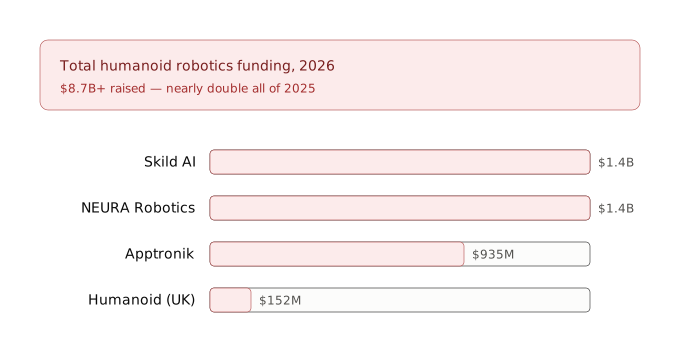
Several major companies pulled in massive sums recently. Pittsburgh startup Skild AI brought in $1.4 billion in its Series C round, jumping its value to over $14 billion to build multi-body AI brains. Over in Europe, London-based Humanoid raised $152 million in a Series A deal at a $1.35 billion valuation. Meanwhile, Germany’s NEURA Robotics opened a $1.4 billion Series C led by Tether, and Texas-based Apptronik pushed its total Series A funding to $935 million with backing from Google and Mercedes-Benz.
Strategic Deals Are Replacing Standard Venture Money
Standard venture capital funds aren’t making these deals on their own anymore. Automakers and parts suppliers are locking in direct partnerships so they don’t get left behind when hardware gets hard to buy. Bosch signed a deal to act as the main contract manufacturer for Humanoid, handling hardware assembly and supply lines. At the same time, motion technology giant Schaeffler agreed to deploy thousands of those robots directly onto its factory floors. Meanwhile, Google partnered with Apptronik to use its Apollo robot as the primary hardware bed for testing Gemini Robotics software models.
Government Investments in National Robotics
National governments are stepping in with state-backed funds, tax breaks, and research grants to protect domestic factories and handle shrinking workforce numbers. Public investment accounts for a growing slice of the market, especially across Asia and Europe where state programs back domestic motor builders, joint manufacturers, and assembly plants so local factories don’t rely entirely on foreign supply chains.
Why Investors Are Betting Big Right Now
Why are backers writing such big checks right now? First, factory and warehouse labor gaps keep growing, and pay hikes haven’t filled open shifts. Companies want humanlike bots because they step straight into buildings designed for people without requiring millions in floor renovations. Second, hardware production costs dropped 30% to 40% over two years, making $30,000 to $50,000 builds realistic rather than $200,000 custom prototypes. Third, modern AI models let robots fix their own mistakes on the fly, so a machine doesn’t freeze up if a container sits an inch off-center.
What This Means for Real Workplaces
All this cash is speeding up a major business trend known as Robots-as-a-Service, or RaaS. Despite buying a bot upfront for $50,000, logistics managers pay a simple monthly fee. That turns a massive capital purchase into a basic monthly operating bill, letting plant managers drop 10 or 20 units onto a night shift with very little financial risk. Anyone following humanoid robotics funding news can see that money isn’t backing fun science experiments anymore; investors are funding the next industrial workforce.
Other Robotics Industry News Today on Humanoid Innovation
Humanoid robots are leaving the lab and going straight onto active factory floors. Here are the latest developments from the field.
Commercial Product Launch
Boston Dynamics unveiled the production-ready, fully electric version of its Atlas humanoid robot.
Moving away from hydraulic parts, the electric platform features 56 degrees of freedom, swappable batteries, and a 30 kg lift capacity. Initial production units are set to deploy at Hyundai automotive facilities to handle parts sequencing.
Core Software Update
Google DeepMind teamed up directly with Boston Dynamics to load Gemini Robotics models into the Atlas hardware.The new software helps the robot process multi-modal inputs, figure out complex sorting tasks faster, and fix its own errors without human help.
Warehouse Logistics Deployment
Agility Robotics reached a big milestone with its Digit humanoid bot after moving over 100,000 totes at a GXO Logistics plant.
The bipedal robot picked containers off mobile transport bots and loaded them onto conveyer belts. This live test proved that humanoids can handle repetitive warehouse tasks in spaces built for human workers.
Consumer and Retail Rollout
Robotics maker 1X started taking pre-orders for NEO, its home and retail humanoid.
The lightweight bot features soft fabric wrapping, quiet electric joints, and a 25-degree-of-freedom hand to sort inventory safely around humans.
Research Paper Insights
A new review paper on Embodied Physical AI showed how vision-language-action models reduce training times for complex tasks.
Rather than taking months to program, new foundation software helps humanoids learn a new assembly line job in just a few days.
Government Initiatives
State-backed initiatives across Germany launched dedicated Centers of Competence for Physical AI.
These programs provide funding for local actuator manufacturing and set up clear safety guidelines for humanoids working on manufacturing lines.
Tracking robotics news humanoid trends shows that companies are focusing on practical results like battery swap times, daily tote volumes, and floor safety.
Boston Dynamics Partnered with Hyundai to Reveal the Atlas Humanoid Robot. This live launch footage shows the electric Atlas performing flexible joint movements and handling real-world tasks on a simulated factory floor.
Why These Latest Humanoid Robotics Breakthroughs Matter
The sudden surge in commercial humanoids isn’t random tech hype. It happens because physical AI software, lower manufacturing costs, and real-world labor shortages are colliding all at once.
Why Is This Happening Now?
Three big shifts explain why this tech is moving so fast:
- Smarter AI Software: Vision-Language-Action (VLA) models help bots reason through physical tasks despite breaking down when an item shifts an inch off-center.
- Cheaper Hardware: Manufacturing costs dropped 40% year-over-year. Goldman Sachs research shows unit prices fell to between $30,000 and $150,000, down from over $250,000 per build.
- Unfilled Jobs: Factories and warehouses face ongoing worker shortages that pay hikes simply haven’t fixed.
Who Benefits First?
Car plants and distribution centers can deploy humanoid robots in facilities designed for human workers, avoiding expensive infrastructure overhauls. During a McKinsey Talks Operations discussion, Vention CEO Etienne Lacroix said the average payback period for the company’s robotic automation projects has fallen to 1.3 years, down from roughly 1.7–2.0 years a few years earlier, with customers increasingly targeting returns within one to three years.
Human floor workers benefit as well. World Economic Forum tracking shows automation takes over high-injury, repetitive tasks, letting people move into safer roles like fleet supervision.
Real Roadblocks Ahead
Mass adoption still faces two major hurdles:
- Supply Chains: High-precision gearboxes, joint actuators, and custom motors don’t have the factory capacity needed for massive orders yet.
- Battery Uptime: Most bipedal bots only run 2 to 4 hours under heavy loads, requiring fast-docking or battery-swap setups for long shifts.
Who Adopts First?
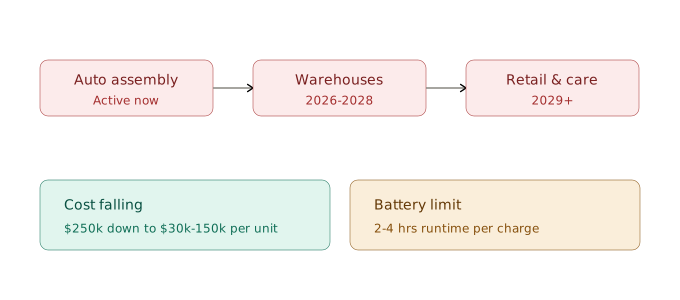
Rollouts follow environmental setup:
- Auto Assembly (Active Now): Structured lines and heavy parts handling make car plants ideal proving grounds.
- Warehouses (2026–2028): Moving totes and sorting packages fits human-height aisle layouts.
- Retail & Care (2029+): Unpredictable spaces with everyday consumers require flawless safety ratings and even lower price tags.
Tracking robotics humanoid industry news shows the sector moving out of the lab and into real production. Goldman Sachs projects the market will hit $38 billion by 2035 as physical AI becomes a staple of modern manufacturing.
Conclusion
Keeping up with humanoid robotics news trends makes one thing clear: these machines are leaving research labs behind. Driven by heavy investment, better software, and active trials in hospitals and auto plants, humanoids are proving their worth on real job sites. As battery performance improves and component prices fall, expect to see these machines transition from short-term tests into full-time roles alongside human workers.
FAQS
What is the latest breakthrough in humanoid robotics?
Surgeons at UC San Diego recently used remote controlled humanoid robots to help run live operations. On factory floors, new multi modal vision and touch models now allow bots to recognize when an item slips so they can adjust their grip on the fly without stopping work.
Which companies are leading the humanoid robotics industry?
Top hardware teams include Boston Dynamics, Tesla, Figure AI, Agility Robotics, Skild AI, Apptronik, and 1X. Tech giants like Google, Nvidia, and Amazon supply most of the underlying software and cloud infrastructure.
Why are manufacturers investing in humanoid robots?
Industrial plants face severe labor shortages and high turnover rates that simple pay raises haven’t fixed. Humanoid bots can walk right into existing, human designed facilities, saving companies from spending millions on floor redesigns.
How is AI changing humanoid robotics?
Modern Vision Language Action models combine camera feeds, voice commands, and finger pressure sensors all at once. Instead of running on rigid pre-written code, the software lets robots navigate unexpected obstacles and handle uneven objects naturally.
What industries are adopting humanoid robots first?
Automotive assembly plants and warehouse logistics centers are leading adoption. Both run structured environments with heavy, repetitive tasks like moving totes and sorting parts where automated help makes financial sense right away.

