

Table of Contents
Adaptive network control is changing modern networking. It uses real-time analytics and machine learning for optimal performance. This approach is different from traditional methods. Instead of just reacting, it predicts and adapts to network conditions. This keeps the network reliable, efficient, and secure.
I’ve spent enough time inside enterprise security rollouts to see the pattern repeat. A team locks down the perimeter, feels safe, then gets blindsided by something already inside the network. Adaptive security exists because that pattern kept failing.
Adaptive network security helps enterprise networks respond faster than attackers can move. It treats every connection, inside or outside, as potentially risky. Cisco ISE is a good example of this in practice. It can quarantine endpoints with Dynamic Access Control Lists (DACLs) or a quarantine VLAN. It can also shut down interfaces automatically. No ticket queue. No waiting for someone to notice.
In this guide, I’ll cover eight effective adaptive network control security features for 2026. I’ll explain why they matter and highlight their real limits, beyond the sales pitch.
Understanding Adaptive Network Security in 2026
In 2026, adaptive network security is central to digital protection across every industry. This isn’t a niche upgrade anymore. It’s becoming the baseline expectation.
What Makes a Network “Adaptive”?
An adaptive network changes its structure based on internal activity. This real-time link between how nodes behave and the network’s structure lets security systems use AI. They can monitor traffic and user actions effectively. By monitoring these patterns, the network can catch threats early before damage spreads.
Software-Defined Networking (SDN) is what makes this reconfiguration possible in practice. SDN separates the control logic (the decisions about where traffic should go) from the physical hardware moving it. This matters even more in modern network topologies like wireless mesh setups, where traffic paths shift constantly, and static rules break down fastest.
Timing is critical for adaptive networks. When node-level and network-level processes use the same clock, they interact. This leads to real connections between structure and function. Traditional static systems can’t do this; they wait for a human to notice something’s wrong.
How Adaptive Security Differs from Traditional Models
Traditional security models assume all traffic inside the perimeter is safe. Adaptive security uses a zero trust approach by default. Every connection gets checked continuously, no matter where it originates.
Conventional models rely on fixed rules and manual updates. Adaptive frameworks use analytics, machine learning, and automation. They change when new threats arise. That’s the real shift: from reacting after the fact to predicting before the breach happens.
Zero trust architecture reinforces this shift: “never trust, always verify.” It separates access to IT resources from network access. This removes the concept of a trusted zone completely. Multi-factor authentication (MFA) is key here. Identity must be verified first. Only then can context or risk scoring be considered. Adaptive systems act on this without waiting for a person to approve each step.
Common Misconceptions About Adaptive Controls
A few myths keep coming up.
First: adaptive AI is not a mysterious black box. It’s inspectable and controllable: you can see why it made a decision.
Second: adaptive security is more than an “AI firewall.” It’s telemetry, automated response, segmentation, and analytics all working together. It’s not just one smart algorithm added to outdated systems.
Third, and this one matters most: full autonomy isn’t the goal. Cybersecurity is still a human field. Analysts bring judgment that machines don’t have yet. The strongest setups pair automation with human oversight, not one or the other. This is the same lesson showing up across AI governance failures more broadly: the technology usually works; the breakdown happens when nobody owns the oversight layer.
8 Adaptive Network Control Security Features That Actually Work
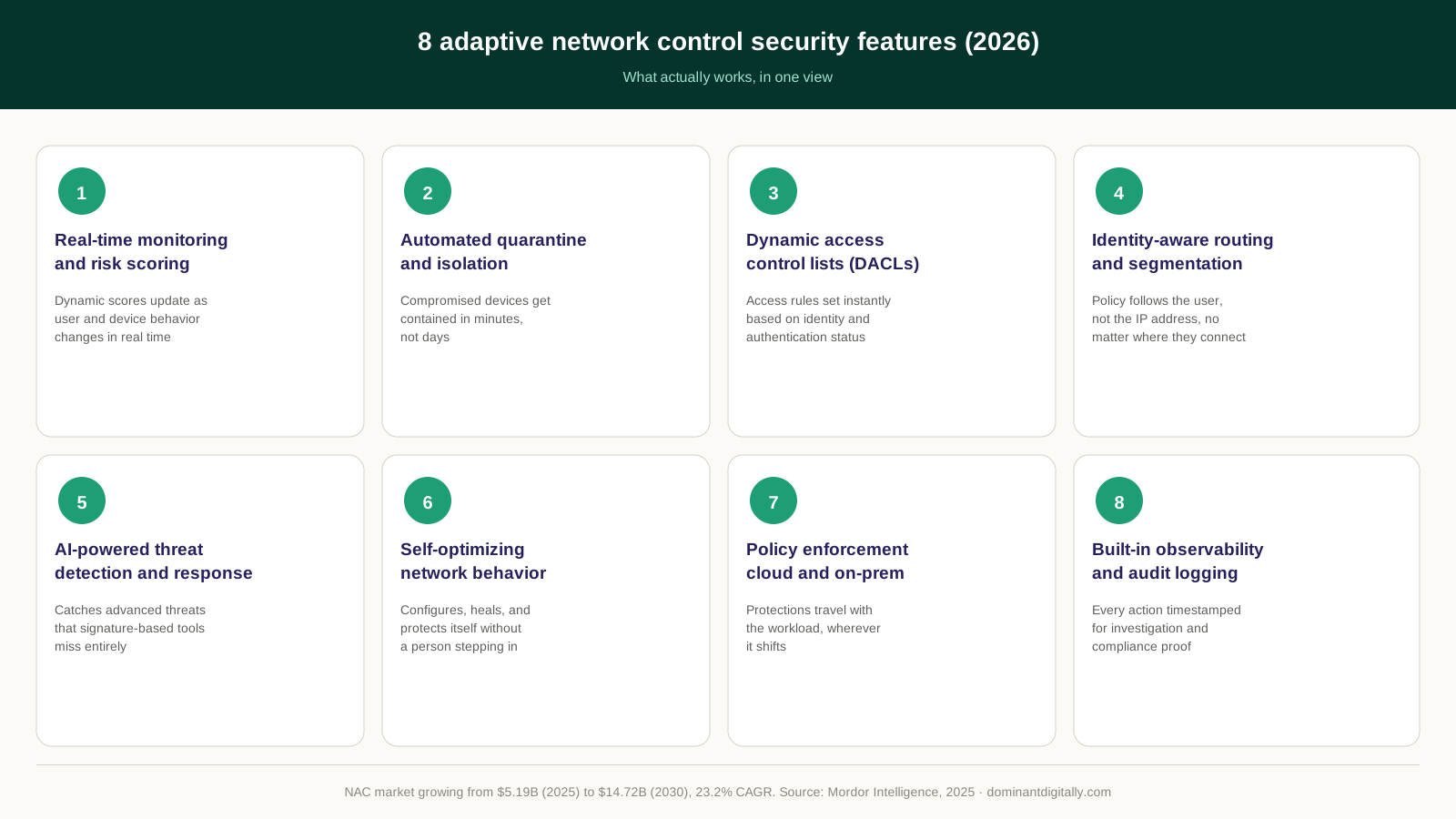
These eight features form the real backbone of adaptive network control in 2026.
1. Real-Time Monitoring and Risk Scoring
Dynamic risk scoring assigns numbers to users, devices, and sessions based on current behavior. Scores update automatically with new data: login patterns, endpoint activity, and location changes. This uses user and entity behavior analytics (UEBA). It sets a baseline for what is “normal” for each user and device. Then, it flags anything that strays from this baseline. Mixing internal signals with external threat intelligence sharpens these scores. This way, security teams can see risk changes in real time, instead of learning about them later.
2. Automated Quarantine and Isolation
When a device gets compromised, adaptive networks isolate it fast, while keeping it reachable for security monitoring.
Cisco’s Rapid Threat Containment is a working example of this mechanism. When Firepower, a SIEM platform, or a connected threat-intel source flags a compromised endpoint, Cisco ISE pushes an enforcement action straight to the switch, router, or wireless controller. This could mean a downloadable ACL, a Security Group Tag, or moving to a quarantine VLAN. No manual CLI intervention is needed. Some deployments use time-sliced containment. This means an endpoint stays in quarantine for a set time, like 20 minutes. After that, it gets automatically re-evaluated.
The stakes here are real. A 2025 study on AI-driven containment models found that manual responses can keep breaches open for months. In contrast, automated enforcement isolates a compromised device in under 15 minutes. This quick action can save millions in avoided damage per incident. Even with the best-case framing, the trend is clear: manual responses can’t keep up anymore.
Cisco’s own IT team ran this exact playbook internally. Cisco IT was the first to adopt Cisco Secure Access, a Secure Access Service Edge (SASE) platform. They rolled it out to 130,000 employees. This helped unify zero trust enforcement for a fully distributed workforce. Rich West, Principal Engineer at Cisco, shared an important result. Centralizing telemetry reduced the need for teams to manually check networking and security data. This change cut troubleshooting time by up to 25%. Jon Woolwine, Cisco’s Director of Network Engineering and Operations, put it simply: moving to a new region is now a sprint. Changing colocation sites feels the same. It’s no longer a “logistical marathon.” Setup times have dropped from months to just hours.
That’s the pattern worth noting. This approach offers more than just fewer breaches. It also reduces the time spent stitching together fragmented tools during an incident.
3. Dynamic Access Control Lists (DACLs)
DACLs apply access rules to users or devices based on their authentication status. They provide identity-based security that works regardless of a user’s physical location. DACLs work with RADIUS servers and NAC platforms. They adjust policies based on role, location, or compliance status. These policy adjustments happen without manual rule changes.
4. Identity-Aware Routing and Segmentation
Modern segmentation defines access by identity, not IP address. Policies follow the user or device no matter where they connect. They link back to the current Identity and Access Management (IAM) system. Microsegmentation adds application-layer detail to block lateral movement and protect vulnerable devices.
5. AI-Powered Threat Detection and Response
AI threat detection analyzes system behavior and flags unusual activity as it happens. These systems keep learning. They catch advanced threats or threats that signature-based tools completely miss. That’s the true advantage of newer detection methods. AI is not just about speed; it can also identify anomalies it has never encountered before.
6. Self-Optimizing Network Behavior
Self-organizing networks use AI and predictive analytics to run on their own. They configure, optimize, and heal without human intervention. They run in a loop. First, they gather telemetry. Then, they process it. Next, they adjust settings. Finally, they repeat the cycle.
Key parts of self-organizing networks:
- Self-configuration: Automatically recognizes, integrates, and sets up new nodes
- Self-optimization: Adjusts technical settings for current conditions
- Self-healing: recovers on its own when a component fails
- Self-protection: includes built-in safeguards against attack
7. Policy Enforcement Across Cloud and On-Prem
Unified policies give consistent control from the network edge to the core. Tag-driven automation lets policies follow workload attributes rather than fixed network locations. Because these protections move with the workload, they shift easily between environments. This is crucial now: many enterprise networks include both cloud and on-prem infrastructure. Attackers mainly target the policy gaps between these two areas.
8. Built-In Observability and Audit Logging
Audit logs build a timeline: who did what, where, and when. These records can’t be changed. This immutability helps in investigations after an incident and ensures ongoing compliance. Built-in observability gives teams real-time insight into network health. Consequently, teams can catch and fix problems before they disrupt operations.
Why This Is Growing So Fast
The Market data backs up what’s happening on the ground. The global network automation market is set to grow from $31.02 billion in 2025 to $84.69 billion by 2030. This represents a 22.25% CAGR. Adaptive control is a core driver of that growth, not a secondary feature.
Zero trust adoption is driving the growth of network access control. The NAC market is expected to grow from $5.19 billion in 2025 to $14.72 billion by 2030. That’s a 23.2% CAGR (Source: Mordor Intelligence, 2025). This growth is fueled by zero-trust rollouts and permanent hybrid work. Many unmanaged IoT and personal devices further fuel this demand. Traditional NAC can’t track these diverse device types.
Comparing Adaptive vs Traditional Network Security Approaches
Static Rules vs. Dynamic Policies
Traditional security depends on fixed rules that need manual updates. It relies on IP addresses and network segments. These were designed for a world with static infrastructure. In contrast, adaptive security uses tags, roles, and posture assessments. It doesn’t care about an asset’s location. It prioritizes the identity and current state of the asset.
Manual Remediation vs. Automated Response
Manual fixes can take days or weeks. Automated systems respond in minutes. The gap highlights why adaptive security is critical for modern security. An automated process solves the problem before a manual one even starts.
Perimeter-Based vs. Context-Aware Security
The old “castle-and-moat” model protects against outside threats but trusts all internal traffic. This approach creates blind spots, especially with encrypted traffic that never gets inspected. Context-aware security checks each access request based on situational factors before granting access. This is the core of zero trust: every connection is treated as inherently risky.
The Real Challenges With Adaptive Network Control
None of this is plug-and-play, and I’d be doing you a disservice by pretending otherwise.
Legacy infrastructure often creates security gaps and performance bottlenecks. Older switches, routers, and firewalls lack adaptive control layers. This leads to operational delays and management overhead. Retrofitting takes a lot of engineering time. Some hardware just can’t support detailed, identity-based enforcement. Such incompatible hardware requires replacement.
There is also privacy and compliance exposure. A system that constantly monitors each connection gathers a lot of sensitive data. This data collection raises concerns regarding GDPR, CCPA, and regulations like HIPAA. Governance needs to be settled before deployment, not patched in afterward.
The skills gap challenge. Adaptive network control combines networking, data science, and security operations. Finding professionals with expertise in all three domains is a significant challenge. Most teams are choosing targeted upskilling. They prefer this over waiting to hire someone who meets all specialized criteria.
Alert fatigue risk. Poorly tuned adaptive thresholds generate noise instead of a signal. If every small issue leads to a quarantine, teams will ignore alerts. This makes the whole system pointless.
The attack surface still needs mapping. Adaptive control reduces risk, but only for what it can see. Shadow IT, unmanaged endpoints, and unpatched legacy systems remain vulnerable. They stay part of the attack surface until included in the policy engine.
These aren’t reasons to avoid adaptive control. They’re reasons to roll it out carefully.
Best Practices for Deploying Adaptive Network Control Solutions
Start with clear policy definitions. Perform a detailed risk assessment to find specific vulnerabilities in your environment. Avoid using a generic checklist. Align policies with the regulations that apply to you, such as PCI DSS, NIST, and GDPR. This compliance works best within a zero-trust framework, which removes implicit trust everywhere, including internal traffic.
Run a parallel observation phase before granting control. Don’t flip adaptive systems directly into enforcement mode. Let the system monitor traffic for two to four weeks. This way, it can learn what “normal” looks like in your environment before it acts on its own. Skipping this step often causes problems in early rollouts. The system may quarantine real traffic because it didn’t learn the baseline.
Ensure compatibility with existing infrastructure. Design for integration with legacy systems rather than a rip-and-replace approach. Use centralized monitoring tools for better visibility in multi-vendor environments. This way, you won’t have to manage each platform separately.
Use granular segmentation from day one. Microsegmentation creates secure boundaries around individual workloads. Breaches stay limited to one segment. Network congestion decreases. Role-based access controls matter.
Avoid alert fatigue with smart thresholds. Auto-adaptive thresholds adjust based on historical patterns: location, frequency, and context. These thresholds generate fewer alerts, ensuring each one is meaningful. Longer evaluation windows reduce false positives without slowing actual response time.
Conclusion
Heading further into 2026, adaptive network control is the strongest defense against threats that keep changing shape. It’s more responsive than static security, it verifies continuously instead of trusting blindly, and it automates fixes faster than any manual process can match.
The eight features here explain why organizations are moving away from static, perimeter-based security toward context-aware, identity-focused models. Real-time risk scoring paired with automated quarantine forms the first line of defense. Dynamic access controls and identity-based segmentation keep threats contained even when perimeter defenses fail outright.
Start small. Define your policies clearly. Confirm compatibility with what you already have. Build in granular segmentation from the start, and give the system time to learn before handing it control. Get the thresholds right, and alert fatigue stops being a problem.
Adaptive network security beats the traditional approach because it accepts a simple fact: threats keep evolving, so the defense has to evolve at the same speed, or faster.
FAQs
Q1. What is adaptive network control security?
It’s a security approach that uses real-time analytics and machine learning to predict and adapt to network conditions, rather than just reacting to them after something’s already gone wrong.
Q2. How does adaptive security differ from traditional network security?
Adaptive security checks context continuously and treats every connection as potentially risky. Traditional security trusts anything already inside the perimeter and depends on manual updates to stay current.
Q3. What are the key features of adaptive network control security?
Real-time monitoring and risk scoring, automated quarantine and isolation, dynamic access control lists, identity-aware segmentation, AI-powered threat detection, self-optimizing network behavior, unified cloud/on-prem policy enforcement, and built-in observability and audit logging.
Q4. How does AI contribute to adaptive network security?
AI analyzes system behavior, flags anomalies, and prioritizes threats as they happen, including threats that signature-based tools have never seen before. That’s the real value: catching the unknown, not just the known.
Q5. What are the real risks or limits of adaptive network control?
Legacy hardware that can’t support granular enforcement, privacy and compliance exposure from continuous monitoring. A genuine shortage of engineers who understand networking, data science, and security together, and the risk of alert fatigue if thresholds aren’t tuned properly.

