


Table of Contents
Seeing content://cz.mobilesoft.appblock.fileprovider/cache/blank.html pop up in your Android browser can be confusing. What is this cryptic address? Why does it keep appearing in your browser history?
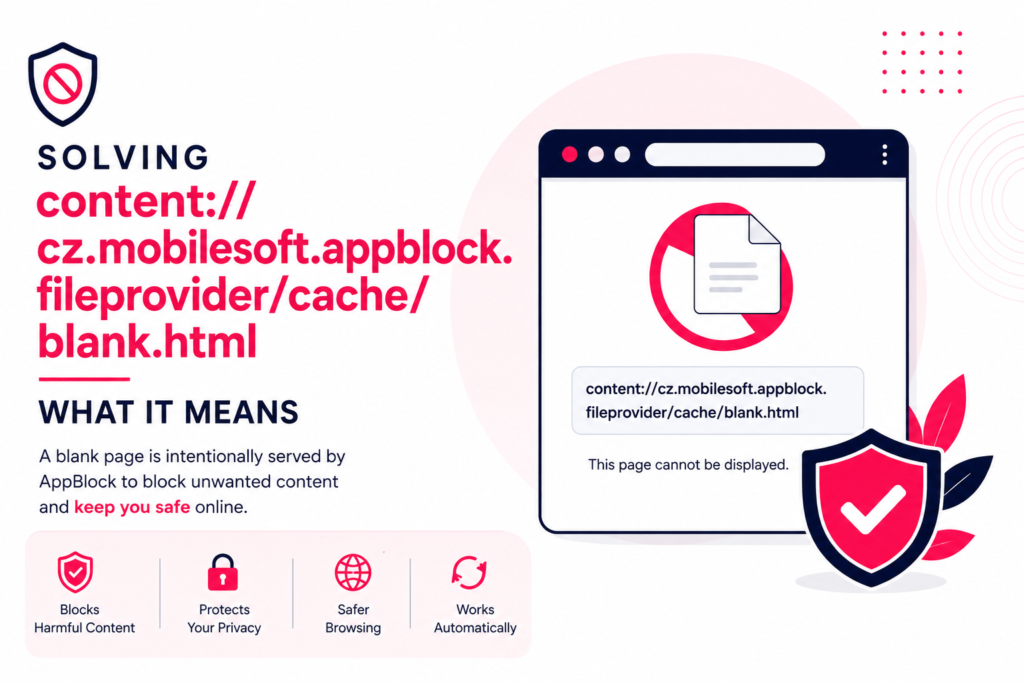
Here’s the good news. This URI isn’t a virus or malware. In most cases, it’s a harmless placeholder that AppBlock uses when it blocks websites on your device. The path is part of Android’s secure file-sharing system.
So why does it show up? AppBlock redirects your browser to a cached file instead of opening restricted websites. That’s all, most of the time.
This guide explains the URI. It tells you what it means and why it shows up. You’ll learn how to fix it. It also covers what to do if you have never installed AppBlock.
What Is content://cz.mobilesoft.appblock.fileprovider/cache/blank.html
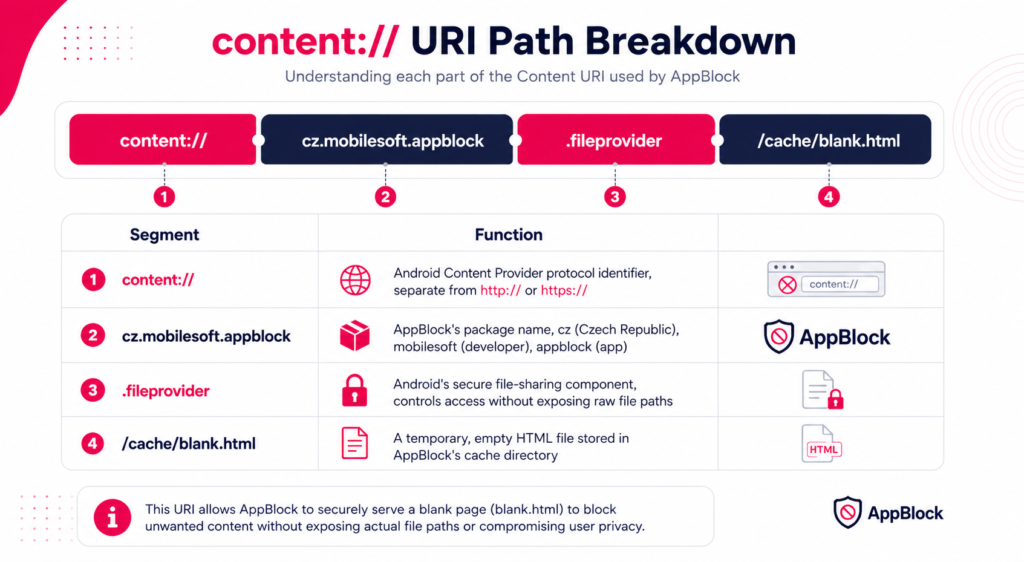
The full path breaks down into several parts. Every section plays a distinct role in Android’s file system.
URI Path Breakdown
| Segment | Function |
| content:// | Android Content Provider protocol identifier, separate from http:// or https:// |
| cz.mobilesoft.appblock | AppBlock’s package name, cz (Czech Republic), mobilesoft (developer), appblock (app) |
| .fileprovider | Android’s secure file-sharing component, controls access without exposing raw file paths |
| /cache/blank.html | A temporary, empty HTML file stored in AppBlock’s cache directory |
Android Content URI System Explained
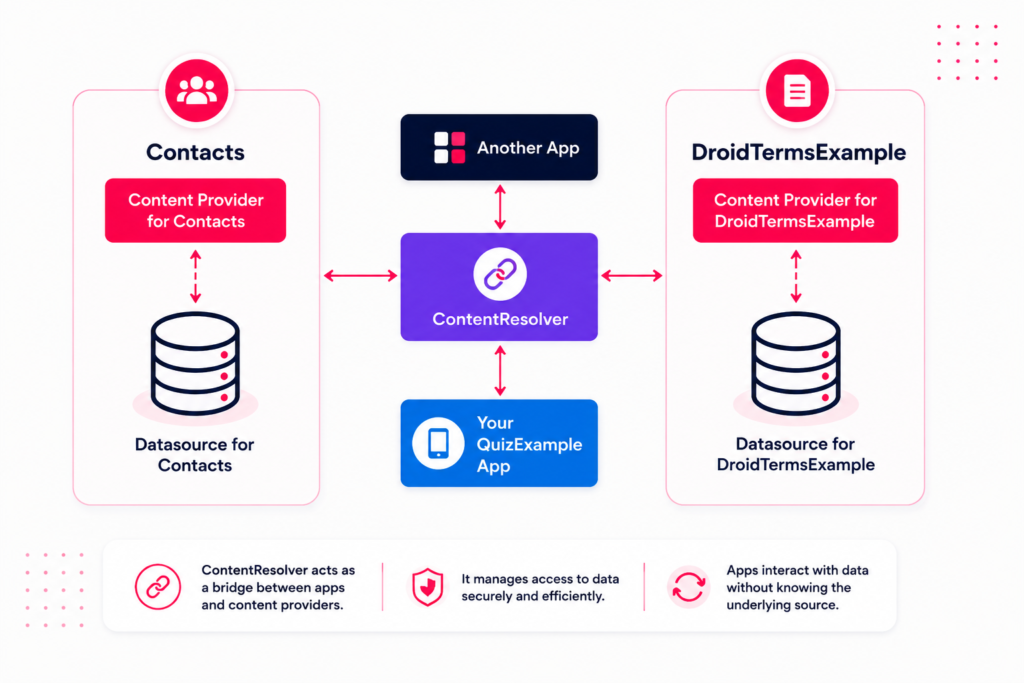
Android replaces standard file paths with content:// links for security. The old file:// system exposed direct file locations. Any app could potentially reach those files.
Content URIs operate in a distinct manner. They open a secure pathway through Android’s FileProvider system. One app can’t snoop into another app’s private files without permission, similar to the identity-aware access models used in modern enterprise network security.
Think of it like a locked box. The app hands over a temporary key to access specific files. When the key expires, access stops.
AppBlock FileProvider Architecture
The middle portion, cz.mobilesoft.appblock.fileprovider, identifies the app owner. AppBlock is a productivity app by MobileSoft, based in the Czech Republic. It blocks distracting websites and apps during focus time.
The Role of blank.html in the Cache Directory
When AppBlock blocks a website, it doesn’t freeze your browser. It redirects you to blank.html, stored in the /cache/ directory.
Here’s how it works. You try opening Instagram. AppBlock intercepts the request. Your browser loads the blank HTML file instead. No scripts run. No media loads. Just an empty page.
The file loads instantly because it’s stored on your device. No network request needed.
Why It Appears in Browser History and Logs
Android records each redirect as a visited page. Every time you hit a blocked site, it gets logged. That’s why you see this URI appear again and again.
The URI also shows up in system logs, crash reports, and WebView caches. Developers and monitoring tools capture it during debugging sessions.
Other Ways This URI Shows Up
Depending on your browser, device, or where you copy the address from, the URI can look slightly different. These are all the same thing, just formatted differently.
- content://cz.mobilesoft.appblock.fileprovider/cache/blank.htm; some browsers truncate the final “l,” showing “blank.htm” instead of “blank.html.” Same file.
- content //cz.mobilesoft.appblock.fileprovider/cache/blank.html (with a space instead of://); this happens when the URI gets copied from a log or notification and the colon-slash-slash gets mangled.
- “cz null” in system logs: the cz prefix is just the Czech Republic country code from AppBlock’s package name. A “cz null” entry means AppBlock tried an operation that returned no result. Harmless, not an error.
None of these variations point to a different or more serious problem. They’re all the same AppBlock placeholder file.
I Didn’t Install AppBlock: Why Am I Seeing This?
This is the question that actually worries people, so it deserves a straight answer.
If you’re sure you never installed AppBlock, don’t assume it’s automatically safe. Check it properly first.
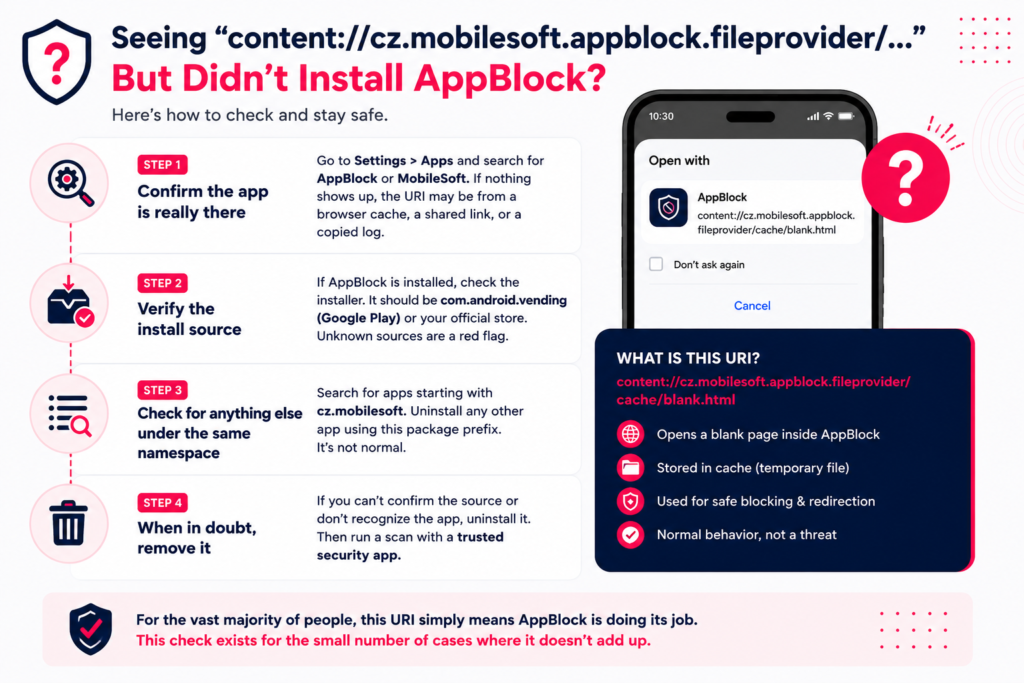
Step 1: Confirm the app is really there
Go to Settings > Apps and search for AppBlock or MobileSoft. If nothing shows up, the URI may have come from a browser cache, a shared link, or a copied log, not an active app on your device.
Step 2: Verify the install source
If AppBlock is installed, open its app info page and check the installer (AppBlock’s official Play Store listing). It should say com.android.vending (Google Play), or match whichever official store your device uses, Huawei AppGallery, Samsung Galaxy Store, or similar. An unfamiliar installer source is a real warning sign.
Step 3: Check for anything else under the same namespace
Search your app list for anything starting with cz.mobilesoft. Search your app list for anything starting with cz.mobilesoft. Uninstall any second app using this package prefix. It’s not normal.
Step 4: When in doubt, remove it
If you can’t confirm the source or don’t recognize the app, uninstall it. Then, run a scan with a trusted security app. This isn’t a common outcome, but it’s worth ruling out rather than guessing.
For the vast majority of people, this URI simply means AppBlock is doing its job. This check exists for the small number of cases where it doesn’t add up.
Step-by-Step Solutions to Remove content cz mobilesoft appblock fileprovider cache blank html
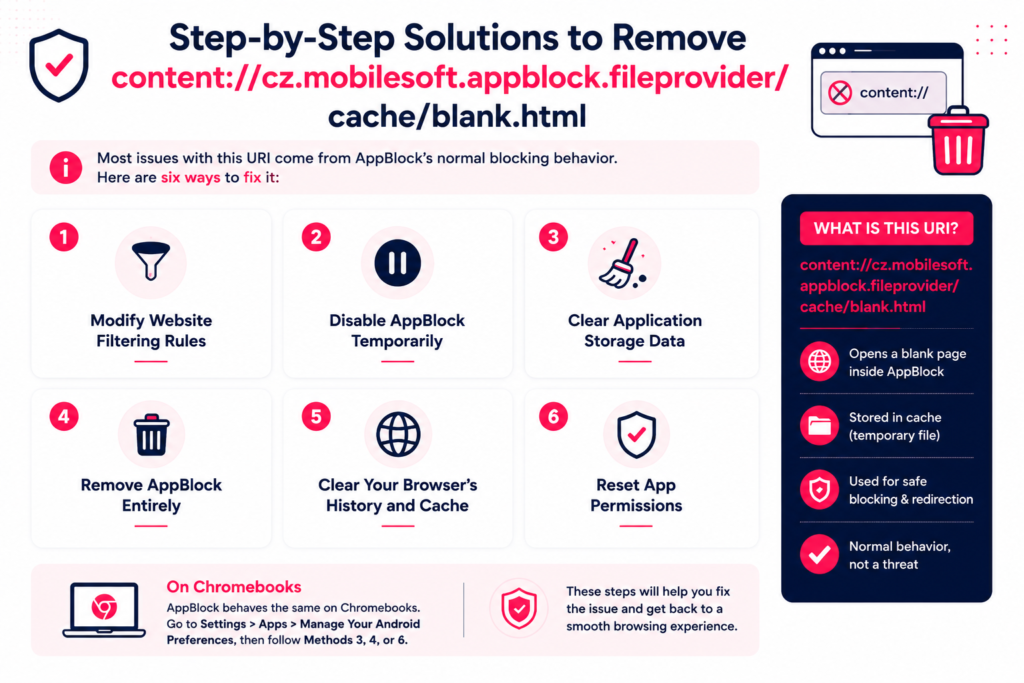
Most issues with this URI come from AppBlock’s normal blocking behavior. Here are six ways to fix it:
Method 1: Modify Website Filtering Rules
Open AppBlock and check your active schedules or Quick Block settings. Adjust which websites get blocked. Disable adult content blocking if that’s causing unwanted redirects.
Method 2: Disable AppBlock Temporarily
Turn off your active schedule or Quick Block without Strict Mode. If Strict Mode is active, meet the deactivation condition first: a charger connection, your PIN, your approval contact, or a timer.
Method 3: Clear Application Storage Data
Go to Settings > Apps > AppBlock > Storage & Cache. Tap Clear Cache first. If the issue persists, tap Clear Storage instead. This resets the app and removes saved settings.
Method 4: Remove AppBlock Entirely
Check if Strict Mode has “Disable AppBlock Uninstalling” turned on. Disable Strict Mode first. Go to Settings > Device Admin Apps and turn off AppBlock as a device admin. Then uninstall normally.
Method 5: Clear Your Browser’s History and Cache
This works the same way in Chrome, Firefox, or Samsung Internet. Open your browser’s settings, clear browsing history, then clear cached images and files. This removes the blank HTML entries left behind by AppBlock.
Method 6: Reset App Permissions
AppBlock needs several permissions to work. Restore them through your device settings if they were auto-revoked due to inactivity. This will help Block work correctly again.
On Chromebooks
AppBlock behaves the same way on Chromebooks running the Android subsystem. Go to Settings > Apps > Manage Your Android Preferences, then follow Methods 3, 4, or 6 exactly as you would on a phone.
Is content://cz.mobilesoft.appblock.fileprovider/cache/blank.html Safe?
Yes, for the standard case. AppBlock stores all blocking data locally on your device. It doesn’t sell personal data to third parties. Your usage stays private, and the app operates transparently within Android’s security model.
The one exception is the scenario covered above: an unrecognized app using the same package prefix. Rule that out first, then treat the URI as routine.
For Developers
The sections below are technical. Skip them if you’re just trying to stop the redirect.
Fixing Permission-Related Access Errors
Add FLAG_GRANT_READ_URI_PERMISSION to your intent when sharing content URIs. For Android 4.1–5.1, add ClipData too; use ClipData.newRawUri with both read and write permission flags. This is automatic when android:grantUriPermissions=”true” is set in the manifest.
Resolving WebView Loading Problems
Enable JavaScript first. Set DOM storage to true; without setDomStorageEnabled(true), WebView can’t use session or local storage. Enable caching with LOAD_CACHE_ELSE_NETWORK mode. For debugging, turn on WebView content debugging on Android 4.4 and higher.
Handling Repeated URI Entries in System Logs
Duplicate entries appear because Android logs each redirect separately. Filter logs by timestamp and URI pattern to tell unique events apart from duplicates.
If you’re maintaining a production Android app with embedded WebViews, this is exactly the kind of integration work handled by our web design & development team.
Analyzing Potential Security Risks
Improperly configured FileProviders create real problems. An attacker can read, overwrite, or execute arbitrary files on a device. Apps using a wildcard path like <external-path name=”root” path=”.”/> expose the entire filesystem, including sensitive databases and native libraries. This is a general Android security note, not a flaw specific to AppBlock, but it’s worth knowing when you see any fileprovider URI, not just this one.
For developers working across multiple platforms, understanding how Android handles content URIs connects directly to modern app development practices.
Conclusion
The content://cz.mobilesoft.appblock.fileprovider/cache/blank.html URI isn’t dangerous in the standard case. It’s AppBlock redirecting blocked sites to a blank page, using Android’s secure file-sharing system.
Six practical fixes are above, from adjusting filter rules to removing the app entirely. If you never installed AppBlock, run the verification steps before assuming it’s harmless. Pick the path that fits your situation and get back to a clean browsing history.
FAQs
Q1. What does the content //cz.mobilesoft.appblock.fileprovider/cache/blank.html URI mean on my Android device?
It’s a secure file path created by AppBlock when it blocks websites. Not a virus, a placeholder that loads a blank cached page instead of the restricted site.
Q2. Why does this URI keep appearing in my browser history?
Android logs every redirect as a visited page. Each blocked site you try to open adds another entry, which is why the URI repeats.
Q3. How can I stop seeing this URI in my browser?
You can change AppBlock’s filtering rules. You can pause its schedule. You can clear your browser history. You can also uninstall the app. Just remember to disable Strict Mode and device admin access first.
Q4. Is the URI safe if I have AppBlock installed?
Yes. AppBlock keeps all blocking data on your device and doesn’t share it with third parties. It’s part of Android’s built-in FileProvider system.
Q5. What should I do if I’m getting permission errors related to this URI?
Go to your device settings. Restore AppBlock’s permissions. Clear the cache. Clear the storage. Allow accessibility and usage-access permissions.
Q6. Why do I sometimes see “blank.htm” or “content //” instead of the full URI?
Formatting differences from how a browser or log displays the address. Same file, same cause, nothing to worry about.

