



Here’s what I’ve learned after watching countless AI projects crash. AI transformation is a problem of governance, a challenge often overlooked in business reality.
The numbers tell a brutal story. Three out of four enterprises face serious problems because their AI systems aren’t connected. Even worse, only 22% move past testing to create real value. Just 4% generate substantial results.
The culprit? Most companies rush to deploy AI without proper oversight. They lack clear rules, accountability, or risk management. So their pilots stay pilots. Their tools multiply unchecked. Their data quality suffers.
In this guide, I’ll explain how AI governance issues can slow down transformation efforts. I’ll also share ways to address these challenges before regulations catch up.
Understanding the AI Governance Gap in AI Transformation Governance
What Is AI Governance and Why It Matters
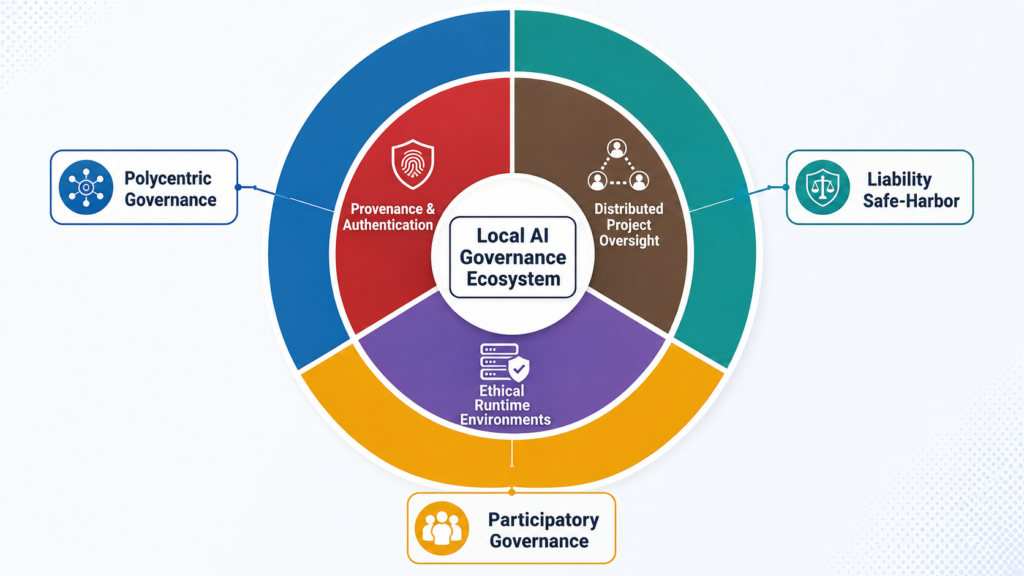
AI governance is the system of rules and frameworks that guide how you build and deploy AI systems. Think of it as both guardrails and enforcement for your AI operations.
But here’s the problem. Though 88% of organizations use AI, only 8% have solid governance frameworks for it. That’s a massive gap between usage and oversight.
AI governance turns ethical intent into practical action. It addresses transparency, accountability, and fairness across your AI lifecycle. Without it, you risk biased results, privacy issues, and security threats. These can harm your reputation and lead to regulatory checks.
In reality, 80% of business leaders see AI explainability, ethics, bias, or trust as a major roadblock to adoption. Your employees and stakeholders may lack confidence in AI’s reliability without clear guidelines.
AI Governance vs Traditional IT Management
Your existing IT governance won’t cut it for AI systems.
Traditional IT governance handles clear systems. It looks at server vulnerabilities. It checks data retention. It also ensures that we meet uptime standards. AI works in a unique way. Machine learning models develop their own decision patterns based on data.
The gap becomes clear when you examine what each framework addresses. IT governance covers system failures and controlled modifications.
AI governance covers three main areas:
- Explaining algorithmic decisions
- Managing models that change beyond their original programming
- Addressing biased data that leads to unfair outcomes
AI governance spans seven areas your IT framework misses:
- Algorithmic accountability for errors
- Explainability for customers and regulators
- Bias detection in results
- Ethical limits before deployment
- Human oversight structure
- Stakeholder Impact Assessment
- Adaptive risk management
This highlights AI governance as part of business evolution and contextual business reality. Traditional governance asks if an actor was authorized to do something. AI governance should verify the agent’s correct actions. It should look at the context. It also needs to consider past behavior and future effects.
The Transformation Gap: Pilots vs Production
Most AI pilots never become production systems. The RAND Corporation reports that more than 80% of AI projects fail. MIT’s research shows that about 95% of generative AI pilots do not give any return.
Organizations struggle because they architect pilots for proof of concept, not production. Barely 25% of AI leaders have the infrastructure muscle to sustain production-grade workloads.
The breakdown happens when pilots use sandboxed data. It also occurs with borrowed cloud credits. This is without a link to enterprise systems. Governance, DevOps, and data compliance come in late. This turns the transition into an expensive rebuild.
If your pilot can’t reach real-time enterprise data or meet data governance rules, it won’t be able to scale. The cost of this failure ranges from USD 5 million to USD 20 million.
In 2025, 42% of companies dropped most AI initiatives. This was a big increase from 17% in the previous year. Organizations are scrapping nearly half of their AI proofs of concept before production.
Algorithms as Decision Makers
AI systems now make decisions that traditionally belonged to humans. From credit scoring to hiring to healthcare diagnostics, algorithms influence high-stakes outcomes.
This creates new legitimacy challenges. Algorithmic decision-making can hurt democracy. It can ignore rules. It may also lead to results that do not match public values.
Algorithmic systems are complex. They depend on each other. This changes how governments and businesses make decisions. Automated decision-making needs safeguards. Without them, it can worsen biases. This can lead to denying benefits. It may also misidentify people or misdiagnose illnesses.
Human oversight becomes critical but insufficient on its own. Meaningful human control requires more than an on/off switch. You need intervention points, escalation procedures, and override mechanisms built into every AI system.
Boards and leaders should stop focusing only on data analysis. They need to interpret data with careful consideration. Also, they must ensure ethical oversight. Relying too much on automated systems can weaken decision-making skills and critical thinking.
Top Challenges in Implementing AI Governance: Key Challenges Organizations Face
Companies know they need AI governance, yet the biggest AI governance problems arise when building frameworks.
No Clear Accountability Structure
When AI systems fail, nobody owns the problem. Business units, IT, and data teams spread the responsibilities. No one person is in charge.
In fact, 97% of organizations reporting AI-related breaches lacked proper access controls. This is exactly the kind of identity-based access gap that adaptive network security models are built to close. Without explicit accountability, AI use cases multiply with no clear owner.
The cost is real. One in five data breaches now involves shadow AI, adding up to USD 670,000 to the average breach cost. Organizations need a senior owner. This person is in charge of AI systems. They ensure these systems meet accuracy, risk, and compliance standards.
Shadow AI and Ungoverned Tool Usage
Seventy-five percent of knowledge workers use generative AI at work, yet more than 80% rely on unapproved tools. Employees paste source code into chat assistants and run coding agents. There’s no policy layer in between.
This creates data leakage nobody can track. When an employee pastes a contract into a public AI tool, the content goes to outside providers. It does not stay internal. There’s no audit trail because the traffic never passes through controlled systems.
Shadow AI causes 20% of data breaches. In 63% of these cases, organizations lack AI governance policies.
Data Quality and Integrity Issues
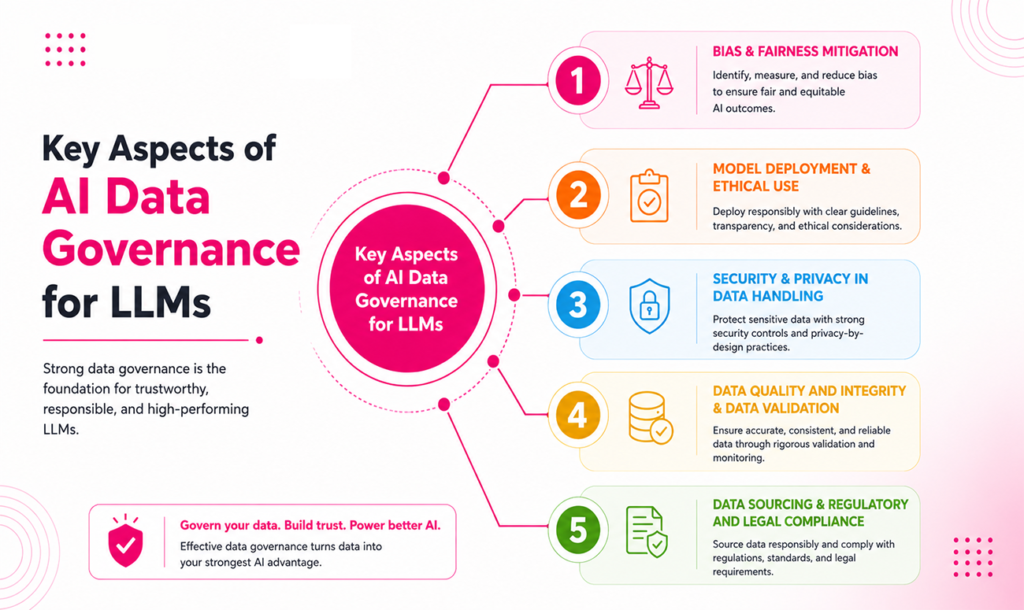
Poor data quality remains the silent killer of AI initiatives. Research says 77% of organizations have data quality problems. Also, 25% of critical data has mistakes. These errors can hurt AI outputs.
Many interviewees noted that 80% of AI is the dirty work of data engineering. They structured legacy datasets for compliance, not analysis. They lack the context about why things happened, only what happened.
Data quality has fallen by 9% since 2021. This decline happens because modern AI models need more detailed and updated inputs. Manual mistakes, format mismatches, and conflicting records weaken how models reason and learn.
Lack of Standardized Processes
Different teams follow their own approaches to model development, validation, and monitoring. Without standard rules, AI systems can vary a lot. Their quality and reliability show considerable variation among organizations.
This fragmentation makes governance inconsistent and difficult to scale. Many organizations don’t have full workflows for intake, assessment, and monitoring. This can lead to use cases skipping steps. Sometimes, they even skip the review process completely.
Making framework language into executable, repeatable processes is a big challenge. Many people see it this way.
Skills Gap and Training Needs
AI talent gaps are widening fast. There is an expected AI talent gap of 50%. Only 1 in 10 global workers has the AI skills that organizations need.
Meanwhile, 55% of employees say they need more training to do their jobs better. Only 35% of workers get AI training or upskilling. This is surprising since 75% of companies use AI in their systems.
AI governance requires collaboration across technical, legal, ethical, and organizational domains. Many institutions still work in isolation by discipline. Only 6% of organizations give all staff complete AI training. Meanwhile, 40% provide no AI training whatsoever.
Balancing Innovation with Control
Organizations encounter a difficult trade-off. Excessive control can slow down decision-making and hinder innovation. So, too little governance can heighten risk exposure.
When governance is too strict, it causes bottlenecks. This leads to workarounds, like the growth of shadow AI. Organizations must find the right equilibrium between performance, transparency, and ethical conduct.
Compliance costs add pressure. For one AI unit, compliance costs can hit €29,277 a year. This is a heavy load for organizations with limited resources. Smaller healthcare providers and startups could feel this impact even more. This is true for those making risky applications.
AI Governance Frameworks: Core Pillars for Business Context and Continuous Improvement
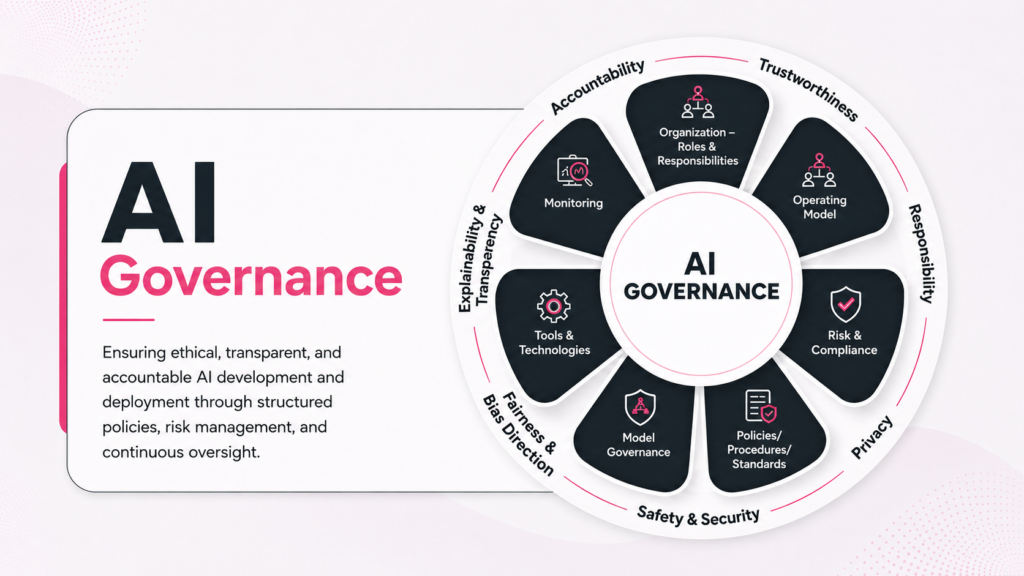
Strong governance frameworks rest on five pillars. Each addresses a specific dimension of AI risk.
Data Sovereignty and Integrity
You need control over your data throughout the AI lifecycle. Data sovereignty involves controlling where individuals or organizations store their data. It also involves deciding who can access the data and how it moves through AI systems.
This goes beyond storage location. It covers real-time inputs, model outputs, and continuous operations. Organizations must follow regional laws for data. This applies to training, inference, and monitoring. Compliance is key.
Data integrity forms the backbone of trustworthy AI models. When data integrity fails, AI outputs become biased, inaccurate, or harmful. Your data needs to be complete, accurate, and relevant. AI produces results based on the quality of the data it receives.
Model Governance and Validation
Model validation is an independent, expert assessment of design, assumptions, calculations, and outputs. It protects against model drift. This happens when accuracy fades as assumptions get old or data changes.
A strong validation framework checks each stage of the lifecycle. It examines inputs. It looks at calculations, assumptions, controls, and outputs. Validators should compare model outputs to models created independently. This confirms that calculations function as intended and deliver reliable results.
Validation isn’t a one-time task. Significant model updates, input data changes, or regulatory shifts should trigger fresh reviews.
Ethical AI and Bias Prevention
Bias in AI usually comes from two sources: model design and training data. Models may show developers’ assumptions. Training data can carry historical biases or systemic gaps.
Machine learning tools handle large amounts of data. So, even tiny biases can cause big discriminatory results. Data preprocessing techniques reduce bias risk. Anonymization plays a key role. It is also important to handle missing data carefully.
Fairness-aware algorithms and human oversight incorporated into processes audit AI decisions for bias. Bias testing checks systems. It uses known benchmarks. This helps find differences among demographic groups.
Risk Classification and Mitigation
The NIST AI Risk Management Framework helps groups find specific risks. It also suggests actions that match their goals. The EU AI Act defines four distinct risk levels for AI systems.
High-risk AI systems have strict requirements. They need to:
- Conduct thorough risk assessments
- Use high-quality datasets
- Log activities
- Maintain detailed documentation
- Provide clear information to users
- Ensure human oversight
- Achieve high robustness
Organizations must identify, map, and reduce risks. These include bias, security gaps, and impacts on fundamental rights.
Human Oversight Architecture
Designers should create high-risk AI systems for easy oversight by people during use. Human oversight seeks to reduce risks to health, safety, and basic rights.
The system should help overseers see its strengths and weaknesses. They can spot issues and avoid over-reliance. They can also interpret outputs. If needed, they can choose not to use it or stop it. For some systems, wait for at least two skilled people to confirm the ID. Then take action.
Human-in-the-loop means trained humans keep decision authority over high-risk agent actions. This requires timely context, intervention authority, and defensible rationale at critical decision points.
Implementing AI Governance Step-by-Step
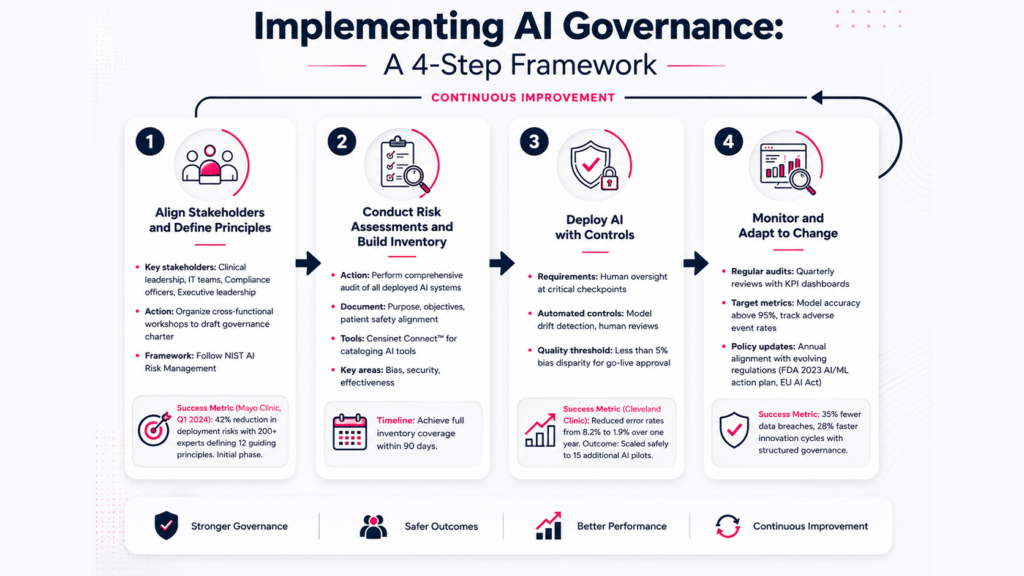
Building governance takes structured execution. Here’s how organizations move from theory to practice.
Assess Current State and Map AI Systems
Start with a complete inventory of every AI system in use. Survey teams. Check procurement records. Scan IT systems. Most organizations have more AI than leaders know.
Document each system’s purpose, data sources, owners, and risk exposure. Without this visibility, you cannot govern what you cannot see.
Classify Use Cases by Risk Level
Next, assign each AI system to a risk tier using EU AI Act classifications or internal criteria. Assess decision impact, customer exposure, regulatory sensitivity, and potential harm.
High-risk systems need strict controls. Low-risk tools move faster with lighter review.
Assign Roles and Responsibilities
Use the Three Lines of Defense model for clear accountability.
- First Line: Owns AI development and deployment
- Second Line: Sets policies and monitors compliance
- Third Line: Provides independent audits
Name one accountable executive per high-risk system. Diffuse ownership means no ownership.
Set Up Policies and Technical Controls
Implement Minimum Viable Governance immediately instead of waiting for perfect solutions. Attach each policy to a specific control and owner.
Embed governance checkpoints into your AI lifecycle at natural decision points. Pre-deployment gates verify risk, privacy, and compliance before launch.
Pilot, Scale, and Optimize
Run a 90-day pilot on two or three high-priority systems. Apply full governance: inventory, risk assessment, monitoring, and accountability.
Surface gaps before scaling. Once validated, automate effective controls and expand across business units. Review quarterly and adapt as AI capabilities evolve.
AI Governance Issues: Regulatory Compliance and Future Trends
Regulations aren’t waiting for you to get ready. They’re already here.
Key Regulations and Standards
The EU AI Act is the first complete AI law in the world. It sets risk-based rules for those who develop and use AI. It outlines four risk levels. These range from prohibited uses to high-risk applications that need strict governance.
High-risk systems have key obligations before entering the market. They need to:
- Conduct a thorough risk assessment
- Use high-quality datasets
- Log activities properly
- Provide detailed documentation
- Ensure human oversight
Non-compliance triggers fines of up to €35 million or 7% of global turnover.
The NIST AI Risk Management Framework helps evaluate risks in four areas. These are Govern, Map, Measure, and Manage. ISO/IEC 42001:2023 formalizes governance roles and oversight mechanisms within organizational structures.
Singapore launched its first state-backed Model AI Governance Framework for Agentic AI. This happened on January 22, 2026. It emphasizes that humans must remain accountable for decisions made by autonomous systems.
Auditability and Documentation Requirements
Documentation should outline the following:
- Purpose
- Authority and scope
- Access permissions
- Risk assessment findings
- Oversight assignments
- Escalation procedures
We must keep logs and change records for auditability.
Clear documentation supports traceability, accountability, and regulatory alignment across the lifecycle. Only 26% of organizations using AI have full documentation. This means they explain the model’s purpose, data inputs, and risks.
Agentic AI and Autonomous Systems
An AI system is agentic when it starts actions, uses tools, or runs multi-step tasks on its own. This shift toward autonomous, self-directed systems is already reshaping how companies plan their 2026 AI roadmaps. Governance issues arise when systems run live. This is worse than when they create outputs for people to review.
Agentic architectures pose risks beyond single organizations. Malicious AI swarms can work together to invade communities. They create fake agreements that threaten real democratic debates.
Techniques like prompt injection and memory poisoning can change goals. This can lead to unauthorized actions. It may also trigger cascading hallucinations. One compromised agent can quickly steal data or start harmful transactions.
The ROI of Strong Governance
Strong governance practices enable market access. Once the EU AI Act takes effect, companies can’t sell high-risk AI systems that don’t follow the EU market.
Seventy-five percent of executives said ethics is key for a competitive edge. Organizations that treat governance as a strategic capability get a 30% ROI boost. This is much better than those who see it as compliance.
So, the average data breach costs USD 4.45 million. This doesn’t include the reputational damage that can hurt customer trust for years. Effective governance technologies could reduce regulatory expenses by 20%, freeing resources for innovation.
Conclusion
AI transformation is not a technology problem; it fails because governance is skipped.
The statistics from earlier tell the full story. Three out of four enterprises struggle with disconnected AI systems. Only 22% move past pilots. Just 4% see real results.
Regulations like the EU AI Act aren’t coming. They’re already here, with fines reaching €35 million. You can’t afford to wait for perfect frameworks or complete clarity.
Start with Minimum Viable Governance today. Map your systems, assign clear owners, and classify risks. Add oversight to your AI lifecycle now. This helps avoid costly rebuilds for compliance later.
Governance isn’t a barrier to strong performance. As a result, it makes it easier to separate pilots from production-ready systems. In the end, AI transformation is a problem of governance. Without oversight, even the best algorithms fail.
Key Takeaways
AI transformation fails primarily because of governance gaps. Around 80% of AI projects fail. This happens because organizations lack clear oversight, accountability, and risk management.
– Only 22% of AI pilots make it to production. This happens because of weak governance frameworks. Each failed initiative can cost organizations between $5 million and $20 million. Additionally, 42% of project teams abandon their projects entirely.
– Shadow AI poses big security risks. About 75% of workers use unapproved AI tools. This contributes to 20% of data breaches and adds $670,000 to breach costs.
• Implement Minimum Viable Governance immediately by mapping all AI systems, classifying them by risk level, assigning clear ownership, and embedding compliance checkpoints before deployment.
– EU AI Act compliance is now mandatory, not optional. High-risk AI systems can incur fines of up to €35 million or 7% of global revenue for failing to comply.
• Strong governance provides a 30% ROI advantage. It opens markets. It cuts regulatory costs by 20%. It also gives a competitive edge with ethical AI.
The path ahead is clear. Organizations need to see AI governance as a key strategy. It shouldn’t be just a compliance task. Begin a 90-day pilot on key systems. Automate effective controls. Then, expand governance across business units. Without proper oversight, your AI investments will just be costly experiments. They won’t bring real business value.
FAQs
Q1. Why do most AI projects fail to move from pilot to production?
Most AI projects fail because they lack proper governance structures from the start. Pilots often use sandboxed data or temporary setups. They are usually separate from enterprise systems. When organizations scale, they often find missing governance. They also see gaps in DevOps integration and data compliance. This can lead to costly rebuilds. Over 80% of AI projects fail to show measurable business value.
Q2. What is shadow AI and why is it a security concern?
Shadow AI happens when employees use AI tools and services without IT approval. Seventy-five percent of knowledge workers use generative AI tools. Their organizations do not approve of these tools. This poses big security risks. Sensitive data, such as source code or contracts, goes to third-party providers.
Q3. How does AI governance differ from traditional IT governance?
Traditional IT governance manages predictable, rule-based systems with clear authorization protocols. There are fundamentally different challenges in AI governance, such as algorithmic decisions that need explanations, models that adapt beyond their original programming, potential bias in outcomes, and ethical boundaries. IT governance asks, “Was this authorized?” AI governance adds another layer. It must ask, “Should this be done?” based on context, behavioral history, and downstream consequences.
Q4. What are the main components of an effective AI governance framework?
Five main pillars build an effective AI governance framework. It protects data sovereignty and integrity. It controls where data is stored and ensures its quality stays high. Second, it makes sure the model is governed and validated. It does this with independent checks on design and outputs. It promotes ethical AI. It prevents bias and tests fairness among different groups. It also manages risk by identifying possible harms and planning how to reduce them. It ensures human oversight, keeping trained people in charge of high-risk decisions.
Q5. What penalties do organizations face for non-compliance with AI regulations?
Under the EU AI Act, organizations using high-risk AI systems must follow regulations. If they don’t, they could face fines of up to €35 million or 7% of their global annual turnover, whichever is greater. Non-compliance leads to extra costs beyond penalties.
Q6. What risks do organizations face without clear AI governance?
Without clear governance, AI projects run into problems. They face compliance issues, data privacy breaches, and wasted money. The risk is not about technology. It’s about money and reputation. Organizations with weak governance frameworks often fail more. They also see lower ROI, according to studies.
Q7. What are the top challenges in implementing AI governance?
The biggest hurdles include cultural resistance, talent gaps, and unclear accountability. Many teams struggle to align governance with business reality. Many do not include governance in their daily tasks. This leads to a gap in AI transformation.
Q8. How does AI transformation governance differ from traditional IT governance?
IT governance focuses on rules and authorization. AI transformation governance goes deeper. It deals with bias, explainability, and ethical boundaries. Instead of asking “Was this allowed?” it asks, “Should this have been done?” This highlights a business need for ongoing improvement.
Q9. Why is AI transformation not just a technology problem?
Leaders often blame the tech stack when AI projects fail, but the real issue is governance. Without clear policies, risk management, and accountability, even the best models collapse. Governance is the missing piece in AI business evolution.
Q10. Can case studies help organizations improve AI governance?
Yes, AI governance case studies in healthcare, finance, and retail show both successes and failures. They point out both successes and failures. This includes data privacy issues under GDPR and ethical mistakes in bias mitigation. Learning from these examples helps organizations build stronger, more resilient governance strategies.
Q11. Why is AI transformation a problem of governance, not technology?
AI transformation often fails. Organizations tend to focus on tools and platforms. They often ignore governance. The real challenge isn’t choosing between Microsoft Azure AI, AWS SageMaker, or Google Cloud AI Platform. It’s about something else. It’s about clear rules for data privacy. It’s also about reducing bias and ensuring accountability.

