


Table of Contents
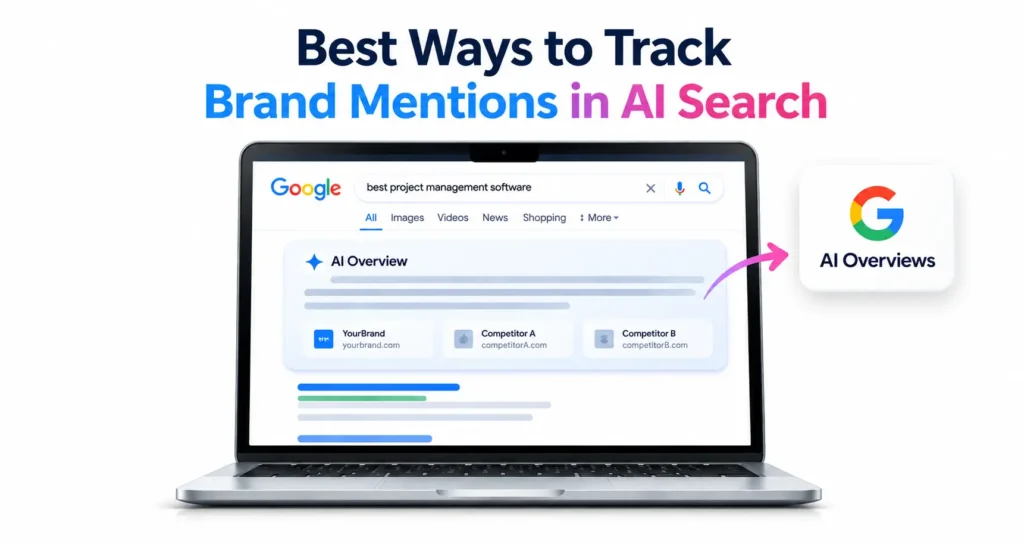
The best ways to track brand mentions in AI search start with a list of real buyer prompts, which you run several times on every AI platform your customers use. Each run is logged for whether your brand appeared, where it ranked, and how it was described. From there, you compare your share of voice against named competitors on a fixed schedule. Repetition matters because AI answers change from one run to the next, so a single check tells you very little.
This guide covers ChatGPT, Google AI Overviews, AI Mode, Gemini, Perplexity, Copilot and Claude. It also includes a ready-to-use prompt list, a tracking sheet layout you can copy, a tool comparison table, and answers to the most common questions.
What Is a Brand Mention in AI Search?
A brand mention happens when an AI tool names your brand in its answer, whether or not it links to your site. Mentions come in six types, and a useful tracking process logs all of them rather than only the first:
• Direct mention: the answer uses your brand name.
• Indirect mention: the answer describes your product without naming it.
• Citation-backed mention: the answer names you and links to a page as its source.
• Comparison mention: the answer lists you alongside competitors.
• Warning mention: the answer names you but attaches a complaint or a limitation.
• Missing mention: competitors are named for a prompt where you should appear, while you are left out.
The last type is the one most teams forget, even though it usually points to the biggest opportunity. Unlinked mentions matter too, because a model forms its view of your brand from patterns across many pages, whether those pages link to you or not.
Why AI Brand Tracking Matters in 2026
AI assistants now send a meaningful share of high-intent visitors. Adobe Analytics found that AI traffic to US retail sites grew 393% year over year in the first quarter of 2026. In March 2025 that traffic converted 38% worse than other channels. By March 2026 it was converting 42% better, making it one of the most valuable sources a retailer has TechCrunch.
ChatGPT still dominates referrals, with OpenAI reporting more than 900 million weekly active users in February 2026. Grips Intelligence data published by eMarketer shows ChatGPT sending 92.2% of US ecommerce AI referral traffic in the same quarter eMarketer. The same data shows Claude’s ecommerce referrals growing 3,798.6% year over year, from a small base.
The leadership position is starting to spread out, though. Digital Commerce 360 and ReFiBuy track which AI platform is the top referral source for each of the Top 1000 online retailers. Between Q1 and Q2 2026, the number of retailers whose top source was ChatGPT fell from 844 to 722. Over the same period Gemini doubled from 16 to 32, Perplexity rose from 8 to 21, and Claude went from leading for one retailer to leading for fifteen Digital Commerce 360. That count measures the leading source per retailer rather than total traffic share, but it still shows why tracking a single platform is no longer enough.
Why AI Search Tracking Is Different From Rank Tracking
A keyword holds one position in a search result at any given moment, whereas an AI answer is generated fresh each time. If you ask the same question ten times, the brands named, their order, and whether a source link appears can all change between runs.
The table below shows the kind of pattern you should expect when one prompt is run ten times on one platform. It is illustrative rather than a published test, but the spread it shows is typical of what manual tracking turns up.
| Run | Brand mentioned | Position | Note |
| 1 | Yes | 2 of 4 | Cited own website |
| 2 | Yes | 1 of 3 | No citation shown |
| 3 | No | Not mentioned | Two competitors named instead |
| 4 | Yes | 3 of 3 | Negative framing on pricing |
| 5 | Yes | 1 of 2 | Cited a third-party review |
| 6 | No | Not mentioned | Generic answer with no brands |
| 7 | Yes | 2 of 4 | No citation shown |
| 8 | Yes | 1 of 4 | Cited own website |
| 9 | No | Not mentioned | Different competitor set |
| 10 | Yes | 2 of 3 | Cited own website |
Across these runs, the brand appears 70% of the time. Checking only run 3, 6 or 9 would suggest it never appears, while checking only run 2 or 5 would suggest it always ranks first. Neither single snapshot reflects reality, which is why scheduled, repeated checks sit at the centre of every method in this guide.
The 5 Core Metrics for AI Search Visibility
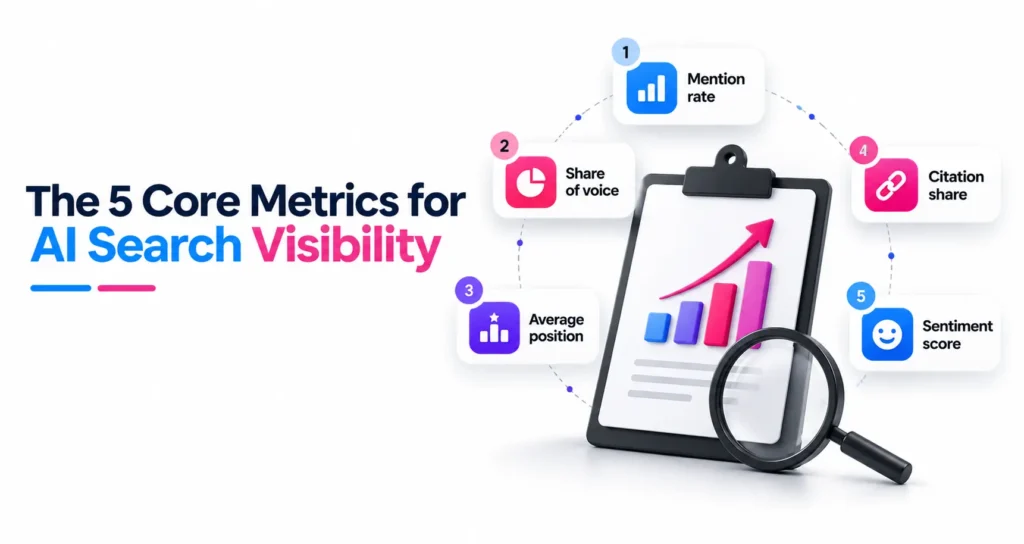
Five metrics form the base of any AI visibility tracking system. Each has a simple formula you can calculate in a spreadsheet.
Mention rate measures how often your brand appears across a set of prompt runs.
Mention rate = (mentions ÷ total prompt runs) × 100
Share of voice measures your mentions against the named competitors across the same prompt set.
Share of voice = (your mentions ÷ mentions of you and all tracked competitors) × 100
Average position records where your brand lands in list-style or comparison answers, averaged across the runs where it appears.
Citation share measures how often the AI links to your domain compared with every domain it cites.
Citation share = (citations to your domain ÷ total citations in the sample) × 100
Sentiment score rates the tone of each mention as +1 for positive, 0 for neutral or −1 for negative. Averaging those scores gives one number per prompt set, and accuracy is tracked separately, as covered later in this guide.
Some tools roll all five into a single proprietary AI Visibility Score. That number is handy for a quick comparison, but it hides which metric is actually moving. Track the five components first, then combine them afterwards if a report needs a single figure.
How Many Times Should You Run Each Prompt?
Run each prompt at least five times per platform, rising to eight or ten runs whenever you plan to act on the result. Spread those runs across several days rather than completing them in one sitting, because answers shift from day to day as well as from run to run.
Small samples are misleading, because three runs of the same prompt can easily show 0%, 50%, or 100% purely by chance. A larger sample smooths that noise into a pattern you can trust.
How to Track Mentions on Each AI Platform
Each platform sources and displays answers differently, so the details you log should change slightly from one to the next.
• ChatGPT blends training data with live web results and only shows links when it browses. Log the mention itself even when no link appears.
• Google AI Overviews appear inside normal Google results and usually link their sources, which lets you keep AI tracking in the same report as your organic rankings.
• Google AI Mode is Google’s conversational search experience and is still expanding how it shows sources, so log mentions whether or not a link appears.
• Gemini is Google’s standalone assistant, and its citation behaviour varies by query.
• Perplexity is built around cited answers, which makes it the easiest platform for tracking citation share.
• Microsoft Copilot combines Bing results with generated answers and shows citations frequently.
• Claude can search the web but does not always do so, which means a Claude mention often reflects your wider reputation rather than a recently published page.
• Meta AI and Grok are newer to showing sources, so treat their data as a secondary signal.
For every answer, record whether a citation appeared alongside the mention. A missing link is not a missing mention, since on several platforms an uncited answer is completely normal.
How to Track AI Referral Traffic in Your Analytics
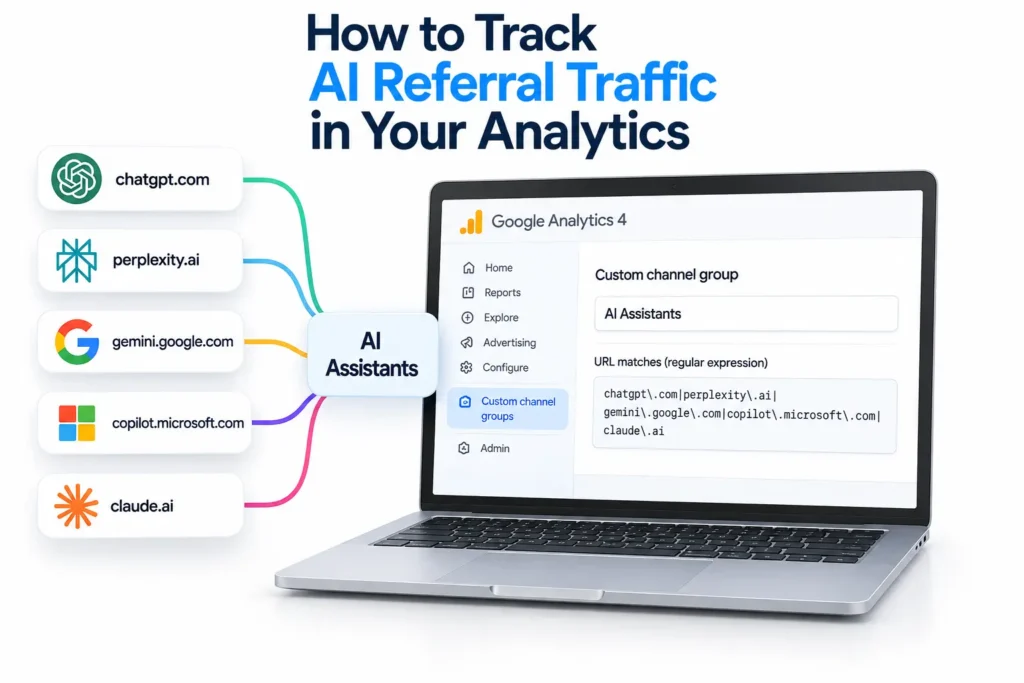
Prompt testing shows what AI tools say about you, while your analytics platform shows whether those answers send people to your site. This method is free and uses data you already collect, which makes it the best starting point for most teams.
In Google Analytics 4, create a custom channel group called AI Assistants that matches the session source against the main AI referrers. A regular expression like the one below covers the platforms that currently send measurable traffic:
chatgpt\.com|perplexity\.ai|gemini\.google\.com|copilot\.microsoft\.com|claude\.ai
ChatGPT also appends utm_source=chatgpt.com to many of the links it shows, so its visits are usually easy to separate. Once the channel is set up, you can compare AI visitors against organic and paid traffic on engagement, conversion rate, and revenue per visit.
There is one limitation to keep in mind: clicks from Google AI Overviews and AI Mode arrive as ordinary Google organic traffic. Search Console does not report them separately either, so for Google’s AI features, prompt testing remains the only reliable way to see whether you are being mentioned.
How to Track AI Crawlers in Your Server Logs
Server logs answer a different question: whether AI systems are reading your pages at all. AI companies identify their bots by user-agent name, so you can count their visits directly from your access log.
| Bot | Company | What it does |
| GPTBot | OpenAI | Collects content that may be used to train models |
| OAI-SearchBot | OpenAI | Indexes pages so they can appear in ChatGPT search results |
| ChatGPT-User | OpenAI | Fetches a page when ChatGPT visits it during a conversation on a user’s behalf |
| ClaudeBot | Anthropic | Collects content that may be used to train Claude |
| Claude-SearchBot | Anthropic | Indexes pages for Claude’s search results |
| Claude-User | Anthropic | Fetches a page when Claude visits it on a user’s behalf |
| PerplexityBot | Perplexity | Indexes pages for Perplexity’s search |
| Perplexity-User | Perplexity | Fetches a page during a user’s Perplexity session |
| Amazonbot | Amazon | Crawls for Alexa and other Amazon AI services |
On a standard Nginx or Apache server, this command counts hits per bot OpenAI crawler documentation:
grep -iE “GPTBot|OAI-SearchBot|ChatGPT-User|ClaudeBot|Claude-SearchBot|Claude-User|PerplexityBot|Perplexity-User” /var/log/nginx/access.log | sort | uniq -c | sort -rn
The user-triggered bots are the most useful signal of the group. When ChatGPT-User or Claude-User hits a rise on a particular page, those assistants are fetching it to answer live questions. Clicks that come from those answers show up separately as referral traffic in your analytics.
Google-Extended does not appear in this list on purpose. It is a robots.txt control that decides whether your content can be used for Gemini, but it has no user-agent string of its own, so it never shows in a log. It also has no effect on AI Overviews, which are part of Google Search and rely on the normal Googlebot Google Search Central.
Manual Tracking or a Dedicated Tool?
Manual tracking suits teams that are just starting out. It costs nothing, and building the data yourself teaches you exactly what each number means before you pay for a tool to produce it.
Dedicated tools to track company mentions in AI-generated answers start to make sense once your prompt list grows past twenty or thirty items. At that size, running every prompt across four platforms eight times each adds up to several hundred checks per cycle, which is difficult to sustain by hand every week. Most teams do best by starting manually and switching once the spreadsheet becomes the bottleneck.
How to Build a Manual Tracking System
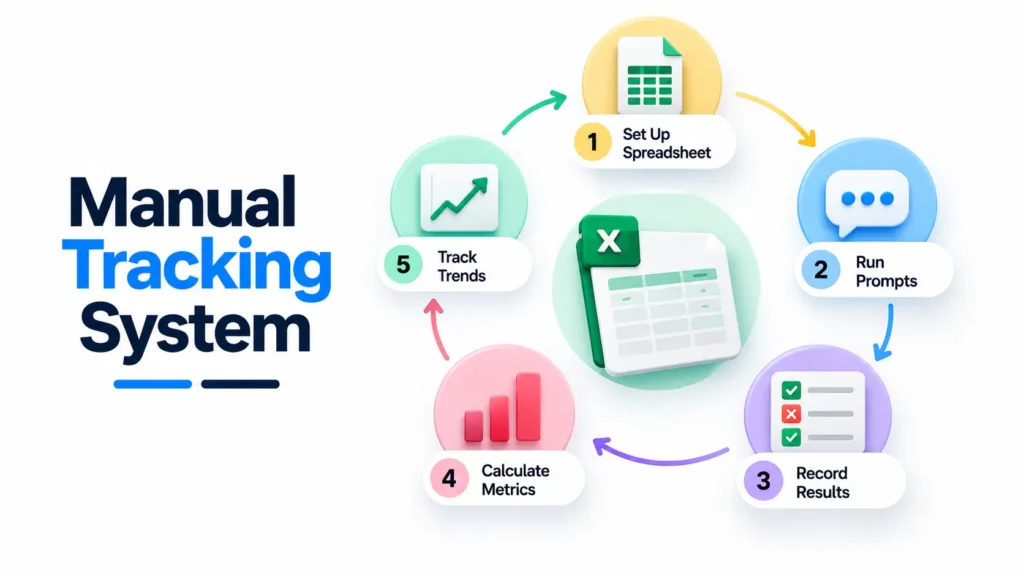
A spreadsheet with twelve columns covers everything you need: date, prompt, prompt category, platform, run number, mentioned (yes or no), mention type, position, citation URL, sentiment score, accuracy, and competitors mentioned.
Once you have enough rows, add two formulas:
• Mention rate: =COUNTIF(mention_column,”Yes”)/COUNTA(mention_column)
• Share of voice: your mention count divided by the combined mention count for you and each tracked competitor, calculated per platform
Run the process weekly across your top ten to fifteen prompts on your three or four most important platforms. Four to six weeks of history gives you a genuine trend line, and it also shows you exactly what a paid tool would be measuring before you decide to buy one.
A Ready-to-Use Prompt List
Split your prompts into four groups, replacing the placeholders with your own brand and category.
Awareness prompts
• What is the best [category] for [use case]?
• What are the top [category] options in 2026?
• How do I choose a [category]?
• What should I look for in a [category]?
• Is [category] worth it for [audience]?
Comparison prompts
• [Brand A] vs [Brand B]: which is better for [use case]?
• What is the difference between [Brand A] and [Brand B]?
• What are the best alternatives to [Brand A]?
• Compare [Brand A], [Brand B] and [Brand C].
• Which costs less, [Brand A] or [Brand B]?
Decision prompts
• What is the best [category] for [budget or company size]?
• Is [Brand] good for [specific use case]?
• What does [Brand] cost?
• Is [Brand] worth the price?
• What is the best [category] for beginners?
Reputation prompts
• Is [Brand] legitimate?
• What do reviews say about [Brand]?
• What are common complaints about [Brand]?
• Is [Brand] reliable for [use case]?
• What are the pros and cons of [Brand]?
To find more, look at the People Also Ask box on Google, Reddit threads in your category, and the questions customers raise on sales calls. These reflect how buyers actually phrase things, which keeps your prompt list grounded in real demand rather than guesswork.
How to Score Sentiment and Accuracy
Score sentiment using the +1, 0, or −1 scale described earlier, then record accuracy in its own column as a simple yes or no. Keeping the two separate matters because they point to different problems.
A negative but accurate mention usually signals a product or service issue that content alone will not fix. An inaccurate mention, such as an outdated price or a discontinued feature described as current, is a content problem that you can correct.
The fix for inaccurate mentions is to publish updated pages with clear facts, specific numbers and named sources. A study from Princeton, Georgia Tech and IIT Delhi tested this directly. Adding statistics, quotations and source citations improved visibility in generative engine responses by up to 40% on the study’s benchmark.
Why Third-Party Mentions Outweigh Your Own Site
How often you are mentioned tells only part of the story, because AI tools give more weight to claims that several independent sources agree on. An AirOps analysis of 21,311 brand mentions across ChatGPT, Claude, and Perplexity found that brands were 6.5 times more likely to be cited through third-party sources than through their own websites AirOps.
That changes what good tracking data looks like, since each logged mention should also note where its supporting source sits: your own site, a review platform, a forum, a comparison article or a press mention. If nearly all of your mentions trace back to your own domain, the AI is relying on your marketing copy, so one outdated page can change how it describes you. Mentions spread across several independent sites that agree with each other are far more stable.
Why Structure and Entities Matter to AI Tools
AI tools try to match your brand to a known entity, the same way a knowledge graph distinguishes a company from a city or a common word with the same name. Consistent naming across your site, your social profiles, and third-party listings makes that match easier to get right.
Many web-connected assistants use retrieval-augmented generation, which pulls current pages from the web before writing an answer instead of relying only on training data. Clearly structured pages with schema markup are easier for those systems to extract, which improves the odds that your latest information is the version they use.
4 Common Failure Modes in AI Mention Tracking
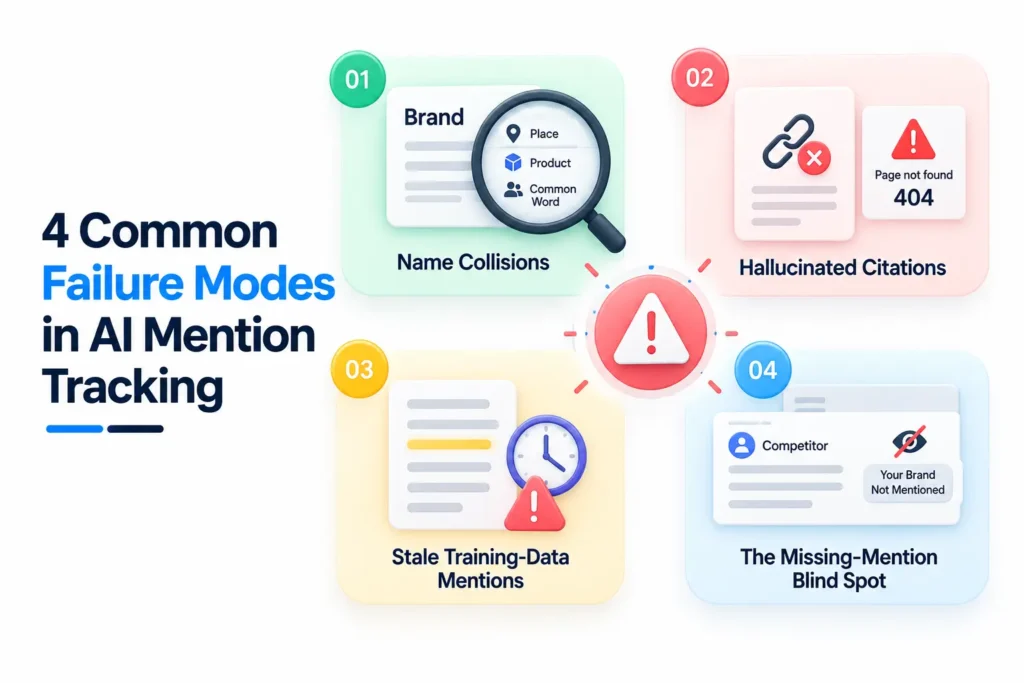
Name collisions occur when your brand shares a name with an unrelated product, place, or common word. Add a context check to your review step so these do not inflate your mention count.
Hallucinated citations occur when the AI names your brand but links to a page that does not contain the claim or does not exist. Spot-check a sample of citation URLs regularly instead of assuming a link is accurate because it appears next to a mention.
Stale training-data mentions occur when a model confidently describes a price or product that has since changed. These can score as positive while being factually wrong, which is exactly why accuracy needs its own column.
The missing-mention blind spot occurs when a process only logs the prompts where you appear. Fix it by running the same prompt set for three to five named competitors, then recording every case where they appear without you. That list is the clearest map of where to focus your content and outreach.
How Often Should You Benchmark AI Search Visibility?
Check your top five to ten prompts weekly on your two or three most important platforms. Once a month, run the full list of twenty to forty prompts across every platform you track, with eight to ten runs each. Then update your mention rate and share of voice trend lines.
When you update a page to fix a mention, wait two to four weeks before re-testing the related prompts. That gap gives AI platforms time to re-crawl the page, so the result reflects your change rather than old data.
Tools to Track Company Mentions in AI-Generated Answers
Once manual tracking becomes too slow, these tools can automate the repeated checks. Pricing and platform coverage change often, while several vendors also charge separately for prompts, projects, or tracked brands, so confirm current plans on each vendor’s pricing page before buying.
| Tool | Starting price | Free trial | Platforms tracked | Best for |
| Otterly AI | $29/mo | 14-day | ChatGPT, Perplexity, AI Overviews, Copilot | Small budgets, quick setup |
| Rankscale AI | $20/mo | Yes | ChatGPT, Claude, Perplexity, AI Overviews | Small teams |
| Peec AI | ~€89/mo | 7-day | ChatGPT, Perplexity, AI Overviews, add-ons | Multi-language dashboards |
| Knowatoa | $59/mo | 7-day | 3 to 7 platforms | Agencies with many clients |
| Profound | $99/mo entry | No | 10+ platforms on top tier | Enterprise teams |
| Semrush AI Visibility | $99/user add-on | 7 to 14-day | ChatGPT, Perplexity, Gemini, AI Mode, Copilot | Existing Semrush users |
| Scrunch AI | ~$250/mo | 7-day | ChatGPT, Perplexity, AI Overviews, Copilot | Enterprise content fixes |
| AthenaHQ | ~$295/mo | Limited | 8+ platforms | Competitor benchmarking |
| Brand24 | ~$99/mo | Yes | Social mentions plus AI dashboard | Social listening teams |
| LLM Pulse | €49/mo | 14-day | Multiple platforms | SMBs and agencies |
| seoClarity | $2,500+/mo | No | 5 platforms | Large global brands |
How Tracking Fits Into GEO and AEO
Brand mention tracking is one part of a wider practice. Generative engine optimization focuses on getting your content cited inside AI answers, while answer engine optimization focuses on being selected as the direct answer, including through voice assistants. Both disciplines overlap with traditional SEO, building on it rather than replacing it.
The best ways to track brand mentions in AI search tell you where you stand, whereas GEO and AEO work is how you improve that position. The two need to run together, since tracking without action produces reports nobody uses, and action without tracking leaves you unable to show what actually worked.
Frequently Asked Questions
What are the best ways to track brand mentions in AI search?
Run a fixed list of real buyer prompts across ChatGPT, Google AI Overviews, Perplexity and Gemini on a repeating schedule, logging every mention in a spreadsheet or dedicated tool. Over time, measure your mention rate and share of voice against named competitors. Adding AI referral tracking in your analytics then connects those mentions to real visits.
What is the best way to track brand mentions in ChatGPT?
Run the same prompt five to ten times across several days, then log whether your brand appears, its position and the sentiment of each mention. A single check can easily miss the real pattern.
Can you track brand mentions in AI answers automatically?
Tools such as Otterly AI, Peec AI and Profound can run your prompts on a schedule and log the results for you. Most teams still benefit from running the process by hand first, so they understand what the numbers mean before automating them.
Does Google AI Overviews always show a source link?
AI Overviews link their sources for many answers but not for all of them, so your brand can be named without a citation attached.
How do I get my brand mentioned in AI search?
Earn coverage on the review sites, comparison articles and forums that AI tools already trust for your category. AirOps found brands were 6.5 times more likely to be cited through third-party sources than through their own websites, which makes outreach to independent publishers more important here than in traditional SEO AirOps.
How do I get my company to show up in AI searches?
Answer your buyers’ exact questions in clear, direct language near the top of each page, then work on earning references from third-party sites in your industry. It is also worth checking your robots.txt file and server logs to confirm that crawlers like OAI-SearchBot and ClaudeBot can reach your pages.
How do I get mentioned in Google’s AI Overviews and AI Mode?
Google says the same SEO best practices apply to its AI features, so the first step is ranking well in normal organic results. From there, give each page a direct, specific answer in its opening sentences, since that is the format AI features lift most easily.
Do AI brand mentions affect SEO?
They do, although the effect is indirect: consistent mentions across authoritative sites strengthen the entity and topical authority signals that search engines and AI systems both rely on.
Do AI-referred visitors convert better than search traffic?
In retail they now do, according to Adobe Analytics. AI-referred traffic to US retail sites converted 42% better than non-AI traffic in March 2026, a reversal from 38% worse a year earlier TechCrunch.
Can a brand appear in ChatGPT but not in Google AI Overviews?
It can, because each platform draws on different sources and training data, so visibility on one says little about the others. Track each platform separately rather than assuming the results carry over.